- Windows 11 integrates a search engine with indexing, but its filters and accuracy fall short for many users.
- Tools like Everything, WizFile, VX Search, DocFetcher, and Listary offer faster, more accurate, and customizable searches.
- PowerToys Run and alternative file managers improve the experience without breaking integration with Windows 11.
- Combining Windows Search settings with these utilities results in a powerful search system without compromising performance.

If you use Windows 11 daily, sooner or later you get fed up with it. wasting time looking for files...folders or programs among menus, subfolders, and a search bar that often doesn't respond as it should. And of course, when you just want to type the name of something and have it appear instantly, The native search experience falls a little short..
Fortunately, there's more to life than standard Windows search. much faster, more accurate and customizable alternatives that allow you to type a few letters and instantly see all the files, with their full path, advanced filters, and without the system dragging or indexing for hours.
How Windows 11 search actually works
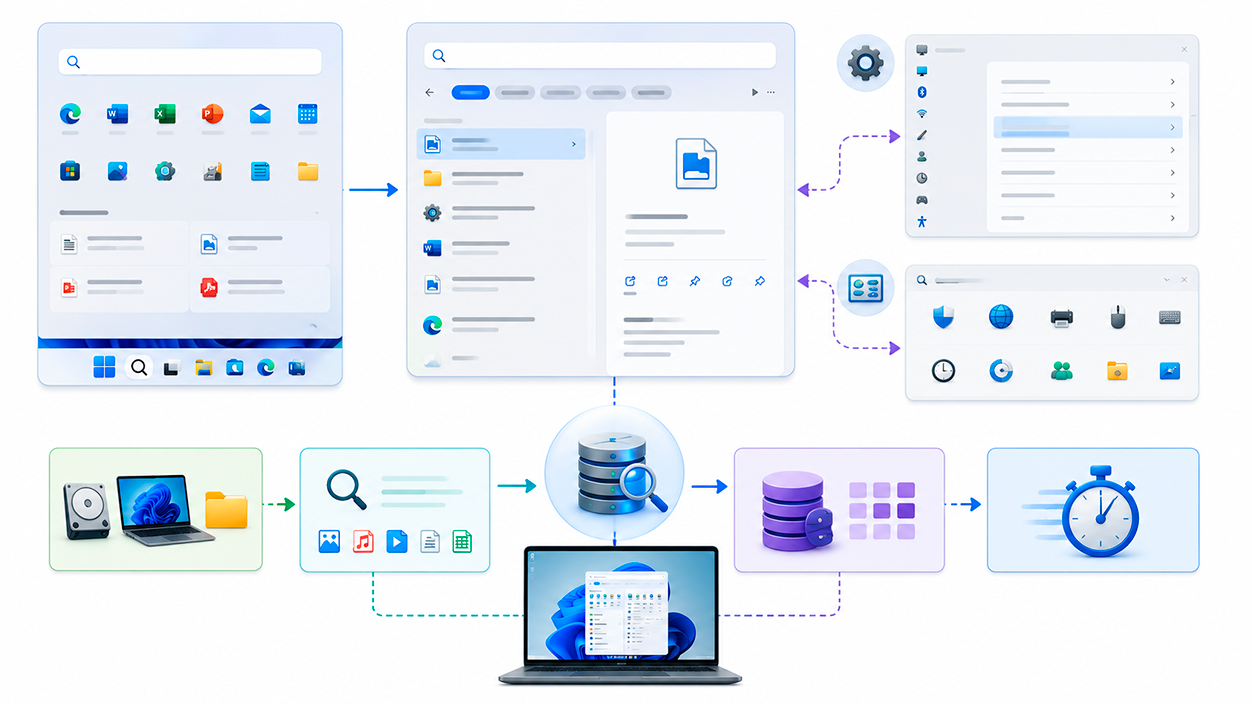
In Windows 11, search is very integrated into the system and can be opened from various locations, but ultimately it relies on the same system. Windows Search indexing service, which is responsible for tracking and cataloging your files.
From the Start menu you can press the Windows key or click on the Start icon and the options will appear. Pinned apps, recommended files, and the search boxAs soon as you click on the box or start typing, the menu transforms to show you applications, files, settings, and suggestions that you can select with the keyboard.
On the taskbar, the magnifying glass icon (or the search box, if you have it enabled) opens the Windows search panel with a box at the topYou type your query and, on the right, you'll see the "Best Match," which is the result Windows thinks you're looking for. Pressing Enter takes you directly to that result, and if you're not satisfied, you can switch to searches in the sidebar. files, folders, documents, photos, applications, or on the WebIf you don't want external suggestions, you can review how Remove Bing from the search bar.
In addition, the Settings app and the classic Control Panel each have their own internal search barInstead of opening submenus one after another, you can type part of an option's name, such as "Active Hours" in Windows Update, and jump directly to that section without having to navigate through all the screens.
All of this relies on the Windows indexing engine. This service analyzes the contents of your drives, saves metadata and references in a database, and thus can return results from thousands or millions of files in secondsIn theory, you shouldn't notice much of an impact on performance. If the indexer is consuming too much power, you can check how to... disable or adjust SearchIndexer.exe to optimize the equipment.
Classic vs. Enhanced: Indexing Modes in Windows 11
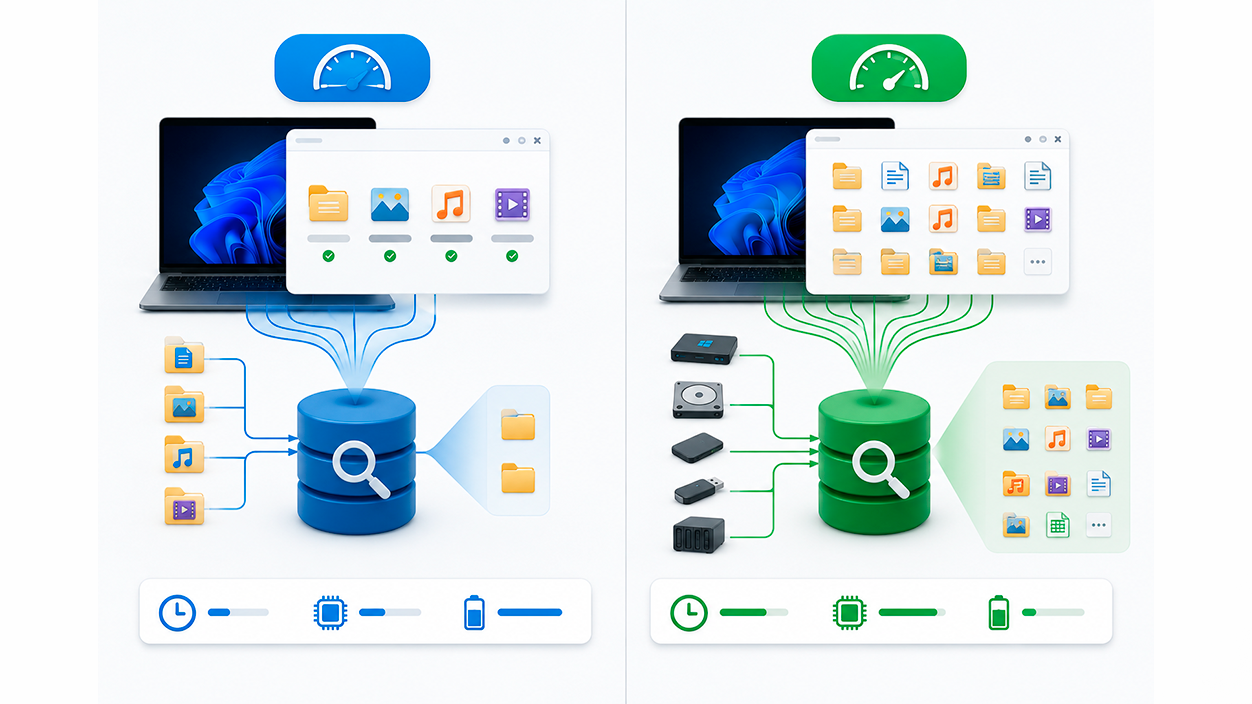
In Windows 11 you can choose between "Classic" or "Enhanced" indexing. This choice is not trivial, because it affects both search speed and... overall performance of the equipment, especially in laptops.
Classic mode limits indexing to a few standard locations such as Documents, Images, Music, and some user profile pathsThis is typical Windows behavior: searching is fast in those folders, but if you tend to put files in unusual locations, external drives, or additional units, many items will be missed.
Enhanced mode, on the other hand, expands the scope and makes Windows Build the index from virtually the entire file systeminstead of just a few folders. This gives you much more comprehensive results, no matter where you do the "mess," but in return it involves more disk reads, more CPU usage, and, on laptops, a noticeable impact on the battery, especially during the first hours or days of indexing.
When you add many folders to classic indexing or activate Enhanced mode, it's normal for the indexing process to take some time. several hours if you have terabytes of dataDuring that time you'll see the search service working at full capacity, the disk moving more than usual, and, on less powerful computers, a certain feeling that "Windows is running slowly."
Therefore, if you're looking for alternatives, it's usually because you want to instant searches without sacrificing performance nor put up with indexers hogging the machine for hours every time you change something in the configuration.
Is Windows 11 search really that bad?
The search for Windows 11 isn't pointless, but it has several weaknesses that lead many users to look for something more serious. To begin with, although it has been improving for years, It is not always accurate or consistentSometimes it shows results that have little to do with what you've written, or mixes local files with web suggestions that you're not interested in at all.
Another problem is that, by default, the filters are quite basic. It's not easy to say "show me only files of a certain size, specific type, or modified between two very specific dates" without going into unfriendly parameters and syntaxThe average user is faced with a long list that they don't know how to quickly refine.
It also doesn't help that the search engine relies on the index: if something isn't indexed, it can't find it. omit or take forever in locating, while third-party tools work directly with the MFT or their own optimized indexes. And if the Windows index ever becomes corrupted, searching can become erratic until you rebuild it.
On the plus side, Windows 11 allows integration cloud results such as OneDrive or Outlook BingIt learns from your local history to prioritize what you use most. This data is stored on your device, which mitigates privacy concerns, and means that if you've been opening the same app for weeks, it will appear higher in the suggestions.
Even so, if you want something that It feels light, instant, and very controllable.Most advanced users end up using external software, whether to search for files, to launch programs, or even to replace part of the File Explorer with alternative file managers.
Tips for getting the most out of Windows 11's native search
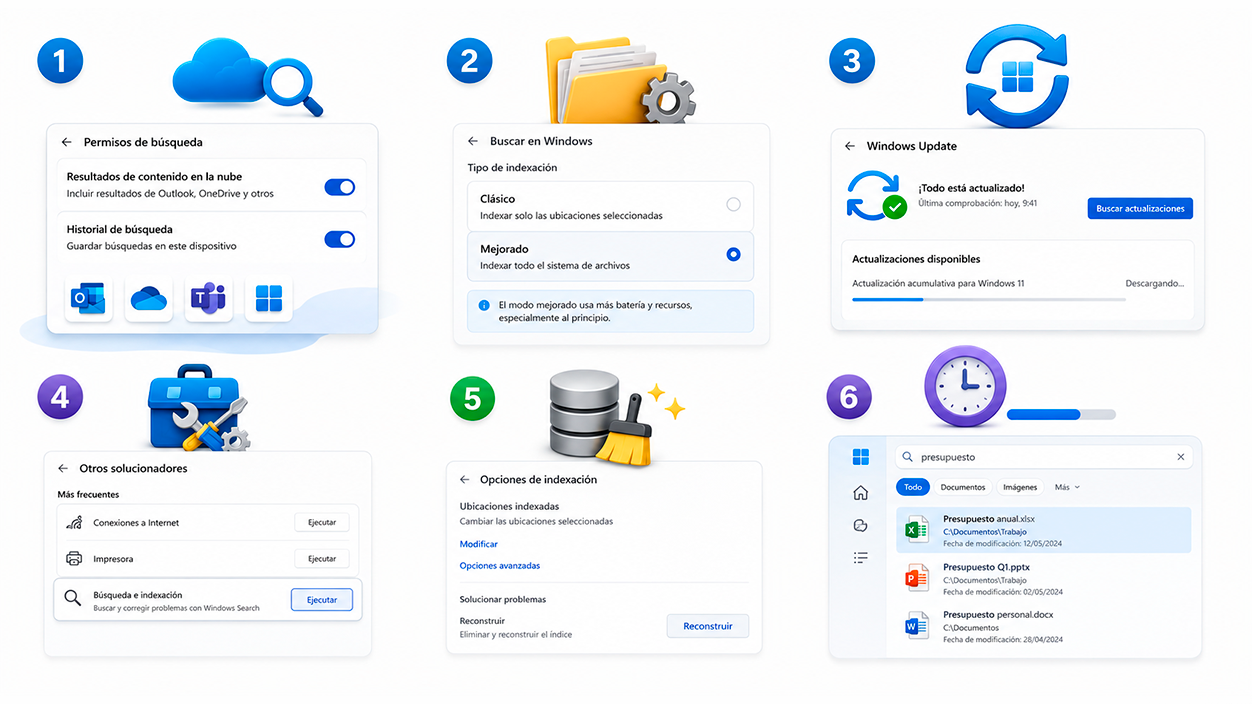
Before moving on to the alternatives, it's worth knowing about some adjustments that may be possible significantly improve the performance of Windows Search on your computer. They don't work miracles, but they do make a difference when the search is slow or freezes.
A logical first step is to activate the cloud content results and search historyFrom the Settings app, under "Privacy and security" and then "Search permissions," you can allow Windows to include data from Outlook, OneDrive, and other services associated with your Microsoft account, as well as save your search history locally to prioritize what you frequently use. If you're interested in semantic search and how to enable it to improve results, take a look at [link to relevant documentation]. What is semantic search and how to activate it.
It's also a good idea to review the indexing type. In "Privacy and security > Search Windows" you can choose between the mode Classic or ImprovedIf your files are widely scattered and you want to find them all using the native search, Enhanced mode can be useful; just keep in mind that It will consume more battery and resources.especially at the beginning.
Another important step is to keep your system updated. You can check for new updates from “Windows Update” in Settings, and if any are available, download and install themOften, slow or failing search problems stem from bugs that Microsoft fixes precisely in cumulative patches.
If none of this helps, you have at your disposal the search and indexing problem solverIn Settings > System > Troubleshoot > Other troubleshooters, there's a specific entry for "Search and Indexing". Running it examines the status of the indexing service, detects potential errors, and suggests automatic fixes.
Finally, if things are really bad, you can completely rebuild the Windows index. In the same "Search in Windows" section, you'll see the advanced indexing optionsFrom there, you can open the classic indexing options window and click "Rebuild." This will delete the current index and force Windows to rebuild it from scratch, a process that can take many hours but usually fixes searches that return nothing or show inconsistent results.
What should a good search alternative in Windows have?
When Windows Search falls short, it's important to be clear about what we expect from an alternative search engine to make it worth installing. At a minimum, it should be... as fast as or faster than native searchand that it is capable of analyzing large amounts of data without blocking the computer.
Besides speed, a good search tool should be accurate and offer advanced filtersIt makes no sense to give you twenty thousand results without any order or structure; what's useful is being able to sort them by date, size, type, name, or even by specific metadata, so you can narrow down your search until you find exactly what you need.
Resource consumption is another key point. You don't want to replace the built-in search with an app that hogs resources. More RAM, more CPU, or it running uncontrollably in the backgroundIdeally, the program should be lightweight, start up quickly, and, if it creates its own index, do so efficiently and in a configurable way.
Custom filters also make a difference. Being able to set conditions such as size range, specific extensions, creation or modification dates, included or excluded routes, etc., makes searches in data-heavy systems much more manageable.
Finally, it's a plus that the tool has a A user-friendly interface, and ideally, one that's well integrated with the look and feel of Windows 11.especially if you care that it doesn't look like you're using something "taped" over the system.
Everything: the ultra-fast alternative for finding files

Everything is for many users the absolute reference in file search engines for WindowsIt's free, ridiculously lightweight (it barely takes up more than 1 MB) and offers results practically in real time as you type.
Its trick is that it doesn't rely on classic Windows indexing. Instead, Everything directly reads the Master File Table (MFT) of NTFS volumesThanks to this, you can know what files exist and where they are without having to scan folder by folder each time.
The interface is very simple: a window with a text box and a list of results that scrolls updating instantly with every letter you typeYou can easily navigate through the directory tree, apply filters by file type, size, or date, and even save favorite searches to return to them whenever you want.
Among its advanced features is the ability to mount a integrated HTTP serverThis allows you to launch remote searches from other devices on the network. It also supports filters by extensions, inclusion/exclusion rules, and advanced searches with specific syntax.
Its only major drawback is that it's designed for NTFS volumes. If you work extensively with disks on other file systems, you'll lose some of its appeal. Even so, for most Windows 11 users, Everything becomes the direct replacement for the file finderYou no longer depend on Windows Search to locate almost anything in a matter of seconds.
WizFile: Instant searches with change tracking

WizFile is another incredibly fast search engine that competes head-to-head with Everything. Its philosophy is similar: access the disk's MFT directly to build a file list without going through the Windows engine, achieving almost instant results.
The interface combines a very responsive search box with a directory tree and a well-organized results viewYou can search by file name or full path, and it supports entering multiple search terms at the same time to refine your search.
One of its most useful features is the ability to monitor folder size in real time. When changes occur on the disk (you create, move, or delete files), WizFile automatically updates its data, without you having to reindex or wait.
As for filters, you can limit by extensions, paths, sizes, or dates, and even save frequently used search configurations. All of this without the program being heavy or intrusive on the system.
If you're looking for something very fast, with behavior similar to Everything but with some extra visual and tracking features, WizFile is a good option. A piece that fits perfectly into a Windows 11 environment and seamlessly replaces Explorer's search function for locating specific files.
VX Search: a rules-based search engine

When you need more than just finding a filename, VX Search becomes especially interesting. This program is focused on offering searches based on very detailed rulesThis makes it ideal for users who handle large volumes of data or semi-professional environments.
Its interface displays a fairly comprehensive view of file information, and allows you to create reusable search profilesIt's not the fastest tool on the list, but it compensates with enormous flexibility in defining exactly what you want to find.
Searches are built with chained rules: you can filter by file type, category, name, size, location, extension, regular expressions, text or binary patterns, creation date, modification or last access, and even by EXIF tags in photos.
Once you have the results, you can classify them, filter them further, copy, move or delete files directlyas well as generating reports and exporting them to SQL databases. This makes it a very powerful option for audits, bulk file organization, or administrative tasks.
VX Search offers a free version for home use, with some limitations, and several paid professional editions. For many users, the free version more than meets their needs. to overcome the shortcomings of Windows Search when it comes to complex searches.
DocFetcher: the “Google” of your documents

DocFetcher focuses on a problem that Windows search doesn't always solve well: find text within the content of documentsNot just because of its filename. It's an open-source tool designed to be like Google for your own files.
It works by creating content indexes for the folders you select. Once created, you can search for words or phrases using DocFetcher. It will show you all the documents that contain that text., along with a small context, without having to open them one by one.
It supports a wide variety of formats: HTML, TXT, PDF, Microsoft Office documents, RTF, LibreOffice/OpenOffice files (ODT, ODG, ODS), SVG, VSD, and many more. It also allows Limit searches by size, file type, or location of the documents.
The interface is simple, with a search box, a panel to define the scope (indexed folders), and a results area. Although the initial indexing may take a while if you have many documents, the results arrive quickly afterward. very fast and highly relevant.
If you work with reports, manuals, code, notes, or PDF libraries, DocFetcher perfectly complements utilities like Everything: One finds files by name; the other, by their contents..
Listary: fast and integrated search with your browsers

Listary goes beyond a typical search engine and behaves almost like one Universal launcher for WindowsIts goal is to allow you to locate files, folders, or programs without having to manually navigate through Explorer or your favorite file managers.
It integrates with tools like Total Commander, Directory Opus, XYplorer, Xplorer2, WinRAR, and FileZilla, so you can search from within them and jump directly to the routes foundThis greatly reduces the number of clicks required when working with multiple file managers simultaneously.
Furthermore, Listary has its own launcher: you type a term and you can both Open files or applications, such as running custom actions. Regarding the results: The results are displayed grouped by extent and type, which helps to quickly distinguish what each thing is.
The user experience is very smooth, with a search box that appears when you need it, configurable keyboard shortcuts, and virtually instantaneous feedback. If you find constantly opening windows and menus annoying, Listary makes it easy. Working with files and programs is more like “typing to jump” than to “click to get there”.
In the context of Windows 11, Listary feels like a very natural layer on top of the system: it doesn't break anything, It doesn't replace Explorer, but it makes it much more convenient to use. along with other applications.
PowerToys Run: Microsoft's lightweight launcher

Within the Microsoft ecosystem, PowerToys has become a highly valued toolkit for advanced users. Among its key features are... PowerToys Run, a launcher that functions as a quick search bar for programs, files, and some system functions.
PowerToys Run is activated with a configurable keyboard shortcut and appears as a text box in the center of the screenYou type the name of an application, a file, or even certain commands, and the tool gives you instant results, with very smooth behavior.
Being open source and developed by Microsoft itself, it fits like a glove in Windows 11: it integrates well with the system, respects the themes and styles and is updated relatively frequently through Windows Update or GitHub.
Furthermore, you have some interesting customization options: you can decide which indexes it uses, where it appears on screen, its behavior when launching elements, and which extensions or plugins are active. All of this makes it Many users stop using the Start Menu search. and become primarily dependent on PowerToys Run to open almost anything.
If you want something that feels completely "native" to Windows 11 but is faster than the default search, PowerToys Run is for you. one of the first tools you should try before you jump into more complex third-party solutions.
Alternatives to File Explorer with enhanced search
Beyond simply replacing the search function, many users are making the leap to alternative file managers which include advanced location features, dual panes, and tabbed views, something that Windows 11 Explorer only partially covers.
Double Commander, for example, is an open-source, cross-platform file manager inspired by Total Commander. It offers two panels side by side, plugin support, file viewing and editing, and an advanced search that allows you to combine several criteria at once.
FreeCommander, while not entirely open source, is free and very popular. It includes Dual panel, tabs, compressed file handling, and an integrated search tool It's much more capable than the standard Explorer. It's ideal if you spend your day moving files around.
MuCommander is also cross-platform and open source, with a tab-based interface and built-in support for remote files via FTP, SFTP, SMB, NFS, HTTP and other protocolsThis allows you to search for and manage files both locally and on servers without having to constantly switch programs.
Tablacus Explorer and Explorer++ are lightweight and highly customizable alternatives, with eyelash and extension supportIts search capabilities aren't always as advanced as those of dedicated tools, but it's a good fit if your priority is having a more powerful Explorer, with multi-pane management and fewer clicks to navigate.
Q-Dir stands out for its ability to display up to four directory windows in a single interfaceThis makes copying, comparing, and searching across multiple locations simultaneously much easier. It also features tabs for each panel and customization options to tailor the view to your workflow.
These alternatives not only improve file management; they also offer More flexible and better integrated searches in their interfacesIf Windows 11 Explorer falls short for you, it makes sense to try one of these file managers along with tools like Everything or WizFile to achieve a much more agile working environment.
With this arsenal of options—from adjusting Windows 11 indexing and using PowerToys Run, to making use of Everything, WizFile, VX Search, DocFetcher, Listary, or file managers like Double Commander or Q-Dir—it's perfectly possible to have a search system on your PC that is Fast, accurate, with advanced filters, and that doesn't ruin the performance of the equipmentleaving native Windows search as a simple occasional support instead of your main tool.


I am a technology enthusiast who has turned his "geek" interests into a profession. I have spent more than 10 years of my life using cutting-edge technology and tinkering with all kinds of programs out of pure curiosity. Now I have specialized in computer technology and video games. This is because for more than 5 years I have been writing for various websites on technology and video games, creating articles that seek to give you the information you need in a language that is understandable to everyone.
If you have any questions, my knowledge ranges from everything related to the Windows operating system as well as Android for mobile phones. And my commitment is to you, I am always willing to spend a few minutes and help you resolve any questions you may have in this internet world.