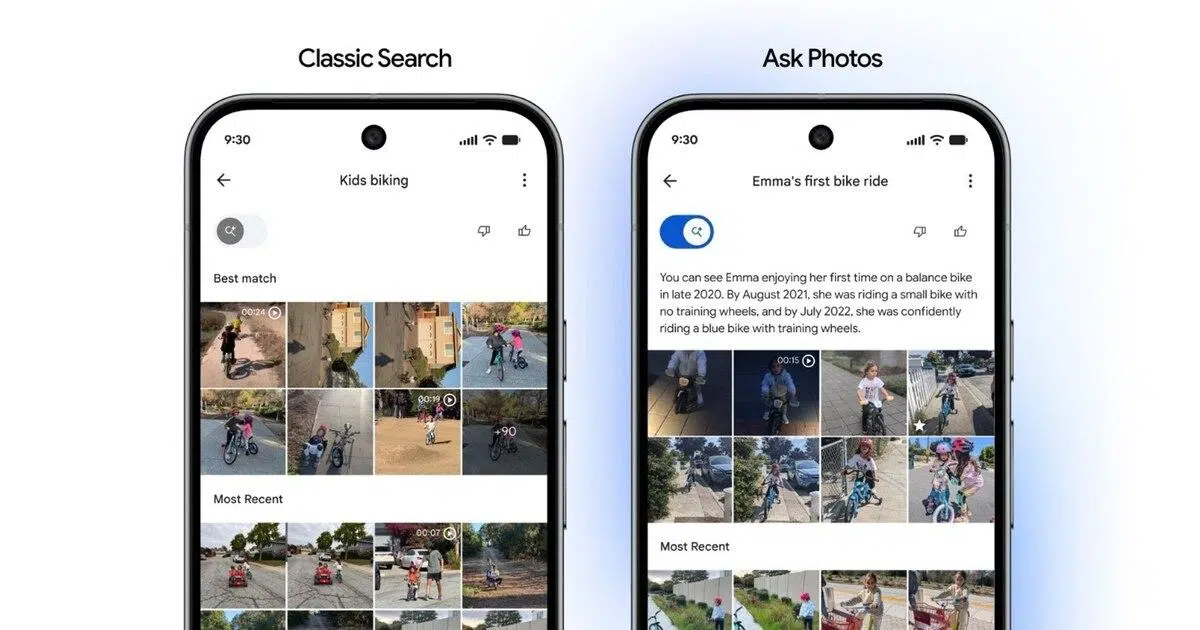
- Google has implemented a switch to toggle between the traditional search engine and the AI tool 'Ask Photos'.
- The decision responds to user criticism regarding Gemini's slowness and lack of accuracy in large libraries.
- While classic search stands out for its speed, AI allows you to locate images using natural language and complex contexts.
The management of our digital photographs has taken an unexpected turn recently. Google, in its quest to integrate artificial intelligence into every corner of its services, launched a very ambitious feature to revamp the way we track our memories, but it ran into an uncomfortable reality: Sometimes, the simplest things work best..
After receiving a barrage of criticism from various forums and tech communities, the company has decided to backtrack, or rather, offer a middle ground. Now, users are not obligated to use AI if they don't want to, thus regaining the ability to choose the tracking method that best suits your immediate needs.

The Ask Photos phenomenon and the backing of Gemini

Originally launched in September 2024, the 'Ask Photos' tool leverages the power of Gemini to transform the search engine into a conversational experience. Unlike the old system, where you typed individual words, here you can use natural language and complete sentences to describe exactly what you want to find.
The promise was fascinating. Instead of typing "girl's bike" and manually filtering through hundreds of photos, you could ask something like "Emma's first bike ride." The system, analyzing the context and metadata, should to give you the exact image without beating around the bushunderstanding the relationship between the subjects and the described action.
Although this feature expanded to over one hundred countries by November 2024, the experience wasn't smooth sailing for everyone. The global rollout revealed that, while the AI technology in Google Photos It looks impressive on paper, The implementation left much to be desired. in certain operational scenarios.
Why didn't AI convince everyone?


The main problem was speed. Many users, especially those with massive photo libraries of tens of thousands of files, noticed that The results took forever to appearGemini needs to process and analyze a huge volume of data to give an accurate answer, which was frustrating for quick searches.
Furthermore, some rather curious accuracy problems arose. Some photography enthusiasts reported that the system either overgeneralized or ignored specific terms which the classic search engine found instantly. There are cases where searches for specific bird species, which used to be immediate, now returned incorrect or no results.
This situation led the Reddit community to describe the feature as a disaster in some threads, arguing that a perfectly functioning tool had been replaced with a innovation that hindered the workflow user journal.
The solution: A switch to regain control

To calm the waters, Shimrit Ben-Yair, head of Google Photos, announced the implementation of a selection button in the app's settings. This switch allows anyone Toggle between quick classic search and smart results of 'Ask Photos' depending on the occasion.
Now we have two clear paths depending on the objective:
- Traditional search: It is the ideal option for locating photos using tags, places or general concepts almost instantly.
- Ask Photos: It is recommended for complex queries where AI is required to interpret a detailed situation.
This flexibility prevents the user from feeling trapped by a technology that, while powerful, can be slow. In fact, the strategy now is complementing innovation with effectiveness proven from previous algorithms, allowing AI to be a support and not an obstacle.
Privacy and Personal Intelligence
Beyond simple image search, Google is moving toward what it calls "Personal Intelligence." This concept aims to connect the AI mode of general search to applications like Gmail and Google Photos to... to offer much more personalized answers based on the user's real context.
For example, if you're looking for leisure activities, AI could suggest itineraries based on hotel reservations found in your email or photos of places you've liked in the past. However, this raises a serious privacy issue. Cybersecurity companies have warned that allowing AI to have visibility over such sensitive data It increases the risk surface and can lead to incorrect inferences about private life.
Google has attempted to allay these concerns by assuring that the use of this data is optional and that They are not used to directly train the models. of language, although human (anonymized) review remains part of the process to improve the quality of services.
The ability to choose between a keyword-based system and one powered by Gemini reflects that, in the software world, User feedback is the ultimate compassGoogle Photos has understood that speed is a fundamental value and that artificial intelligence should be an optional tool that adds value, not replaces the efficiency of what already worked well.

I am a technology enthusiast who has turned his "geek" interests into a profession. I have spent more than 10 years of my life using cutting-edge technology and tinkering with all kinds of programs out of pure curiosity. Now I have specialized in computer technology and video games. This is because for more than 5 years I have been writing for various websites on technology and video games, creating articles that seek to give you the information you need in a language that is understandable to everyone.
If you have any questions, my knowledge ranges from everything related to the Windows operating system as well as Android for mobile phones. And my commitment is to you, I am always willing to spend a few minutes and help you resolve any questions you may have in this internet world.