- Gemini 2.5 and Gemini 3 use different and incompatible thinking mechanisms: thinkingBudget versus thinkingLevel.
- The error “Thinking level is not supported for this model” appears when thinking parameters are mixed with incorrect model generation.
- Reasoning levels directly influence latency and cost, as thought tokens are billed the same as output tokens.
- Silent changes to UI and Pro modes have caused confusion, so it's advisable to explicitly control the model and level of thinking used.
If from one day to the next The “Thinking level” or the Gemini Pro option has disappeared from your accountYou're not the only one. Between silent interface changes, internal reasoning adjustments, and configuration errors between versions 2.5, 3.0, and 3.1, it's normal to see the message “Thinking level is not supported for this model"Or the absence of Pro mode leaves you with a poker face."
In recent weeks, several issues have arisen: perceived downgrades in Gemini 3.1 Pro, temporary disappearance of Pro mode in some personal subscriptions, changes to thinking parameters, and confusion between thinking_level and thinking_budget. Furthermore, Google has been limiting or hiding features like “Show Thought” or “Deep Think”. which has led many people to talk about "lobotomy", "bait and switch" and other such pleasantries.
From the “effort 0,5” controversy to the disappearance of “Show thought”
One of the triggers for the general anger has been the discovery, using the old button, of “Show thinking”that Gemini contained an internal "effort" control set to 0.5. In screenshots leaked by users, internal model text like this could be seen: “The token limit is fine. Effort 0.5. I’m done. Silence all internal thoughts…”.
This led many to conclude that Google launched a highly "enhanced" Gemini 3.1 Pro, and within a few weeks, lowered the level of default reasoning.The term “bait and switch” has been repeated quite a bit: first they show you the model working at maximum capacity, and then they adjust the “effort” downwards without clear warning, while the subscription fee remains the same.
To top off, Google removed the "Show Thought" option from the visible interface.Previously, in some modes, you could see a summary of the model's reasoning process; for a time, due to a bug, internal content was leaked with technical messages that revealed how the reasoning effort was configured. Once detected, It disappeared from the UI and it's no longer possible to see that internal monologue directly, which increases the feeling of opacity.
Meanwhile, another part of the community reports that Gemini feels more "short," more cautious, and less insightful in complex responses. than in its first few weeks of life. All of this has fueled the narrative that Google is deliberately "holding back" Gemini, especially in Pro modes and some custom Gems, while Canvas mode seems to be somewhat spared from these cutbacks.
The Pro mode mess that disappears and reappears without explanation
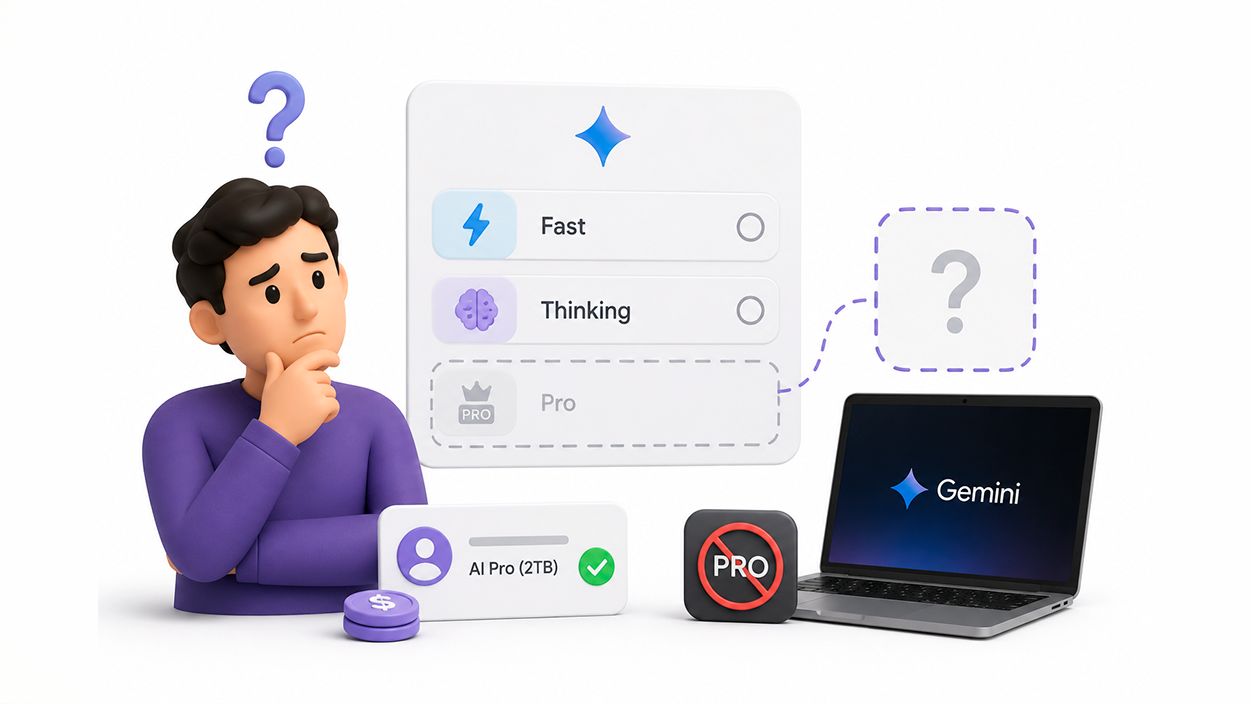
Beyond the technical aspects, there have been very specific cases of users with a “Google AI Pro (2TB)” subscription in which The model selector stopped showing the "Pro" option, leaving only "Fast" and "Thinking"This is especially egregious because, even though the Pro mode didn't appear, the bill still arrived in full.
Some people compared their personal accounts with their corporate accounts and saw that The business account still showed “Fast / Thinking / Pro”, while the personal account only showed “Fast / Thinking”.In other words, two active accounts, same paid product, but different options available in the interface. Hence the reasonable question: "What is Google doing?"
In one of these documented cases, the user contacted Google support. First they had him try the usual things: incognito mode, different browsers, mobile app… And in all of them, Pro was missing. Finally, support acknowledged that it seemed like a “system error”He opened a ticket and promised a response by email in 1-2 days.
The worrying thing is that, for several days, There was no clear technical solution nor public communication that explained what was happening with Pro modeThe affected user even considered cancelling the subscription: without Pro, according to him, Gemini ceased to be competitive against Google's own free AI search, which "thinks a little more" than the limited paid service.
After several weeks and several edits to the original thread, Finally, the Pro option reappeared without further explanation.The user expressed gratitude, but it was clear that, between the comments from people saying "Pro has merged with Thinking" and the ambiguous responses, there was a lack of transparent communication from Google. The only thing that was clear was that, While Pro was absent, the fee continued to accrue..
Why does the error “Thinking level is not supported for this model” appear?
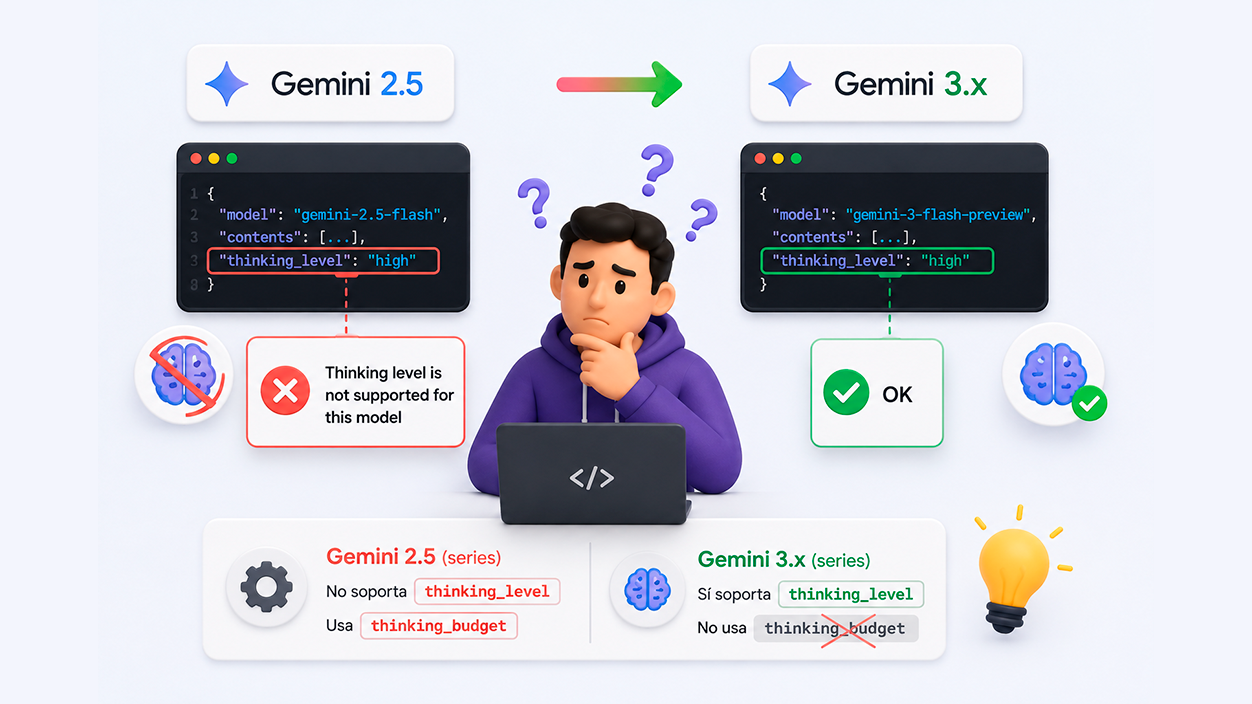
Leaving aside the "political" aspect and Google's internal decisions, there is one very specific mistake that is repeated time and time again among developers: “Thinking level is not supported for this model” when calling gemini-2.5-flashThe curious thing is that when switching to gemini-3-flash-preview everything works without hardly touching any of the code.
The reason is relatively simple: The Gemini 2.5 and Gemini 3 series use distinct and incompatible thought configuration mechanisms.If you mix parameters from one with the other, you'll get a 400 Bad Request.
In the series Gemini 2.5 (Pro, Flash, Flash-Lite) The reasoning is controlled by the parameter thinking_budgetwhich defines how many “internal thought” tokens the model can use. Instead, Gemini 3 series (3.0/3.1 Pro, 3 Flash, etc.) uses the parameter thinking_level, which works by semantic levels (minimal, low, medium, high) instead of by number of tokens.
When you try to call, for example, gemini-2.5-flash with a thinking_level parameterThe API for that model family simply doesn't recognize it. It doesn't exist in its schema. The typical result is a JSON response like this:
{ «error»: { «message»: «Thinking level is not supported for this model.», «type»: «upstream_error», «code»: 400 } }
The key is that There is no automatic bridge that converts thinking_level to thinking_budgetThe isolation between generations is hard-coded, with no backward compatibility or transparent conversion. If you want to use 2.5, you use budget; if you want to use 3.x, you use level.
How to properly configure the thinking mode in Gemini 2.5

If your project depends on the 2.5 series (for price, stability, or compatibility), you need to speak its language. Gemini 2.5 FlashThe valid parameter is thinking_budget, with several very specific options:
- thinking_budget = 0: completely disables thinking mode. Ideal for simple instructions or for maximizing speed and reducing costs.
- thinking_budget = -1: activates dynamic thinking mode; the model internally adjusts the tokens according to complexity, up to a defined maximum.
- thinking_budget between 512 and 24576 (or other ranges depending on the variant): fixed budget of reasoning tokens, useful when you need very fine cost control.
En Gemini 2.5 ProThe model is designed to always reason: It does not allow for completely switching off thought.Its minimum is around 128 thought tokens. Instead, Gemini 2.5 Flash-Lite comes with thinking turned off by default (thinking_budget = 0), and only if you set a value ≥512 is reasoning mode activated.
An important nuance is that Image models like gemini-2.5-flash-image do not support any thinking parametersIf you try to pass thinking_budget or thinking_level in extra_body, the model will return an error such as “This model doesn't support thinking”. In these cases, the correct configuration is simply not to send any thinking parameters.
For those who constantly switch between models and combine several series in the same project, there are tools that help Automatically adapt the parameters according to the model namemapping generic intensities such as “low/medium/high/dynamic” to specific budgets in 2.5 or levels in 3.x. Aggregation platforms such as APIYI, for example, offer a Unified API compatible with all versions of Gemini 2.5 and 3.0/3.1which makes it easier to try combinations without racking your brain with each change and also makes Upload your own documents to Gemini.
How thinking works in Gemini 3 and 3.1: levels, Deep Think and limits
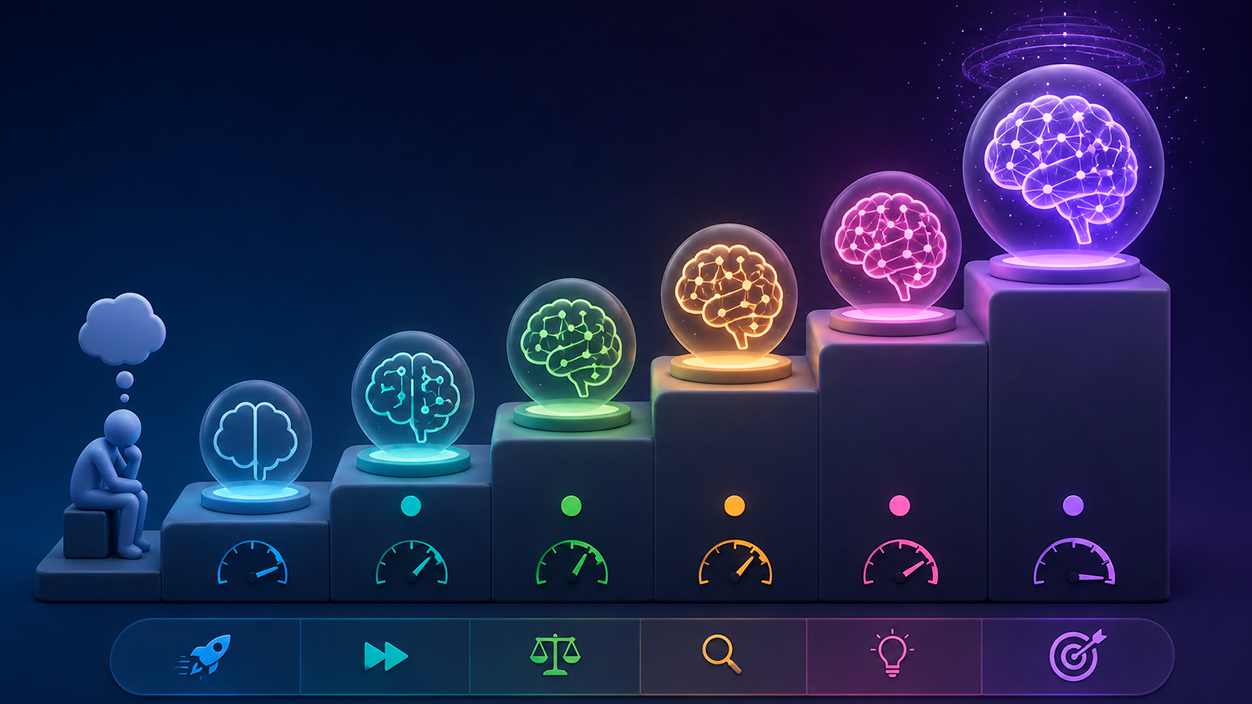
With the arrival of Series 3, Google wanted to simplify life for developers. Instead of forcing you to decide whether you want 2048, 8192, or 16384 thought tokens, introduce the thinking_level parameter, which offers semantic levels: minimal, low, medium and high, according to the model.
In practice, this means that Gemini decides internally how many thought tokens to allocate for each level, seeking to improve inference speed (Google speaks of up to 2x faster compared to manual budget management at 2.5) and freeing you from having to adjust exact numbers.
The support matrix, however, is not identical for all 3.x models. For example, Gemini 3.0 Pro only supports low and highwhile Gemini 3.0 Flash supports from minimal to highIn Gemini 3.1 Pro Preview there's another twist: The medium level is added.which is positioned exactly between low and high in both cost and depth of reasoning.
In fact, many comparative tests indicate that The old high mode of the Gemini 3 Pro is quite similar to the new medium mode of the Gemini 3.1 ProThe high setting of 3.1 Pro activates what Google calls Deep Think Mini, a kind of “turbo mode” of reasoning capable of solving math olympiad problems or very complex planning tasks, at the cost of latencies of several minutes and much higher thought token bills.
Regarding defaults, there is a critical detail: If you do not specify thinking_level when using 3.x models, the default value is usually high (dynamic).In other words, the most expensive and slowest mode. If you only want to use Gemini for simple translations, classification, or light chat tasks, you'll want to force low or even minimal (in Flash), because Otherwise, you'll pay as if everything were based on deep thinking, like Deep Think..
Thought summaries, signatures, and token billing

Even though the interface has removed the "Show Thought" button, The official Gemini API still allows working with thought summaries and thought signatures.especially when you use Google SDKs (Python, JavaScript, Go) or call the REST API directly.
With the option includeThoughts = true inside thinking_configThe model can return, in the response, parts marked as `thought: true` that contain a summary of the internal reasoning used to arrive at the final answerThese are not the complete thoughts, token by token, but a condensed version, yet they already give a good clue as to how he has broken down the problem.
For multi-turn workflows, especially in agent-based contexts, the following come into play: “thought signatures” or thought signaturesEncrypted and verifiable representations of the reasoning state generated by the model, which you should forward as is in subsequent requests, without mixing, cutting, or combining them with other parts. This allows Gemini maintain a consistent line of reasoning across multiple callsinstead of starting from scratch each time.
In economic terms, one thing must be very clear: Thought tokens are billed at the same price as exit tokensAnd furthermore, even if you only receive a thought summary, billing is based on all thought tokens actually generated internally to build that summary. That's why, in very complex tasks at a high level, you can easily see figures of tens of thousands of thought tokens consumed by a single call.
Google's best practices are quite clear: Don't activate high levels of thinking for trivial tasksUse low or minimal when the task doesn't require multi-step reasoning. Reviewing thought summaries can be helpful for debugging unusual results, but it's not something you want running 24/7 if you're concerned about cost.
ThinkingLevel vs ThinkingBudget: clear rules and typical mistakes
Many integration errors revolve around a very simple misconception: thinkingLevel and thinkingBudget are not interchangeable and cannot be used at the same timeEach one is associated with a family of models, and mixing both in the same call causes immediate 400 errors.
The quick rule is as follows: Gemini 3.x series → thinkingLevel; Gemini 2.5 series → thinkingBudgetTrying to put thinkingBudget on a 3.1 Pro model, even though there is theoretically some backward compatibility, can degrade performance or even fail if the API implementation has hardened validations.
Typical scenarios that break things:
- Call gemini-2.5-flash with thinking_level: "medium"The model doesn't know what to do with that parameter, and returns "Thinking level is not supported for this model".
- Call gemini-3.1-pro-preview with thinking_budget: 8192Although some documentation mentions compatibility, some implementations reject it or give unpredictable performance.
- Send both thinking_level and thinking_budget in the same requestThe API responds with a 400 indicating a conflict in the thinking configuration.
A fairly sensible tactic, especially if you're working with multiple versions or migrating from 2.5 to 3.x, is to implement parameter adaptation functions by model Or you can rely on platforms like APIYI that already provide a compatibility layer. This way you can continue thinking in terms of "simple/medium/complex" at the business level, while the code internally translates that into specific budgets or levels depending on the active model.
In migration processes, it is common to map the classic budgets of 2.5 (0, 512, 2048, 8192, 16384, -1) at approximate levels in 3.x (minimal, low, medium, high). For example, going from a thinking_budget of -1 (dynamic) in 2.5 Flash to a thinking_level of high in 3.0 Flash usually gives reasonable performance and is also faster thanks to the optimizations of this new generation.
Among the most frequent misunderstandings is the idea that HIGH mode should always be used because “it gives more quality”. In reality, In simple tasks it offers little improvement over MEDIUM or even LOWHowever, it multiplies the cost of thought tokens several times over. It's also false that LOW "doesn't reason"; it's still superior to models without thought, it simply spends far fewer internal tokens.
Taken together, this whole network of levels, budgets, signatures, and summaries, along with the silent UI changes (“Show Thinking” disappearing, “Enable Thinking” not appearing with certain models in extensions like Cline, the Pro mode coming and going…), explains why so many people feel that Gemini is changing beneath its feet without the desired transparency.By understanding how the technical components connect and how they are billed, it becomes much easier to decide which model to use, what level of thinking makes sense for each case, and when it is worthwhile to pay for deep reasoning or, conversely, to limit oneself to a minimal or even deactivated mode of thinking when the model allows it.


I am a technology enthusiast who has turned his "geek" interests into a profession. I have spent more than 10 years of my life using cutting-edge technology and tinkering with all kinds of programs out of pure curiosity. Now I have specialized in computer technology and video games. This is because for more than 5 years I have been writing for various websites on technology and video games, creating articles that seek to give you the information you need in a language that is understandable to everyone.
If you have any questions, my knowledge ranges from everything related to the Windows operating system as well as Android for mobile phones. And my commitment is to you, I am always willing to spend a few minutes and help you resolve any questions you may have in this internet world.