- Always check that your V16 beacon is listed in the official list of connected models approved by the DGT and has a valid certification code.
- Check the test code, IMEI number, and guaranteed connectivity date on the beacon itself, which must cover at least 12 years.
- Confirm its operability by observing how the activations are reflected in the DGT incident map and in alternative maps based on DGT 3.0 data.
- Only purchase beacons from trusted channels to avoid counterfeits, minimize privacy risks, and ensure regulatory compliance.

¿How to check if your V16 beacon is still operational? We are in the midst of a paradigm shift in road emergency signage, and for many drivers, it is still not entirely clear. How to check if your V16 beacon is still operational and actually connected to the DGT (Spanish Traffic Authority)Emergency triangles have taken a back seat and, since 2026, the absolute star is the connected V16 light: a small luminous device with GPS and integrated SIM that, when used correctly, can prevent very serious scares on the roadside.
The problem is that, along with the regulatory changes, there have also been doubts, questionable models, and even counterfeits. If we add to this that The fine for not carrying an approved V16 beacon or for not using it correctly is around 80 eurosIt's normal to wonder if yours meets all the requirements and if, when the time comes, it will be shown on the DGT maps and will remain valid for years.
Offside triangles and connected V16 beacon as the new standard
From the beginning of 2026, the rule is clear: The connected and geolocated V16 beacon replaces the old emergency triangles as the primary system for signaling breakdowns and accidents. The triangles, which for years have been mandatory, meant that the driver had to get out of the vehicle and walk along the road to place them, with the consequent risk of being hit by a vehicle.
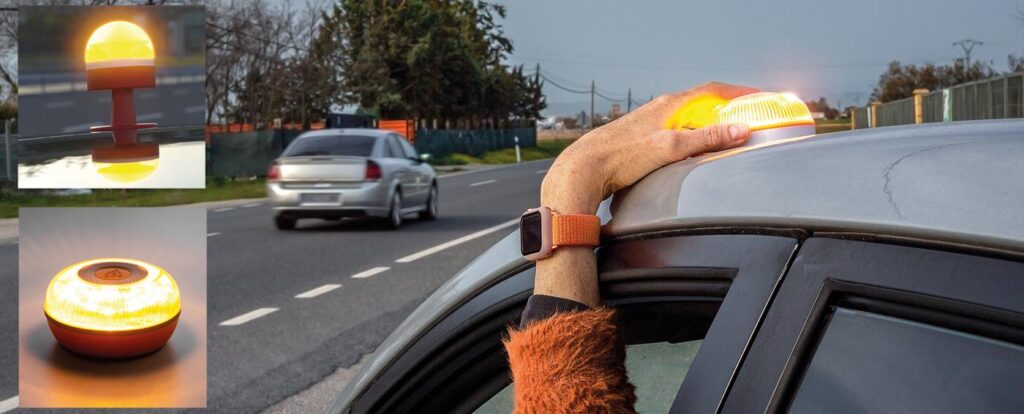
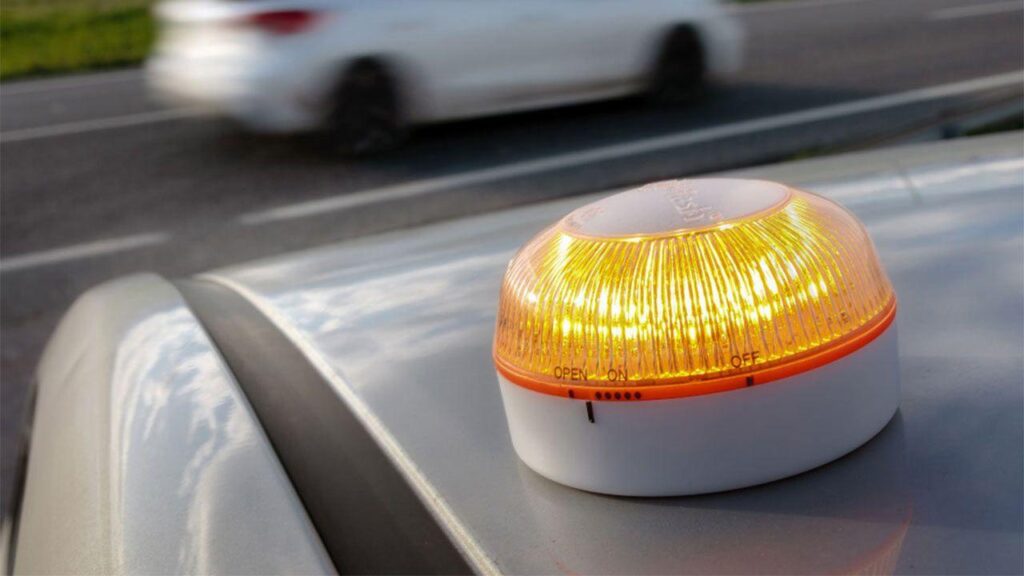
With the V16, the game changes completely: You can signal the incident without leaving the car.Simply switch on the beacon and attach it to the roof using its magnetic base. From that moment, it emits a high-intensity flashing light that is visible from a distance, even in poor visibility, drastically reducing the risk of accidents when a car is stopped on the road.
These devices already existed in simpler versions, but the key to the regulatory change is that Now the legal V16 must be connected to the DGT 3.0 platformTo do this, it integrates a GPS module and a non-replaceable SIM card that sends the exact position of the immobilized vehicle to traffic systems, where the data is processed and shared with other actors in the mobility ecosystem.
The Directorate General of Traffic uses that information to display warnings on variable message signs, in vehicle navigation systems with V-27 signal, and in navigation apps that use official dataIn other words, your beacon no longer just serves to make you visible with physical light, but also to make your incident appear on maps and real-time alert systems.
What data does your V16 beacon actually send and how does it protect your privacy?
With so much media noise, it's normal that some people think the DGT (Spanish Directorate General of Traffic) can track the driver continuously, but the reality is that The connected V16 beacon is not constantly sending data or sharing personal informationIt only communicates with the DGT 3.0 platform when it is switched on, that is, when you activate it due to a breakdown or an accident.
At that moment, the beacon transmits a series of very specific data: the device ID, GPS coordinates, time, and activation statusNo license plate, ID, insurance policy, or driver information is displayed. In fact, for the first few moments, the signal is completely anonymous and simply indicates the location of a vehicle stopped at a specific point on the road network.
The DGT 3.0 platform itself has explained that its mission is “to facilitate the interconnection of all actors in the mobility ecosystem”Car manufacturers, navigation providers, mobility apps, city councils, public transport, fleet management systems, etc. In other words, it allows all these systems to receive information that a vehicle is stopped at a specific point, and to display alerts and adjust their traffic algorithms.
Furthermore, the DGT only receives position updates at regular intervals (approximately every 100 seconds) while the beacon is active. without the possibility of directly identifying who is inside or linking that data to a personHowever, like any connected device, security depends on the hardware design, software, and platform being well protected against vulnerabilities.
Therefore, experts recommend Always buy V16 beacons from official channels, with recognized brands and visible certifications.avoiding suspiciously cheap bargains or products of dubious origin that may not comply with regulations or add privacy and security risks.
Key technical requirements: GPS, SIM, NB-IoT and guaranteed connectivity
Beyond the flashing light, the connected V16 is, in essence, an IoT device designed to function even in the worst conditionsTo be legal from 2026 onwards, it has to meet a series of very specific technical requirements set out in Royal Decree 159/2021 and in the homologation regulations.
First, you must incorporate a GPS system capable of accurately locating the vehicle's position in real timeThis location is what allows your incident to appear on the DGT traffic map, on the road's electronic message boards, and on connected platforms.
Secondly, the transmission of that data is carried out through an integrated and non-replaceable SIM cardIt connects to the network using NB-IoT technology. This technology is designed for Internet of Things devices: low power consumption, wide coverage, good indoor penetration, and the ability to stay connected even in areas with weak signal, such as tunnels or remote rural areas.
The regulations also require that the beacon have a minimum operating time for light (at least 30 continuous minutes), a sufficient luminous intensity to be visible from a long distance and a casing that ensures resistance to rain, wind and adverse weather conditions.
But one of the most important points, and one that many users overlook, is that Data connectivity must be guaranteed for a minimum of 12 years from the date of manufactureDuring this period, the DGT 3.0 transmission service must be included in the price, without extra fees, top-ups, or subscriptions. Some brands even offer longer periods or added services, which is especially attractive for fleets and businesses.
How to know if your V16 beacon is approved and legal
With so many offers in online and physical stores, it's not uncommon to find emergency lights that are "sold as V16" but are actually They are not approved, they do not connect to the DGT (Spanish Directorate General of Traffic) or they are outright counterfeitsThat is why the DGT has insisted that the only reliable way to distinguish a legal V16 is to check its certification.
The first filter is to check the certification code which must appear engraved, printed, or permanently affixed to the beacon or its packaging. Valid codes usually begin with LCOE or IDIADA, followed by a specific number, indicating that the device has been tested in official laboratories and has passed the required visibility, autonomy, and connectivity tests.
That same labeling must clearly state, the reference that the model is approved by the DGTIf the supposed badge is a removable sticker, blurry or without a recognizable test number, be suspicious: it could be an unsuitable product, even if it looks like a connected V16 on the outside.
Another important element is the presence of IMEI numberThe IMEI is the identifier of the communications module or the integrated SIM. Every connected V16 beacon must display it. Older, unconnected models, or replicas that only emit light, do not have an IMEI because they do not communicate with the network.
Finally, look on the box or the case. the guaranteed connectivity dateThe service period must be specified (for example, connectivity included until a certain date), meeting at least the 12-year requirement stipulated by the regulations. If you don't see any reference to this period, it's very likely that the device does not meet the requirements.
Consult the official list of V16 models certified by the DGT
Besides checking your device's label, the most reliable way to know if your beacon is legal is to go to the Official list of DGT-certified connected V16 modelsThis list, which is updated periodically, includes all the devices that have passed through the testing laboratories and received approval.
That report includes, among other data, the laboratory that performed the tests (LCOE or IDIADA), the certification code, the commercial name of the beacon, and the responsible companyFrom well-known automotive brands to devices distributed under different names but with the same technological base.
The DGT has been adding dozens of references to that list: from pioneering models such as Help Flash IoT or FlashLED SOS, to more recent equipment from manufacturers such as OSRAM, HELLA, Goodyear, Philips, NETUN, MIROVI or others that market the same beacon base under different brands (ResQLight, DriveLit, ProFlash, etc.). All of these codes and names form the official register of valid connected beacons..
If an online or physical store offers you a "V16 type connected" light that is not listed here, or whose code does not match any of the registered ones, The wisest course of action is to discard it.Besides exposing yourself to penalties for using a non-approved device, you could find that, when the time comes, your beacon doesn't communicate anything to DGT 3.0.
The DGT itself has also stated on several occasions that prohibition of certain models that, despite having been sold, do not meet all the requirements or are no longer valid. Hence the importance of periodically checking the official list, especially if you bought your V16 well in advance or if you manage fleets with many different units.
How to check if your V16 beacon is still operational and connected to the DGT (Spanish Directorate General of Traffic)

Beyond confirming that your model is on the official list, it's normal to want to know if, as of today, Your V16 beacon is still operational, maintains connectivity, and is actually visible in the DGT systems.There are several ways to verify this fairly safely without risking your life with dangerous tests.
First, some manufacturers and distributors offer Web portals or apps where you can enter the certification code or IMEI This is to verify that your unit is still active on its platform and that the associated connectivity hasn't expired for any reason. It's a useful first check, especially for beacons purchased some time ago.
The regulations also stipulate that You can verify the validity of the model on the official DGT website.Verify that the certification code exactly matches the one listed in the public database. If your beacon is listed there, it is among the devices recognized as valid.
Regarding checking the real-time connection, there's a temptation to turn on the beacon "just to try it" in the middle of an open road, but you have to be extremely careful here: The legislation includes penalties of up to 30.000 euros for generating false positivesThat is, by activating V16 without a real incident and keeping it on for more than 100 seconds simulating an emergency.
If you need to confirm practical operability, do so only in a controlled environment and, preferably, in coordination with a roadside assistance service, a repair shop or a crane operator who is already used to dealing with these alerts. Remember that those who categorize the cause of the incident in DGT 3.0 (breakdown, accident, stopped vehicle, etc.) are precisely the roadside assistance operators with V-24 signal, not the driver.
View your V16 beacon on the DGT traffic map
One of the clearest ways to check that your device is communicating correctly is to observe how The activations of the V16 are reflected on the DGT incident map.This map not only shows beacons: it also includes road closures, roadworks, detours, landslides, adverse weather, stopped vehicles and any event relevant to traffic.
In the map legend, connected V16 beacons are normally represented with a hazard icon or a stopped vehicle iconClicking on each one displays a card with information such as the type of event (by default, vehicle stopped), the road and direction, the orientation, the time from which the notification is active, the corresponding province and municipality.
To facilitate viewing, the map offers a menu of Filters are accessible via the three-line button in the upper right corner.From there you can activate or deactivate different types of incidents to keep, for example, only the warnings of stopped vehicles, which are usually those that correspond to V16 beacons turned on.
Every time someone activates an approved V16, the beacon automatically sends the information to DGT 3.0 the device ID, its coordinates, and the exact activation timeThe system processes this data and generates a stopped vehicle event on the map, which is what you can see in real time from the official DGT website.
It is worth emphasizing that, from a privacy perspective, These points on the map do not allow us to know who is inside the car or what type of vehicle it is.They only locate the incident on the road and serve to warn other users and coordinate emergency and rescue services.
Alternative maps with public data from DGT 3.0: how to use them
Following the opening of data on the DGT 3.0 platform, third-party websites have emerged that They show on a map all the V16 beacons that are active or have recently been active.One of the best known is a project developed by a cybersecurity engineer, which takes information from the DGT's public API and maps it in a more specific way.
In these alternative maps, devices are usually represented with beacon icons of different colorsFor example, currently active options are shown in yellow, while those that were recently active are shown in a darker shade. The platform is updated regularly, even displaying the time of the last update at the top of the screen.
Just like on the official map, clicking on each icon displays Detailed information about the location, activation time, and other technical details of the eventIt is exactly the same information that the DGT (Spanish Directorate General of Traffic) handles, but presented in a way that is more focused on the beacons, without so much noise about other incidents.
An added advantage of these websites is that They allow you to share the incident with navigation apps like Google Maps, Waze, or Apple MapsThis generates a direct route to the vehicle's location. This can be very useful for emergency services, rescue professionals, or even family members who come to the aid of someone who has broken down.
However, it's important to be clear that These alternative maps are not official.Although they consume public data and come from legitimate sources, they have been developed by people and entities outside the DGT, so their correct functioning and availability depend exclusively on their creators and access to the API.
Advantage or potential risk? Road safety versus public exposure
Having public maps with the V16 beacons connected has a very positive side: It improves travel planning and helps avoid unexpected traffic jams. due to a broken-down car in the middle of the lane. Integrated into GPS navigation systems, this data allows apps to provide advance warning of real incidents on the route.
Furthermore, the use of official information considerably reduces fake ads that may appear on collaborative platforms Like Waze or Google Maps, when a user mistakenly flags a stopped car or a non-existent accident. The presence of the V16 beacon on the DGT 3.0 platform helps validate that the incident actually exists.
However, reasonable doubts have also been raised about the potential malicious use of these public mapsIn theory, anyone could check where there is a vehicle immobilized on a secondary road, at night and in an isolated place, and take advantage of it to approach with less than noble intentions under the guise of helping.
The DGT insists that The data is anonymous and managed under strict security protocols.The information is limited to coordinates and the event's status. However, as with any connected technology, zero risk is impossible, and the context in which information is shared must always be considered.
Therefore, a basic recommendation is that, if you experience a breakdown in a compromised environment, Stay inside the vehicle with your seatbelt fastened whenever it is safe to do soActivate the V16 beacon, call 112 or your assistance service and follow their instructions, instead of accepting help from strangers if you are unsure.
Many users are wondering if they will be able to View active V16 beacons directly on Google Maps, Waze, or your car's built-in navigation systemTechnically it's possible, but today most applications only show generic "incidents", such as stopped cars or accidents, without differentiating if there is a V16 behind.
Both Google and Apple are powered by official sources (such as the DGT) and collaborative dataThis opens the door to increasingly precise integration. The DGT's idea with its 3.0 platform is precisely to build an ecosystem where all these stakeholders share reliable, real-time information.
In practice, for the average driver, the important thing is that If your beacon is approved, connected and active, your incident will be reflected as a relevant traffic event which other users will see on their routes and on variable message signs, helping to reduce scares and sudden braking.
Looking ahead, the DGT's strategy is to go beyond beacons and massively connect vehicles, infrastructure and mobility servicesFollowing the lead of other countries already exploring these intelligent traffic networks, the V16 is just the tip of the iceberg of an increasingly digitized road safety system.
Ultimately, what matters to you as a driver is having the certainty that The beacon you keep in the glove compartment or trunk not only illuminates, but also communicates correctly with the DGTSeeing it reflected on official maps or connected applications when you really need it is the definitive proof that it is still operational.
If you check that your model is on the official list, confirm that the certification code and IMEI are correct, verify that the connectivity is still valid, and know how its signal is reflected on the incident map, You can drive with relative peace of mind knowing that your V16 beacon will do its job when you really need it., protecting both you and the other people who travel on the same road.
Index
- 1 Offside triangles and connected V16 beacon as the new standard
- 2 What data does your V16 beacon actually send and how does it protect your privacy?
- 3 Key technical requirements: GPS, SIM, NB-IoT and guaranteed connectivity
- 4 How to know if your V16 beacon is approved and legal
- 5 Consult the official list of V16 models certified by the DGT
- 6 How to check if your V16 beacon is still operational and connected to the DGT (Spanish Directorate General of Traffic)
- 7 View your V16 beacon on the DGT traffic map
- 8 Alternative maps with public data from DGT 3.0: how to use them
- 9 Advantage or potential risk? Road safety versus public exposure
- 10 V16 beacons and GPS navigators: what you can actually see

Passionate about technology since he was little. I love being up to date in the sector and, above all, communicating it. That is why I have been dedicated to communication on technology and video game websites for many years. You can find me writing about Android, Windows, MacOS, iOS, Nintendo or any other related topic that comes to mind.