- The lack of space on Android TV causes slowness, errors, and problems installing apps, but this can be alleviated with good maintenance.
- Deleting apps you don't use, disabling pre-installed apps, and clearing the system and app cache frees up a significant amount of memory.
- USB drives and external hard drives, configured as internal or removable, allow you to expand storage and move data or apps.
- Using file managers, network storage, and regularly checking available space helps keep TV running smoothly.
If your Android TV keeps telling you that There is not enough spaceWhether apps are closing or your computer is running slower than the supermarket queue, you're not alone. one of the most common problems in TVs with Android TV and Google TV, both in television models and in devices such as Chromecast or TV Box.
The good news is that there are many ways to free up space on Android TV And restore smooth performance without having to factory reset your TV every other day. From deleting unused apps to clearing the cache, moving content to a USB drive, or repurposing old hard drives, you have plenty of options to free up storage and improve performance. Here's how.
Why your Android TV runs out of space (and what problems it causes)
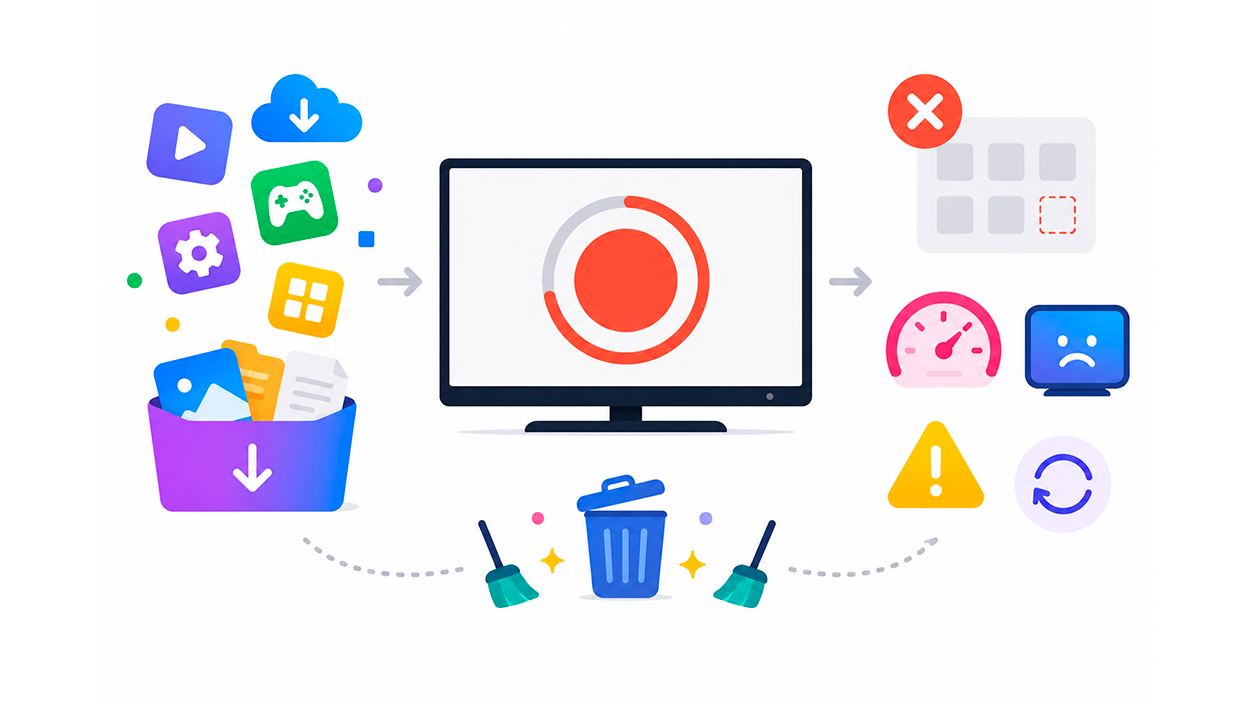
Over time, your TV accumulates apps, games, updates and temporary files which are stored in the internal memory. Many TVs and TV boxes come with 8, 16, or at most 32 GB, so it's not uncommon for that memory to fill up quickly.
When storage is almost at its maximum, the symptoms begin: You can't install new appsThe ones you already have are malfunctioning, freezing, the interface is choppy, and in some cases, even system updates fail. This problem is even more noticeable on large screens and with more demanding systems like Android TV or Google TV.
In addition to the applications themselves, the system saves temporary files and data remnants (The infamous cache, junk folders, and miscellaneous files) which, although invisible, take up a considerable amount of space. If you never clean them up, they end up being the main culprits behind your device running out of storage.
Delete apps and games you don't use to free up space
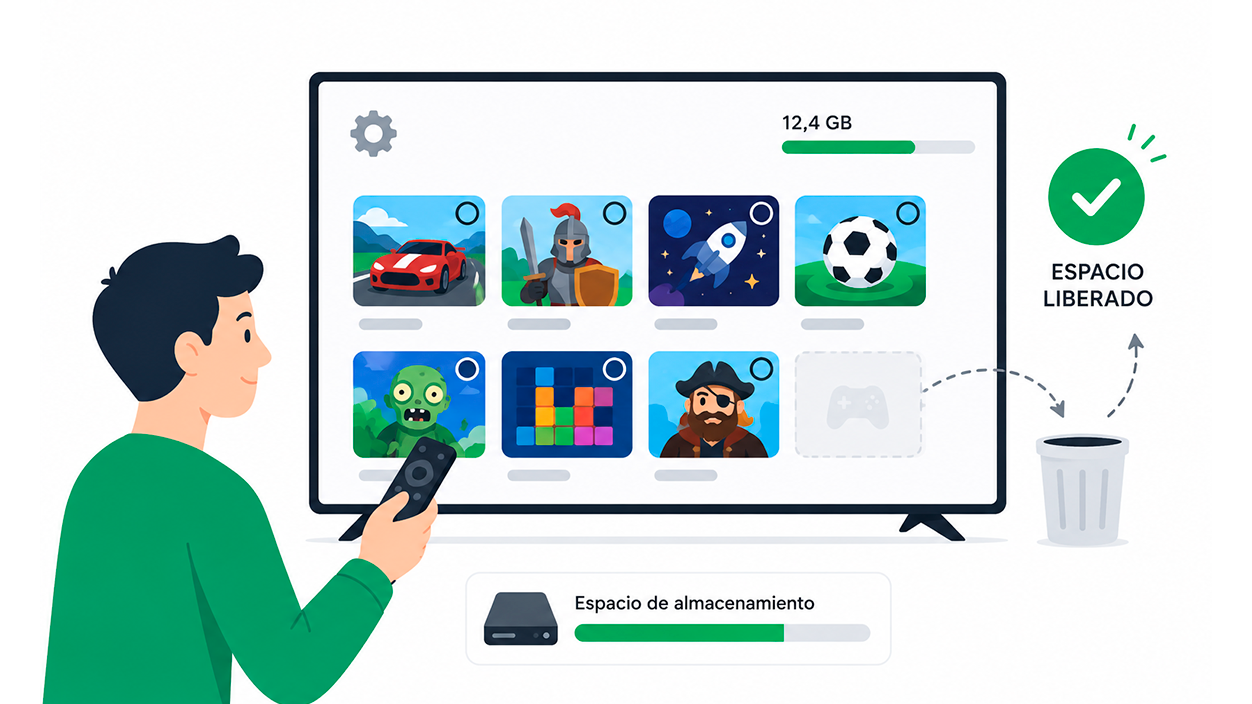
The first logical step to free up memory is to check what you have installed and uninstall the apps and games that you no longer use. It's fast, effective, and you don't need anything more than the TV remote.
On most Android TVs, you can do it like this:
- From your Android TV, enter the home screen.
- Scroll down until you find the icon of Settings or Settings.
- Within the settings, go to the section "Device" and enter “Applications” either "Apps"
- In the section of “Downloaded” You will see all the apps you have installed.
- Select the app or game you want to remove and tap on “Uninstall”.
- Confirm with “Accept"when the system asks you to."
This will free up not only the size of the app itself, but also some of its associated data. However, it's important to keep in mind that Not all apps can be uninstalledespecially those that come pre-installed by the manufacturer or by Google.
What to do with pre-installed apps that can't be deleted
Many TVs with Android TV or Google TV come with a collection of manufacturer apps (your own stores, demos, services you never use…) that take up memory and add no value. In some cases, you can't uninstall them, but you can reduce their impact.
When you enter the details page for one of these applications in the Settings menu, you may see that The "Uninstall" button does not appearInstead, you'll see the option "Disable" either "Deactivate"
Al tap on “Disable”, the app disappears from the interfaceIt stops updating and the amount of data it can store is reduced. The application remains technically installed, but with a much smaller footprint and no longer able to occupy more space or consume resources in the background.
Since you're already in the applications menu, it's worth taking a look at the following as well. the apps you installed yourself You tried it "just to try it out" and never opened it again. Just like on your phone, it's easy to accumulate streaming services, games, or players you no longer use. Uninstalling them is one of the quickest ways to free up storage space.
Clear the app cache to free up space
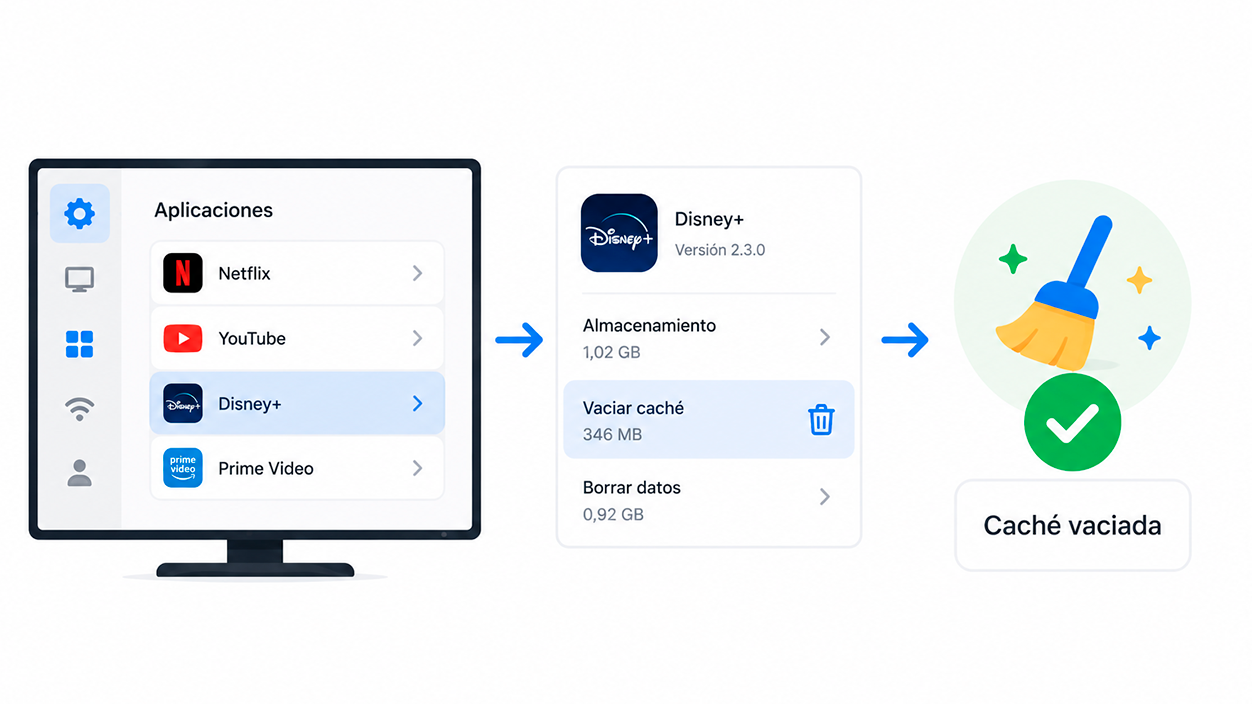
Besides deleting apps, one of the most effective maintenance tasks is clear the application cacheJust like on your mobile phone, apps generate and save temporary files to load faster, but over time these files take up a lot of space without providing anything essential.
Each app's cache includes data such as images, video clips, thumbnails, or temporary filesThey usually help apps start up faster, but if your TV has little internal memory, it's better to sacrifice a little of that initial "turbo" in exchange for freeing up storage.
To clear an app's cache on Android TV or Google TV, the steps are very similar to uninstalling it:
- Open the Settings from the television.
- Access the section of “Applications” either "Apps"
- Select the app you want to review.
- Within your profile, look for the option “Clear cache” either "Clear cache"
- Confirm the action when the system asks you to.
By doing so, only the following are eliminated: temporary filesYour sessions, lists, and personal settings won't be deleted, so you won't have to log back into Netflix or redo your settings. The only thing you might notice is that the first time you open the app after clearing the cache, It will take a little longer to load.
Clear other cached system files
It's not just apps that accumulate cache: the Android TV system itself can also save cache. global temporal data which end up taking up a good chunk of internal memory. Luckily, it's also possible to delete them from the settings menu.
In many models, you can follow this route:
- Enter the Settings of your Smart TV.
- Select “Device preferences” or a similar menu.
- Go to the section on "Storage".
- Inside, locate the option “Shared internal storage” or equivalent.
- Look for an element called “Cached data”.
- Press it and the system will ask you if you want to delete this data; select “Accept"
This process will eliminate them all at once. temporary system and app files that are categorized as general cache. It's a very quick way to reclaim a lot of space, especially if you've never done it before.
How often should you clear the cache on Android TV?
There is no fixed rule that says how often you should clear the cache, because it depends a lot on how you use TVEven so, there are some guidelines that can serve as a reference.
If you're one of those who almost always use the same two or three applications (For example, a streaming platform, YouTube, and little else) and you rarely install new things, you probably won't need to clear the cache very often. The system will remain relatively stable.
On the other hand, if you like try many different apps, games, and players If you frequently install and uninstall services, the cache will grow faster. In these cases, spending a couple of minutes now and then clearing the cache of the most resource-intensive applications and deleting system cached data can make a significant difference in performance.
There are also clear signs that it's time to clean house: the TV it starts to slow downThe menus are slow to respond, the platforms freeze, or you get a warning that You don't have enough space to install anything new. Another helpful tip is to go into Settings and check the storage section to see how much free space is left.
Use advanced apps like x-plore to locate large files
In some cases, even if you delete apps and clear the cache, you still see that a significant portion of the space is taken up by the category “Various” or “Misc.” in internal storage. That's where junk files, app remnants, or folders that the system doesn't properly identify are often hidden.
For more in-depth solutions, you can install a advanced file manager like “x-plore” on your Android TVThis app includes a very useful feature called “disk map"which visually shows you which folders and files are taking up the most space."
A typical case: a user with a Hisense TV discovered, thanks to x-plore, that he had 1,5 GB in a “trash” folder (recycle bin) and another gigabyte in directories that didn't seem important. Once located using the disk map, he was able to access those folders from x-plore and delete the files, recovering an extra 2 GB that he couldn't see through the normal settings.
If you're interested in doing something similar, the general idea is:
- Download “x-plore” from Google Play on your Android TV.
- Open the app and use the “disk map” function to see what takes up more space.
- Navigate to suspicious folders (e.g., "trash" folders, download remnants, etc.).
- Delete the files that you are clear about what you don't need.
However, be careful and don't delete things haphazardly: focus on junk folders, remnants of uninstalled apps or downloads that you have identified, so as not to damage anything important in the system.
Connect a USB drive to expand the storage space
Another very useful way to avoid always running out of storage space is connect a USB drive (USB drive, external hard drive…) to your Android TV. However, you need to understand how this system works because it's not exactly the same as on a mobile phone.
To begin with, Android TV is only compatible with units that use FAT formatsWhen you connect a USB drive, the TV checks its format and, depending on what it detects, will offer you different options.
Normally, two things can happen:
- If the format is compatible and Android TV recognizes it, the unit is configured directly as removable storage.
- If it does not recognize the format, the system will ask you to format the drive and choose whether you want to use it as internal or removable storage.
Before formatting, it is essential that you keep in mind that Everything on the USB drive will be erased.So copy any content you want to keep (movies, photos, documents, etc.) to another location because it will disappear in the process.
Choose between internal or removable storage
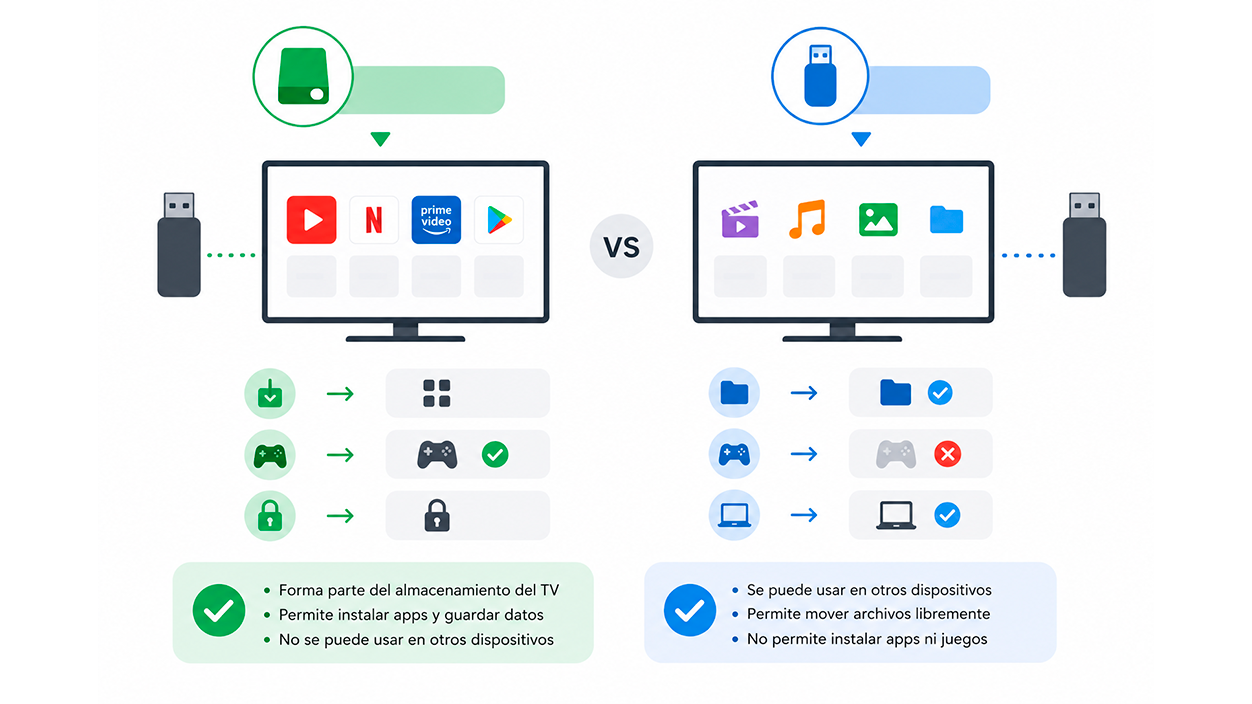
When you connect the USB drive and Android TV asks you to choose how to set it up, you will usually have two main options: internal storage o removable storageEach one has its advantages and limitations.
If you choose internal storage:
- The unit becomes part of the Android TV's own storage.
- You will be able to install apps and save data directly on it.
- The content cannot be freely moved to another device, because it remains linked to that television.
If you choose removable storage:
- The unit behaves like a standard USB, which you can disconnect and use on other devices.
- You can move files, videos, music, documents from one place to another.
- You can't move apps or games to this type of storage.
In many cases, the most practical solution is to use the USB drive as internal storage if your priority is install more apps and not so much for transferring files between devices. If you want to move movies or TV shows from one place to another, it's better to use it as external storage.
How to eject a USB drive without losing data
Before unplugging the USB drive from the TV, it is advisable to eject it correctly Remove it from the system to avoid data problems. Removing it abruptly could corrupt files or cause errors later.
The process is usually very similar on almost all Android TVs:
- Go to the home screen from your Android TV.
- Enter the menu of Settings.
- Within “Device”, select “Storage and restoration” or “Storage and restoration”.
- Choose your USB drive from the list.
- Press the option "Expel" or equivalent.
Once the system confirms that the drive has been ejected, you can safely disconnect it from the USB port. Keep in mind that if you had applications installed on that USB as internal storageOnce you eject it, you will no longer be able to see or use them until you reconnect the unit.
Change the storage type of the USB drive
If you previously configured the USB drive as removable storage and now want to use it as internal storage (or vice versa), you can change settings laterHowever, the process involves reformatting the drive.
The usual steps are:
- Access the home screen of Android TV.
- Open the Settings.
- In “Device”, go to “Storage and restoration”.
- Select your USB drive.
- Choose how you want format it (such as internal or removable).
Remember that this process erase all data from the USB driveSo before doing so, first copy the files you want to keep to another location.
Move applications and data to the USB drive
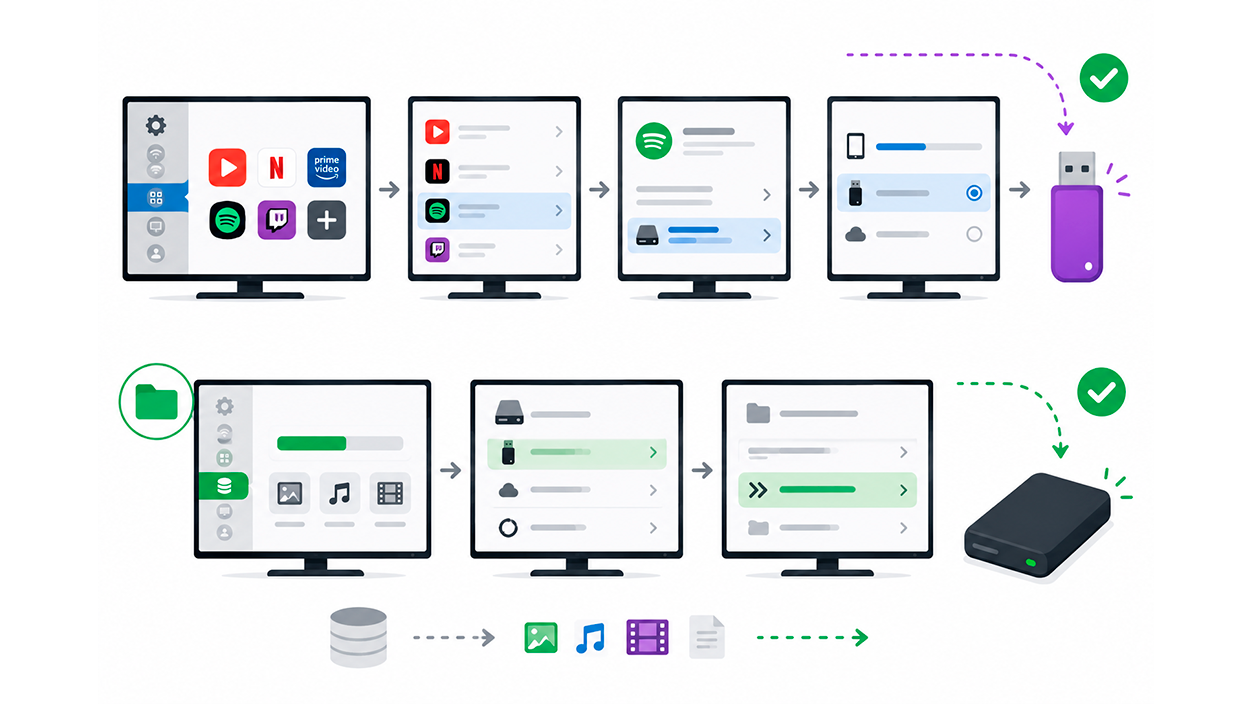
If you have configured a USB drive as internal storage, you can use it to move apps and other content from the TV's internal memory and thus free up space.
To move applications to the USB drive, you can usually follow these steps:
- From your Android TV home screen, enter Settings.
- Go to the section “Applications” within “Device”.
- Select the app you want to move.
- Scroll to the option “Storage used” or similar.
- Choose the USB drive as a new destination.
The system will perform the migration, and from that point on, some of the application data will be saved to the USB drive, freeing up space on the internal storage. However, if you eject the drive at any point, You won't be able to use those apps or see them in the list. until you reconnect the USB drive.
You can also move other types of content to the drive configured as internal. On many devices, the process is:
- Gonna Settings from the main screen.
- Go into “Storage and restoration”.
- Select your USB drive.
- Press the option “Migrating data” or “Move now” to move content.
Again, keep in mind that if you move important content to the USB drive, it's possible that you need to have it always connected to access all your apps and files.
External storage: useful, but not always the definitive solution
Connecting a USB flash drive or external hard drive to your TV doesn't mean that suddenly Disappear all your internal space problemsUnlike some mobile phones with microSD cards, on Android TV and Google TV the use of external storage for apps is more limited and, depending on the device, the integration can be better or worse.
Even so, an external drive is very valuable for store own content (For example, downloaded TV shows or movies, home videos, music…) without needing to store them on the TV's internal memory. You can move these files with a file manager and leave the internal storage almost free for the system and apps.
If you also use an advanced player like Kodi or similarYou'll be able to easily navigate through folders on your hard drive or USB and play files without having to struggle with confusing menus. For many users with a Xiaomi TV Box or similar devices, this completely transforms the experience.
Make use of old hard drives with your TV Box
If you have at home old hard drives stored in a drawerYou can give them a second life by connecting them to your Android TV Box (for example, a Xiaomi TV Box) and turning them into a large storage space for multimedia content.
The general procedure would be:
- If the album is already external with its USB casingYou just need to connect it to the TV Box's USB port.
- If it's an internal hard drive 2,5” or 3,5”You will need a compatible USB enclosure (usually SATA if it's relatively recent).
- Once mounted in the casing, you connect it to the TV Box with the corresponding USB cable.
Then comes the step that nobody likes: format the diskMany TV boxes allow you to format directly from the system itself in formats like exFAT or NTFS, which are compatible with Android TV. If you prefer, you can also format it from your computer before connecting it to the TV.
Formatting means that All previous content will be deletedSo be sure to back up anything you want to keep. Once it's ready, you can use the drive to Save TV shows, movies, music, recordings, and even some apps. depending on how it is integrated with the system.
Combining it with a good player like Kodi or a similar app, you'll have a kind of “home media server” without depending so much on the internet connection or the TV Box's limited internal storage.
Upload your content to the cloud and play it on your TV
Another way to avoid overloading the TV's internal storage is do not physically store the files on itInstead of storing videos, photos, or music on your device, you can upload them to the cloud or a network server and play them through dedicated applications.
Services such as Plex or other media players that work over the Internet allow you to access your content hosted on a server (it can be your own computer, a NAS or a cloud service), so that the The actual size of the files does not fall on the television's internal memory.
It's true that these apps take up some space because they need to be installed, but the bulk of the storage space is stored in the cloud or on the server, not on the TV. It's a particularly interesting option if you use large video libraries in high quality.
Clear the cache on your Smart TV to optimize performance

Returning to the topic of cache, periodically deleting this temporary data not only helps you free up space, but also serves to optimize TV performanceWhen the cache accumulates excessively, the system can become sluggish, menus slow down, and apps take longer to react.
As we have already seen, the procedure for clearing the global cache on many Smart TVs involves going to the Television settings, enter into “Device preferences”, then in “Storage", choose "Shared internal storage” and click on “Cached data"to delete them."
This type of maintenance only takes a few minutes, but in the long run It makes a difference in stability and fluidityIt keeps the system lighter, reduces the likelihood of errors when installing new apps, and prevents updates from failing due to lack of space.
How to check the available space on your Android TV
Before you install new applications or update the system, it's helpful to check how much free space It stays on your TV. This way you can decide if you need to clean up, move data to an external drive, or even expand the storage.
To see it, the route is usually very similar to the one we have already discussed:
- Open the menu of Settings of the Smart TV.
- Enter “Device preferences” or a similar menu.
- Access the section of "Storage".
- Select “Shared internal storage”.
- Look at the section "Available" to see how much free space you have.
With that information you can assess whether it's time to delete applications, clear cache, move files to a USB or even connect an additional external memory. Checking this section from time to time will help you anticipate the typical "insufficient space" message.
With all these options on the table—uninstalling apps you don't use, disabling pre-installed ones, clearing the cache regularly, using advanced file managers, taking advantage of USB drives and external hard drives, or even using the cloud—it's relatively easy to keep your Android TV running smoothly. Sufficient space and decent performance for years without constantly battling full storage warnings or having to restore the system every other day.

I am a technology enthusiast who has turned his "geek" interests into a profession. I have spent more than 10 years of my life using cutting-edge technology and tinkering with all kinds of programs out of pure curiosity. Now I have specialized in computer technology and video games. This is because for more than 5 years I have been writing for various websites on technology and video games, creating articles that seek to give you the information you need in a language that is understandable to everyone.
If you have any questions, my knowledge ranges from everything related to the Windows operating system as well as Android for mobile phones. And my commitment is to you, I am always willing to spend a few minutes and help you resolve any questions you may have in this internet world.