- The main console and sharing system allows multiple accounts on the same console to enjoy PlayStation Plus games and benefits.
- Sharing PS Plus with friends on different consoles involves legal and security risks, so it should only be done with people you fully trust.
- Family accounts allow you to share benefits with minors, limiting content according to age and configured parental controls.
- Alternatives such as gift cards or subscription sharing platforms help you save without having to give up full control of your account.

Sharing PlayStation Plus between accounts has become one of the most common ways to save money and get the most out of the consoleMany people buy games "part-to-part" or share a subscription to enjoy online multiplayer, monthly games, and the PS4 and PS5 catalogs without paying the full price. But, as with almost everything in the world of subscriptions, there are nuances, limitations, and some risks that are worth knowing before jumping in.
If you have two consoles in different homes, want to share with a friend or family member, or are considering using third-party sites to split costs, it's important to understand exactly how the system works. Main console, sharing and Family SharingWe'll cover what Sony officially allows, what it doesn't approve of, and the differences between using it with adults and minors. Let's take a closer look so you can decide what's best for you and how to set it up without any problems.
What is PlayStation Plus and what does it offer?

PlayStation Plus is Sony's subscription service that allows, among other things, play online and access extra content both on PS4 and PS5. It's a recurring payment that can be monthly, quarterly, or annually, and it gives access to a series of very specific advantages that you should know about if you're going to share an account.
One of the key advantages is the online multiplayer modeMany titles like Call of Duty, NBA 2K, and similar games require a PS Plus subscription to play their online modes with other players. Some free-to-play games allow online play without a subscription, but the vast majority of the competitive and cooperative game catalog requires an active membership.
Each month, subscribers receive a selection of monthly games to download at no extra costOn both PS4 and PS5, these titles remain associated with your digital library as long as you're subscribed, allowing you to download and play them whenever you want. By maintaining your subscription over time, you can build a massive collection without having to pay for each title individually.
The higher-level plans include a catalog with hundreds of games The PS4 and PS5 library includes bestsellers like God of War, Marvel's Spider-Man, Mortal Kombat 11, and many others, as well as indie games and new releases that are added regularly. This rotating catalog is a major draw for those who want to play a lot without buying each game individually.
Another interesting extra are the demos and exclusive temporary trials For the Premium plan. We're not talking about simple, limited demos, but trial versions of the full game, which let you play for a limited time as if you'd bought it. If you then purchase the full game, you can continue playing right where you left off, which is very convenient for deciding what's worth spending your money on.
PS Plus also includes cloud storage for saved games. Specifically, it offers 100 GB of online storage To back up your saves, ideal for preventing loss due to system failures, console changes, or formatting. Plus, you'll free up hard drive space and be able to continue your games on any other system by logging into your account.
In addition to all this, there are special offers on the PS Store, with Exclusive discounts for members These discounts are sometimes combined with general sales, creating what are known as "double discounts." This means that a title with a general 15% discount might end up having an even bigger discount if you're a subscriber. There's also exclusive content within some games: skins, emotes, flags, and other cosmetic items available only to members.
PlayStation Plus plans and prices
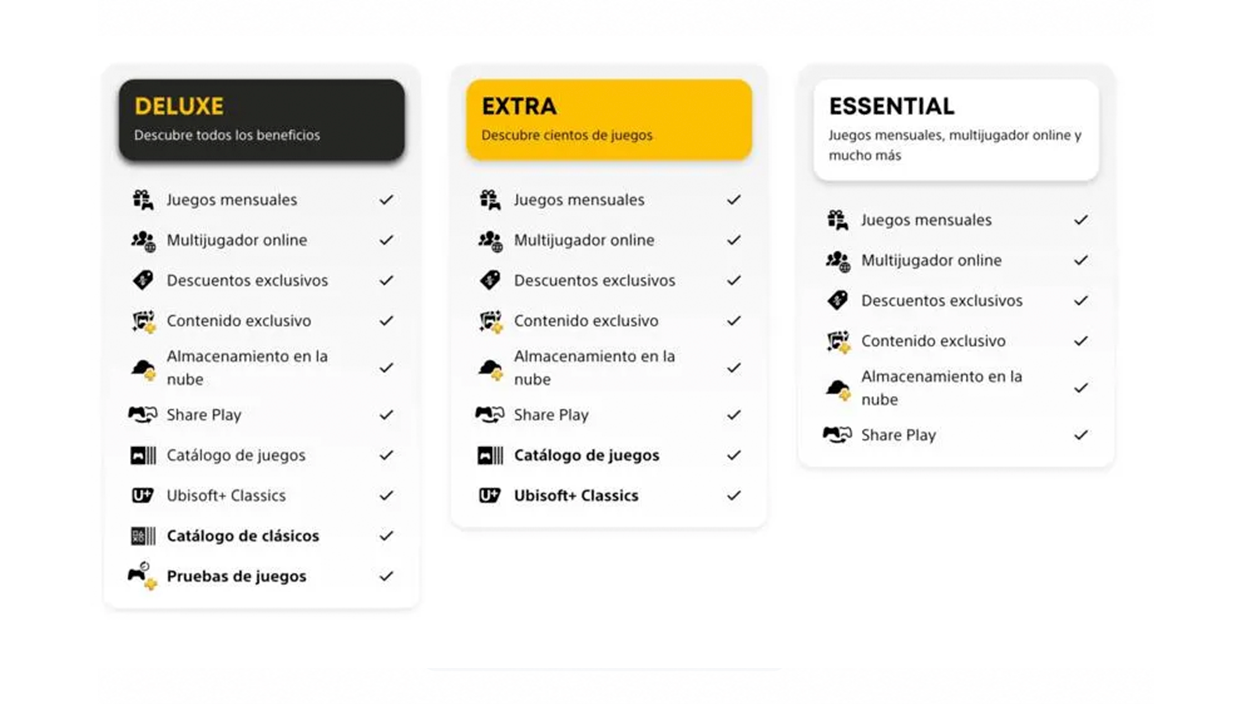
There are currently three subscription levels: PS Plus Essential, Extra and PremiumThey all share a common base, but as you move up a level, more advantages are added in exchange for a higher price.
PlayStation Plus Essential It's the cheapest option and the closest to the classic PS Plus. It includes online multiplayer, monthly games, cloud storage, exclusive discounts, and features like Share Play. Its approximate prices are:
- Monthly subscription: €8,99 per month.
- Quarterly subscription: €24,99 every three months.
- Annual subscription: €71,99 per year (also includes 1 Sony movie credit on the new video system).
PlayStation Plus Extra In addition to all of the above, it includes the so-called Games Catalog, with hundreds of PS4 and PS5 titles, as well as gameplay aids, exclusive content, cloud storage, multiplayer, and Share Play. It's a stepping stone designed for those who want a "Netflix for games" on their console. Its approximate prices are:
- Monthly subscription: €13,99 per month.
- Quarterly subscription: €39,99 every three months.
- Annual subscription: €125,99 per year (3 Sony movie credits).
PlayStation Plus Premium It's the most comprehensive plan and also the most expensive. It includes the Extra game catalog, trials of recent games, the cloud gaming and a catalog of classics from different PlayStation generations. It also includes discounts, the Sony Pictures catalog, Ubisoft Classics, multiplayer, and Share Play. Its prices are:
- Monthly subscription: €16,99 per month.
- Quarterly subscription: €49,99 every three months.
- Annual subscription: €151,99 per year, with 5 Sony movie credits.
It's worth knowing that Sony can Check prices periodically to adjust them to the market, local taxes, or service changes. If there's a price increase, the company usually gives at least 60 days' notice by email, so you can cancel before the new price takes effect. Price reductions don't usually have such a clear notice period.
For those who have never subscribed, there is usually the option of a 7-day free trial in the Essential and Extra plans; you can check How to claim free days of PS PlusAt the end of the trial period, if you haven't canceled, it automatically becomes a paid monthly subscription with automatic billing. If you've tried PS Plus before, the trial option sometimes reappears after a while, but this isn't guaranteed; you'll need to check the PlayStation Plus menu on your console.
How to subscribe to PlayStation Plus
You can register directly from your PS4 or PS5. From the main menu, go to the features screen and select “Join PlayStation Plus”From there, you choose the plan you want and click on "buy subscription." The system will automatically renew the service at the end of the period, unless you disable renewal in your account settings.
To pay, you need to have a payment method set up on your PlayStation Network account. This can be a bank card, PayPal, or other compatible systems. If you don't want to enter your card details on the console, you can always use prepaid cards and subscription cards which are sold in physical stores and online. You enter the code that comes with the card in the PlayStation Store and the corresponding balance or subscription is applied.
You can also use PlayStation Store balance cards in amounts such as 10, 20, 40, 50 or 100 euros (and other values), which can then be used to pay for both games and the subscription itself. If you have any balance left over after paying for PS Plus, you can save it for future digital purchases. Another widely used and secure method is to link your PayPal account, so that the payment is processed from there without directly exposing your card details.
What does sharing PlayStation Plus between accounts entail?
When we talk about “sharing PS Plus” we are actually referring to two different scenarios: on the one hand, share on the same home console with multiple accounts (including those of minors); and on the other hand, sharing a subscription or games between two different consoles, usually yours and that of a friend or family member. This second case is the most problematic.
The best-known method is based on the system of Main console/console sharing and offline playA PSN account can be active on multiple consoles, but only one can be designated as "primary" (on PS4) or have "Share Console and Offline Play" enabled (on PS5). This primary console allows any user of the system to enjoy the games and many PS Plus benefits of the account that has designated it as primary.
Therefore, many users agree to the following: the account that pays for PS Plus marks the one as primary. friend's consoleThe actual account owner plays on their own console as a secondary device. It's a virtual role swap: you play on your PS4/PS5 with your user account, but your console isn't the primary console for that account; the primary console is at the other person's home, and vice versa when you share both services.
Risks and warnings when sharing an account
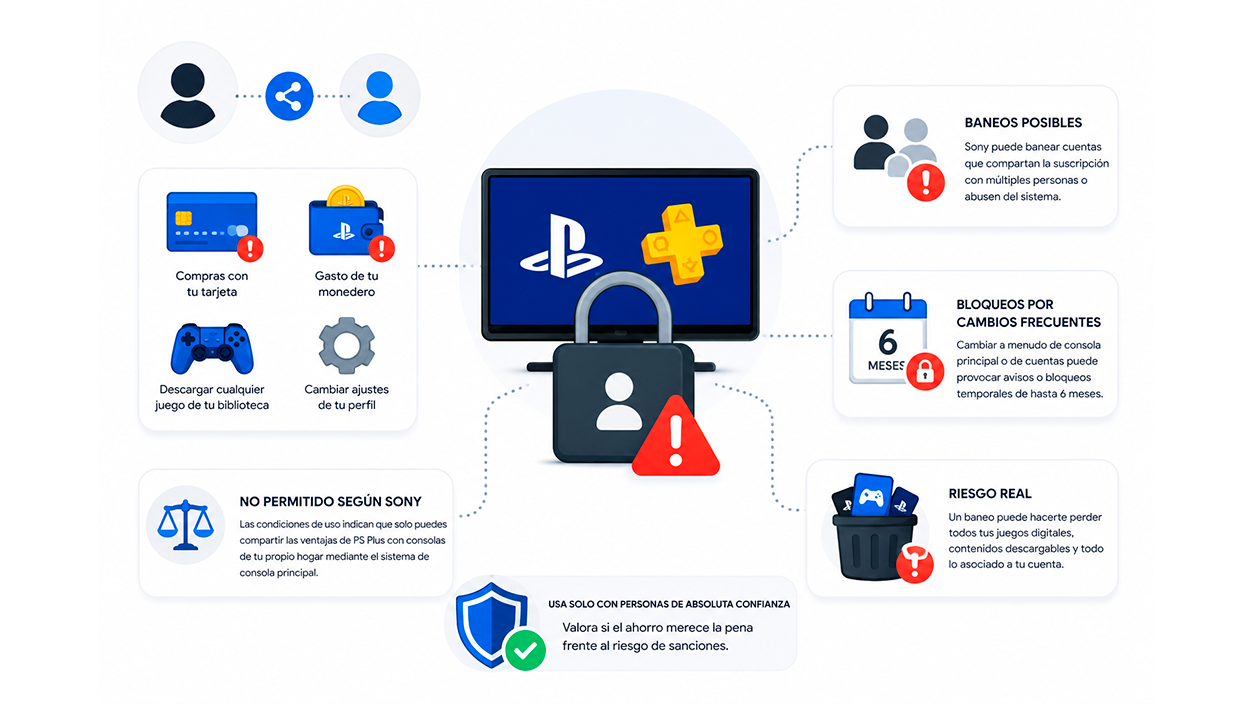
Before you rush to share PS Plus with someone, it's vital that you understand that You're going to give him full access to your accountThis means that this person could, in theory, make purchases with your card, spend your wallet balance, download any game from your library, or change your profile settings. Therefore, this practice only makes sense with someone you trust completely: a partner, sibling, very close friend, etc.
Another risk is that, legally, according to Sony's terms of use, Sharing PlayStation Plus benefits with consoles other than those in your own home is not permitted.Except for the primary console system within the same household. Sony's website specifies that you can only share your games and PS Plus benefits with accounts on a PS5 console configured with Console Sharing and Offline Play enabled, and on your primary PS4 console. The company neither promotes nor endorses using PS Plus to "share costs" with third parties.
Currently, Sony doesn't seem to be aggressively pursuing those who share their subscription with just one friend, but it does warn about Possible bans if shared with multiple people or abused by the systemAdditionally, when you frequently change your main console or shared accounts, you may encounter warnings or temporary blocks of up to 6 months preventing you from changing the settings again.
In case of a ban, the problem is serious: you lose all purchased digital games, downloadable content, and, in general, everything associated with that account. Therefore, beyond trusting the person you're sharing with, you should consider whether the savings outweigh the risks. risk of sanctions from Sony.
How to share PlayStation Plus between two PS4s
If you want two people with two different PS4s to share PS Plus and games, you usually do an "account transfer." The idea is that your friend's PS4 becomes the primary console for your accountand yours becomes secondary. In return, your friend's console can mark yours as primary for their own account if they also want to share their games with you.
The general process is as follows: On both consoles, log in with both accounts involved (the one that pays for PS Plus and the other). Then, on your friend's console, log in with your user account and in the settings, mark that console as the one you want to use. “Primary PS4” from your account. This way, any user of that PS4, with their own profile, can download and play the games in your library and benefit from many of the advantages of your subscription.
On your own PS4, you'll still be able to use all the PS Plus features with your profile, play online, download games of the month, access the catalog, and more. Your friend, on theirs, will be able to Download monthly games, titles you purchase digitally, and those you have in your library.and play them with their own user account. Each player will have their own trophies and save files, so you won't mix up your progress.
However, there is one important limitation: You will not be able to use the same profile simultaneouslyIf your friend logs in to their console with your account while you're using it, they can disconnect you, and vice versa. Normally, each person plays with their own account, and the shared account is only used to activate the main console and download content.
Regarding the advantages, there are some nuances. On your PS4, you'll have full access to everything included in your subscription. On your friend's console, they can play the games downloaded and purchased with PS Plus, take advantage of the monthly games, and access online multiplayer using their own profile (provided the parental control settings (if permitted), but you won't be able to use your cloud storage, your PS Store discounts, or the automatic downloads of exclusive PS Plus patches. These more "personal" features are usually tied to the subscription holder.
How to share games and PS Plus on PlayStation 5
On PS5 the system works similarly, but the option is called “Share console and offline game”The mechanism is very similar to that of PS4, only the terminology and the menu where the settings are located are different.
To activate it, you must log in to your PS5 with the account that has the PS Plus subscription. Then, in the top menu, select the gear icon to enter SettingsFrom there, go to "Users and accounts" and scroll down to the "Other" section. There you will find the "Share console and offline game" option.
The text below indicates that, if enabled, any user of that console will be able to access games and certain benefits even when the machine is in rest mode or disconnected from the networkAll you have to do is click "Activate" to make that PS5 the shared console for your account. If you ever want to stop sharing, simply log back in and click "Deactivate."
One interesting feature is that the system is, in a way, bidirectional: when the other person activates sharing on their console with their account, they also allow you to access their games on your PS5, configured in the same way. However, again, this is something you should only do with people you trust. someone you truly trust and with whom you have clear communication about what is shared and what is not..
Management of saved games and users when sharing
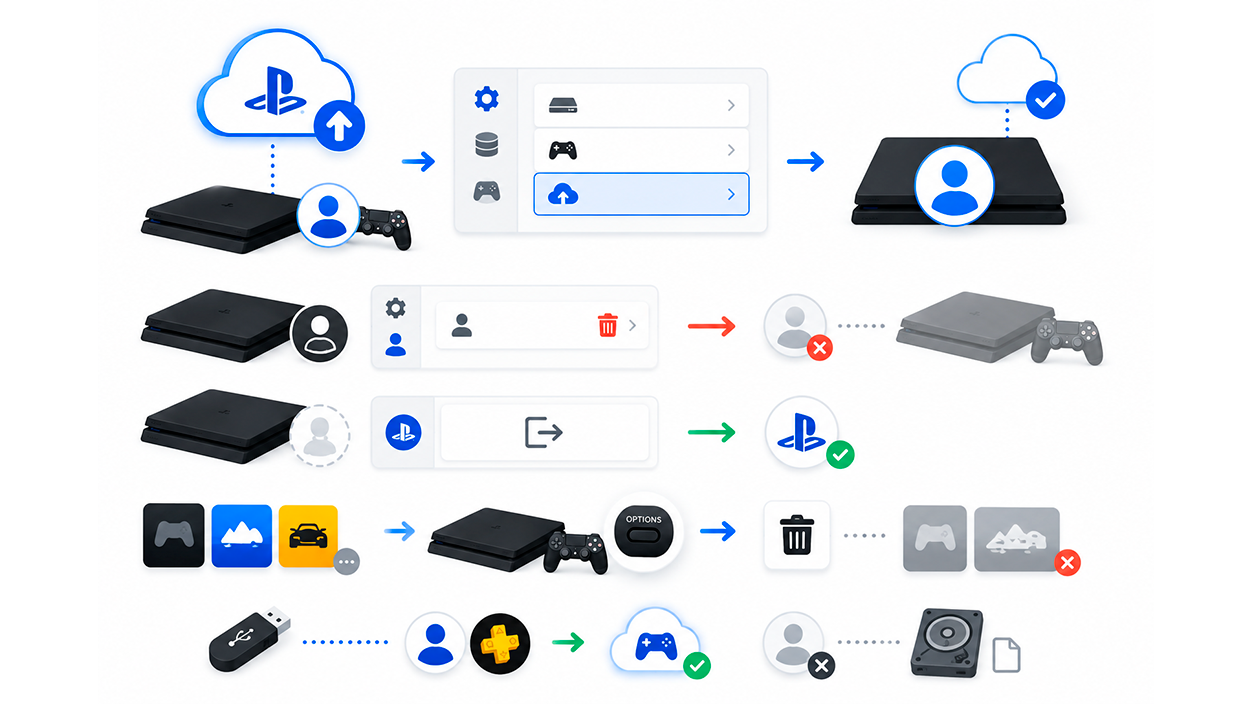
When you play on a secondary console (for example, your friend's PS4 or PS5), your save data won't automatically be uploaded to the cloud if that machine isn't the primary console for your account. In that case, you should create a separate account. manual upload of saved data to online storage so as not to lose progress.
On PS4, the steps are: log in with your local user account, open Settings, go to "Application Saved Data Management," choose "Data Saved on System Storage," and then select "Upload to Online Storage." This ensures your progress is backed up to the cloud and doesn't depend solely on the secondary console's hard drive.
If at any point you want to stop sharing your account on someone else's console, the recommended course of action is delete your local user from that machineTo do this on your PS4, go to Settings, then "Users," and select "Delete User," choosing the profile that was created for your account. This will prevent that person from logging into your PSN account from their system.
If you used the guest login option instead of creating a permanent user account, you only need to Sign out of PlayStation NetworkThis is done from Settings, by going to “PlayStation Network/Account Management” and tapping “Sign Out”. In this case, there's no need to delete the local user, because your account won't be permanently associated.
Additionally, if you don't want that console to keep your downloaded games after you stop sharing, you can delete the content associated with your account. Select the games installed under your user account in the menu, press the Options button on the controller, and choose the "Delete" function. remove the data from the hard driveThis ensures that they cannot continue playing them once you have logged out of your profile.
One detail that often goes unnoticed is that of the saved games in the cloudOnly the subscription holder has this service available; the user with whom the console is shared, if they do not pay for PS Plus on their own, will have to save the games locally and make manual backups, for example, on a USB flash drive, if they want to have an additional backup in case of problems with the console.
Sharing PlayStation Plus with minors in the family
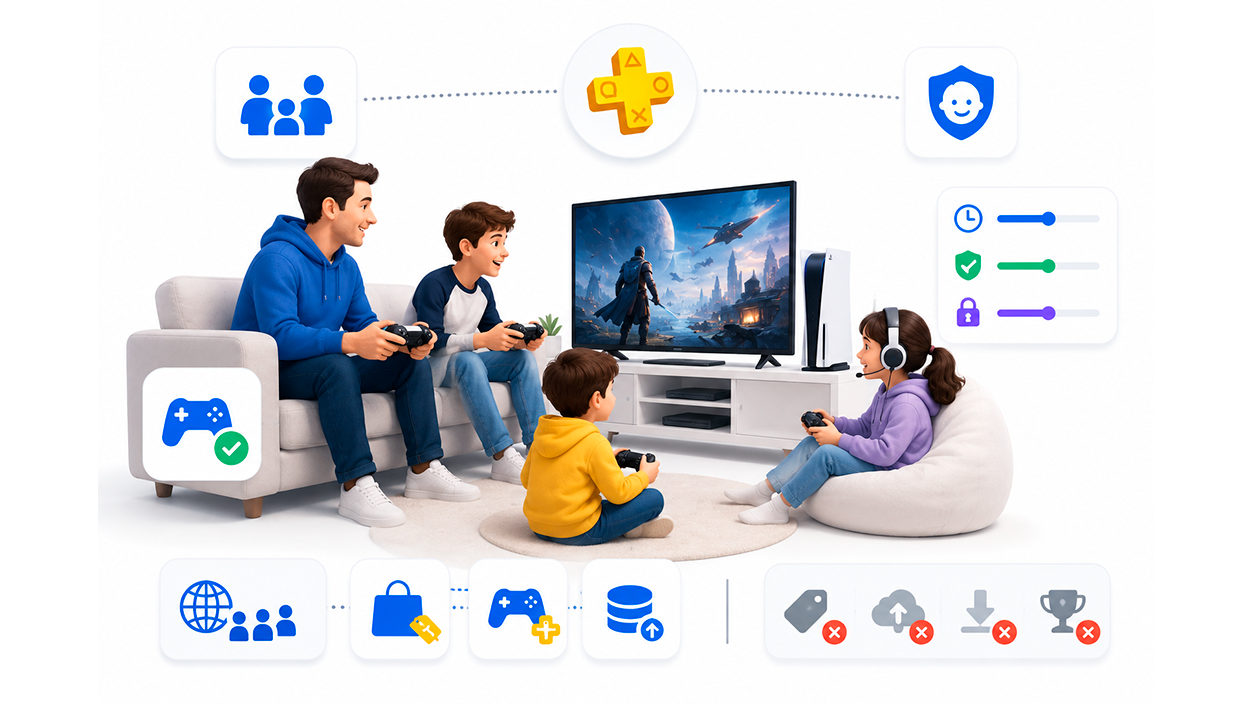
In the context of home use, Sony does explicitly allow the sharing of PS Plus with younger members of the family through the family account and parental control system. We're not talking about a "trick" here, but an official feature designed specifically to allow parents to manage what their children do on the console.
The family manager can create child accounts and set spending limits, time controls, age-based content filters, and other restrictions. Children can subscribe to PlayStation Plus using the administrator wallet funds to pay the recurring fees, always within the economic limits that have been set for them.
When sharing a console (PS5 or PS4) at home, the adult can have a PS Plus subscription on their account and, thanks to the primary or shared PS4 setting on PS5, Some of the main advantages of the service extend to minors' accounts.This way, children can play online, access downloaded games and catalogs according to their subscription plan, and take advantage of the console's social features under adult supervision.
However, minors will only be able to access content that is... suitable for their ageThis is due to both official game ratings and parental control settings configured by the family administrator. If a title is rated for older than a certain age, or if the adult has blocked that type of content, the child account will not be able to play it even if the overall subscription allows it.
To set up Family Sharing on PS4, you typically do the following: sign in with the account that has the subscription, go to Settings, navigate to the PlayStation Network menu, and select "Activate as your primary PS4." From that moment on, any other user who signs in to that console will be able to enjoy the shared benefits, within the limits set by the family configuration.
Among the things that can be shared with other members of the household are the online multiplayer, downloaded games (including those purchased at a PS Plus discount), monthly games, and access to catalogs PlayStation Plus and the classic catalog (in the Extra and Premium plans) are included. However, they do not inherit exclusive purchase discounts, cloud storage for game saves, automatic patch downloads, or exclusive early access trials, which remain tied to the subscription.
Safe alternatives to saving if you don't want to share your account
If you don't trust sharing your account with anyone or don't know anyone to organize it with, there are online services that allow you to spread the cost of digital subscriptions among several people in a relatively structured way. They're not official Sony products, of course, but they've become quite popular among users who want to pay less without having to find interested friends.
One of them is Spliiit. On this platform, you can offer your PlayStation Plus subscription to share it or join someone else's. Simply go to the website, register, log in, and click "Propose" if you want to be the subscription administrator, or "Subscribe" if you want to join another user's group. The service manages payments between the parties, so you receive your share and the other person only pays the agreed-upon amount.
Another similar service is Togetherprice. In this case, you can create a group To share PlayStation Plus between two people, for example, and split the cost in half. You become the group administrator, pay the subscription, and then the service will transfer each member's share to you. If you don't want to create the group, you can also search for an existing one, request to join, and pay your share.
In both cases, even though the platform offers some structure and additional security, in the end you are still giving another person access to your account or being part of a sharing scheme not expressly authorized by SonyTherefore, the same warnings about potential ban risks, trust issues, or payment disputes still apply. You're simply reducing the friction when it comes to finding people to share with.
If all of this seems too risky, you can always opt for simpler solutions, such as gift a gift card with credit or a specific PS Plus card For that person you don't want to share your account with, instead of giving them your username, buy them a PlayStation Network gift card or a 1, 3, or 12-month subscription card, and you're all set.
These cards are sold in many stores: video game retailers like Game, chains like Fnac, El Corte Inglés, MediaMarkt, Carrefour, online stores like Amazon, or specialized websites like Xtralife. Depending on the type, you can choose between cards with balances of 5, 10, 15, 25, 50 euros (and other amounts) or cards that already have the funds. PS Plus subscription for a specific periodThe recipient simply needs to redeem the code on the PlayStation Store from the console or the browser.
Since these are prepaid cards, once purchased there are no additional charges or automatic renewals (unless you later activate renewal from the console itself). It's a way to allow someone else to play online or access the catalog without having to share passwords or risk your purchases or personal data.
In short, the PlayStation Plus system offers a great deal of flexibility both for enjoying games and benefits solo and for share them with family or friendsHowever, it's important to know exactly what's officially allowed, what falls into a gray area, and what the security and terms of service entail. With a good main console setup, careful control of who has access to your account, and smart use of gift cards and third-party services, you can save a considerable amount and continue enjoying online play and catalogs without any problems.

I am a technology enthusiast who has turned his "geek" interests into a profession. I have spent more than 10 years of my life using cutting-edge technology and tinkering with all kinds of programs out of pure curiosity. Now I have specialized in computer technology and video games. This is because for more than 5 years I have been writing for various websites on technology and video games, creating articles that seek to give you the information you need in a language that is understandable to everyone.
If you have any questions, my knowledge ranges from everything related to the Windows operating system as well as Android for mobile phones. And my commitment is to you, I am always willing to spend a few minutes and help you resolve any questions you may have in this internet world.