- Ollama allows you to run open-source LLMs locally, guaranteeing total privacy and eliminating token costs.
- The configuration requires attention to RAM and GPU, with 16GB being the recommended standard for smooth performance.
- It is possible to connect local models to the browser using extensions and configure CORS to interact with web content in real time.
- The tool integrates with IDEs like VS Code and virtualized environments like Docker to optimize software development.
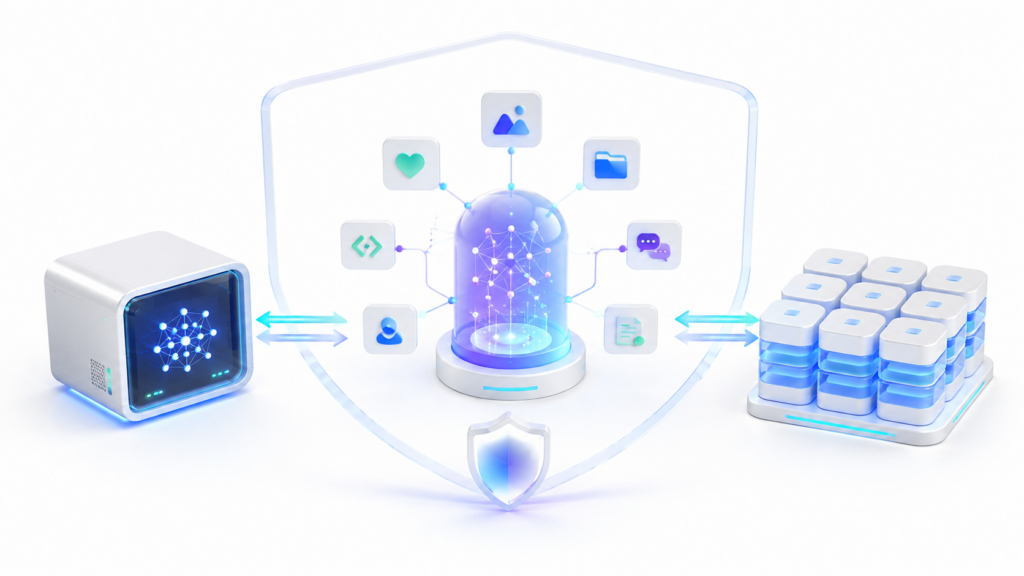
How to use Browser Use with Ollama and local models? You've probably noticed that AI is involved in absolutely everything these days. ChatGPT is king, but of course, with so much power comes a little bit of paranoia: What happens to the data? What are we uploading? Who's reading our prompts, or does my boss know I'm using AI to get work done faster? These are perfectly logical questions, which is why many people are moving away from cloud computing and building their own systems. local artificial intelligence environment.
The idea is simple yet powerful: to have total control. In this article, we'll explain in detail how to master Ollama, a tool that allows you to run language models on your own computer without... Not a single byte leaves your machineWe'll cover everything from basic setup to integrating all of this into your browser so that AI can analyze the websites you visit in real time, without monthly subscriptions or fine print about privacy.
What the heck is Ollama and why is it so cool?

To put it simply, Ollama is an open-source platform that acts as a language model manager (LLMs). Think of it as an app store, but for artificial intelligence. It lets you download models like Llama, Mistral, or DeepSeek and run them directly on your hardware, whether you're using Windows, macOS, or Linux. Best of all, once you've downloaded the model, You don't need internet to chat with him.
The big advantage here is the sovereignty of your dataYou can pass confidential contracts, private notes, or sensitive code to the model without fear of them being used to train the next version of a business model. Plus, you forget about token fees that sometimes leave your wallet practically empty at the end of the month. It's basically... Democratic and private AI.
What you need to prevent your PC from exploding

You don't need a NASA supercomputer, but any old toaster won't do either. The critical component here is the RAM memoryIf you have 8GB, you'll be able to run small models, but be prepared for slow response times. Ideally, you should have... at least 16GB of RAM for a smooth experience. If you're a Mac user with Apple Silicon chips, you'll have more than enough thanks to the unified memory.
As for storage, it depends on which model you want. A small quantized model might take up around 2GB, but if you get ambitious with mass modelsYou might need anywhere from 40GB to absurd amounts like 1.3TB. The GPU (graphics card)If you have a compatible NVIDIA or AMD card, the model will respond almost instantly, while if you rely solely on the CPU, you'll need to be patient.
Let's get started: Installation and first steps

Installing Ollama is a piece of cake. You can go to the official website or use the terminal. On Linux and Mac, a simple command of curl It does all the work. Once installed, Ollama starts a local server on the port 11434To check that everything is running smoothly, simply log in http://localhost:11434 from your browser; if you see a confirmation message, you're in.
To download your first model, open the terminal and type ollama pull llama3.2If you want to start talking to him directly, use ollama run llama3.2From there, you already have a powerful assistant running on your hardware. If you want to see what you have installed, the command is ollama listand to delete any you no longer use, ollama rm.
Key concepts: Quantization and Cloud Models

You may have seen terms like quantization and they might sound like gibberish to you. Basically, it's a process to reduce the precision of the model's weights (going from 16 bits to 4 or 8 bits). This makes the model take up much less space and require less processing power. less RAMsacrificing a tiny bit of precision that, in most cases, you won't even notice. That's why you'll see labels like q4_K_Mwhich indicate a balance between size and quality.
And if your PC falls short but you want raw power, Ollama has launched the cloud modelsThese allow you to use gigantic models (like DeepSeek-v3.1 of 671B) using the same interface. You just need to add the suffix. -cloud to the model name and make a ollama signinThe cool thing is that, even though they're in the cloud, Ollamama promises do not retain your data.
How to integrate Ollama with your browser and the real world
Having the model in the terminal is fine, but using it while browsing is where the magic happens. Imagine analyzing a dense scientific article or Compare competitor prices without endless copying and pasting. To achieve this, there are extensions like SurfMind that connect your local Ollama with the website's DOM.
For this to work, you must first configure the CORS To allow the browser to communicate with Ollama, you need to run the server with the variable. OLLAMA_ORIGINS="*"Then, in the extension, you choose the Ollama preconfiguration, and point to the URL http://localhost:11434/api/chat And that's it! You now have one! private web analyst that can summarize texts or find weak points in a legal document in seconds.
Advanced options: Docker and Development Environments
If you prefer not to clutter your operating system, the best option is to use DockerRunning Ollama in a container provides a brutal layer of isolation. For those seeking a visual interface more similar to ChatGPT, Open WebUI It's the ideal pairing. It can also be installed via Docker and offers you a intuitive graphical environment where you can manage your models and chats without touching the console.
Furthermore, if you're a programmer, you can integrate Ollama into your workflow. Starting in March 2025, GitHub Copilot It allows you to use custom models through the BYOK (Bring Your Own Key) feature. Simply go to the model management in VS Code, select Ollama, and your code editor It will start suggesting lines based on your local model, keeping the code strictly on your machine.
Recommended models based on what you're looking for
Ollama's bookstore is enormous, so here's a quick guide to help you navigate it. general tasks or chatGo for the safe option with Llama 3.2 or Mistral. If coding is your thing, DeepSeek-Coder CodeLlama are the best options. To analyze or summarize documents, look for templates with the tag instructbecause they are specifically trained to follow precise orders.
If you need AI to "see," you have to opt for models multimodal like Llave or Moondream. These allow you to send it an image and ask questions about it. Always remember to check the command ollama ps to check if the model is running on the GPUIf it says CPU, the speed will drop drastically, and it will be time to optimize your drivers or close Chrome tabs.
Having a local AI system means going from being a simple user of a closed tool to owning your own knowledge engine. From the easy installation of Ollama and the management of quantized models to save RAM, to integration with browser extensions and environments like Docker or VS Code, the ecosystem allows prioritize privacy without sacrificing power. Setting up this workflow frees you from monthly fees and gives you the assurance that your sensitive information will never leave your own hardware.

Passionate about technology since he was little. I love being up to date in the sector and, above all, communicating it. That is why I have been dedicated to communication on technology and video game websites for many years. You can find me writing about Android, Windows, MacOS, iOS, Nintendo or any other related topic that comes to mind.