- Samsung combines urban events, 3D signage, and transparent panels to bring holographic displays closer to the general public and businesses.
- Spatial Signage and Micro LED and Micro RGB solutions reinforce their leadership in large format displays, with glasses-free 3D experiences for commercial environments.
- Samsung's laboratories are making progress on prototypes of ultra-thin 4K holographic video and patents for mobile phones with interactive aerial image projection.
- The success of holograms depends on the creation of specific content, AI-based tools, and strategic alliances with players like Cisco, Logitech, and Microsoft.

The idea of the Samsung holographic displays It sounds like pure science fiction, very much in the style of Star Wars, but the truth is that we're no longer just talking about fantasy. In recent years, the Korean company has been rolling out a series of prototypes, patents, spectacular events, and commercial solutions that demonstrate that Holograms are starting to creep into our daily livesfrom outdoor advertising to business meetings or future mobile interfaces.
In this article we'll review in detail how Samsung is betting on the holographic displays, glasses-free 3D signage, and transparent panelsWhat technologies are behind it (MicroLED, holographic video modules, massive data processing algorithms, etc.), in what devices and real-world scenarios they are already being used, and What can we expect for the future of Galaxy mobile phones?Luxury televisions and large-format professional solutions.
Samsung and live holograms: urban shows for Galaxy
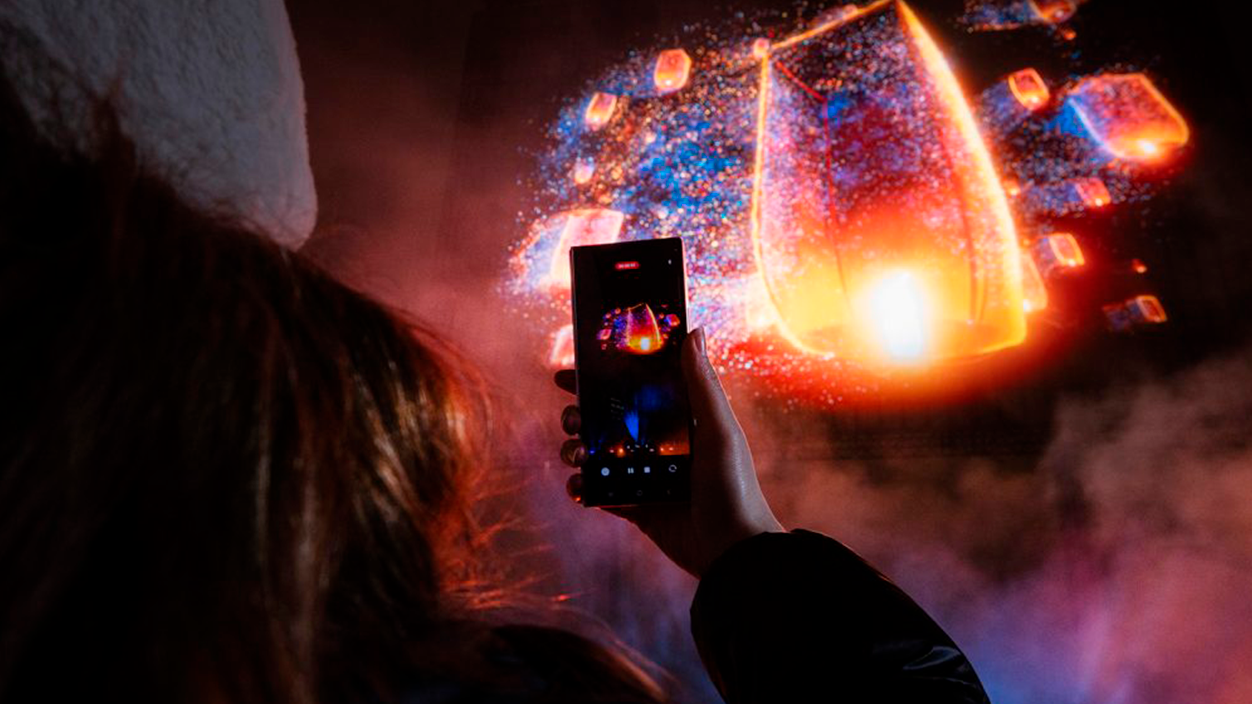
One of the most striking examples of this new holographic wave was the activation that Samsung carried out in London as a preview of the Galaxy Unpacked 2025 eventThe brand transformed several areas of the city, such as the Shoreditch neighborhood, into enormous luminous canvases thanks to live holographic projections combined with voice elements and artificial intelligence.
During that campaign, the following were installed: large format holographic displaysThe installation featured images approximately 20 meters wide by 15 meters high, positioned about 30 meters above the ground. These surfaces projected a wide variety of scenes that evoked everyday memories that anyone could capture with their mobile phone: vibrant underwater landscapes, exotic plants, iconic sporting moments, or a sky filled with floating lanterns. All of this was integrated into an immersive experience designed to attract attention from afar and, at the same time, hint at what was to come with Galaxy AI.
The brand's objective was to offer a window to the future of mobile experienceA much more intuitive, visual, and “magical” interaction, with new features that would debut in the next generation of the Galaxy S series. These live holographic projections not only physically transformed the cityscape, but were amplified through social media, where influencers and users shared videos and photos of the installation, increasing the campaign's global reach.
The activation combined immersive holographic projections and voice controlThis marked a significant step towards mobile experiences where the interface isn't limited to the smartphone's flat screen, but extends into the space around us. In this way, Samsung used the concept of holographic displays not only as a visual appeal, but as a preview of a Galaxy ecosystem where AI plays a leading role.
From science fiction to the living room: transparent televisions and the hologram effect
Beyond urban spectacles, Samsung is working on transparent screens that come very close to the sensation of a hologramAt the CES trade show in Las Vegas, one of the biggest showcases of technological innovation, the company presented its first transparent panels based on MicroLED technology, thus joining a trend that brands such as LG or Xiaomi had already experimented with.
Samsung showed three transparent MicroLED displays Barely a centimeter thick, these screens were capable of displaying superimposed images while perfectly revealing what was behind them. In the demonstrations, abstract scenes and brushstrokes of color were projected, seemingly floating in the air against a background of newspapers or decorative elements placed behind the panel. CES attendees were able to record videos, place their hands behind the screen, and experience the almost holographic effect firsthand.
The visual result, according to specialized media such as Engadget, feels much closer to a hologram than a conventional televisionThanks to the extremely high pixel density of MicroLED technology, these screens offer extraordinary sharpness, with deep blacks, high brightness, and highly accurate colors. Samsung has explained that it has been researching this type of transparent MicroLED panel for over six years, and for now, it has not revealed specific market launch dates or prices, although it is expected that, at least initially, they will be very exclusive and expensive products.
Meanwhile, other manufacturers like LG have presented their own proposals, such as the Signature OLED TA 77-inch transparent television based on OLED technology. This model includes an opaque film that can be raised or lowered: when raised, the screen behaves like a "normal" television with an opaque background; when lowered, the image appears to float above whatever is behind the panel. Although this solution isn't strictly a hologram, the sensation of viewing content suspended above the surroundings helps explain why these products are often described as having a "holographic effect."
In both the case of Samsung and LG, There are no confirmed prices or exact mass release dates yet.But the intention of both companies is clear: the luxury televisions of the future will not only boast inches, but also transparency, aesthetic integration into space, and visual experiences that increasingly resemble the holograms we saw in science fiction.
Samsung patents: mobile phones with holographic projection and screens in the air
While transparent TVs are taking shape, Samsung has also been registering patents related to holograms applied to smartphonesOne of the most interesting is associated with the Galaxy S family, initially linked to the Galaxy S11 Plus, although everything points to many of these ideas arriving later, in future generations such as the possible Galaxy S12 series and subsequent ones.
Those patents describe a mobile phone with full screen and no visible bordersWith completely rounded corners and an under-display front camera, without holes or a notch, it's a solution that other brands like Oppo and Xiaomi are already working on. But the most innovative aspect isn't just the phone itself, but an associated accessory: a "docking station" designed to display stereoscopic images and project what the documentation calls "aerial images."
This base would act as a advanced projector with holographic capabilitiesBy placing a smartphone in the device, the system can project images onto a wall, table, or other compatible surface, allowing users to view photos and videos in large format or deliver presentations in educational or corporate settings. Unlike a traditional projector, this system also allows for the projection of a virtual touchscreen surface that the user can interact with in mid-air.
The patent states that this The projected control surface would also be touch-sensitive.This would allow users to manage multimedia playback, advance slides, enlarge or reduce images, and generally control their mobile device without touching the physical screen, simply by interacting with the projection. If this concept materializes, it would open the door to some truly spectacular situations, such as controlling music by sliding a finger across a floating light panel or manipulating 3D models in a professional presentation.
For now, all of this remains a registered design and not a commercial productIt remains to be seen whether Samsung will decide to launch a dock of this type alongside a future generation of Galaxy S or Galaxy Note devices, or if these ideas will evolve into other formats. In any case, the direction is clear: to take the user experience beyond the physical screen to take advantage of the space around the device, with immersive projections and gesture controls.
Samsung Spatial Signage: Glasses-free 3D signage for commercial spaces
Samsung's leap into the holographic displays in the professional environment This is embodied in solutions such as Samsung Spatial Signage, a line of glasses-free 3D digital signage geared towards high-impact environments: retail, luxury, museums, entertainment, showrooms and corporate lobbies, among others.
Spatial Signage made a prominent appearance at the event Integrated Systems Europe (ISE) 2026 in Barcelonawhere Samsung announced its global launch. The first commercial model is an 85-inch screen with 4K UHD resolution (2.160 x 3.840) in a 9:16 aspect ratio. This "vertical" format is ideal for displaying products with 360-degree rotationsincluding front, rear and side views, something very attractive for shop windows in fashion, automotive, jewelry or technology.
The key to Spatial Signage lies in the patented 3D Plate technology Samsung's technology creates a sense of spatial depth behind the LCD panel. Content is displayed with the usual sharpness of a 2D image, but with the addition of natural 3D depth, making it much more visually appealing without the need for glasses or additional peripherals. This allows for promotions, exhibits, or key information to be highlighted far more effectively than with a traditional flat screen.
The 85-inch model integrates the Samsung's Quantum ProcessorThe processor handles 4K UHD upscaling, 16-bit color mapping, and dynamic HDR optimization. Thanks to this combination, the screen achieves a very high level of detail, smooth tonal transitions, and uniform color reproduction, even in highly complex scenes. It also includes an anti-glare panel to ensure visibility in environments with intense or challenging lighting, such as stores with large windows or spaces with direct spotlights.
In terms of design, Spatial Signage opts for a ultra-thin profile of only 52 mm It is 1.5 mm thick and weighs approximately 49 kg. It is compatible with the Slim Fit wall mount (sold separately), allowing it to be installed almost like a conventional signage display, avoiding the bulky showcases or structures that other 3D solutions typically require. This facilitates its integration into spaces where design is key and physical space cannot be sacrificed.
Samsung has confirmed that the The 85-inch model is now available globally And that additional 32-inch and 55-inch versions will be released later. This opens the door to glasses-free 3D applications in small shops, medium-sized museums, or spaces where such a large screen isn't needed, but a distinctive visual effect is essential to capture attention.
AI Studio and Samsung VXT: AI-powered 3D content creation
For a glasses-free 3D screen to make sense, it is essential to have content adapted to that formatThat's why, together with Spatial Signage, Samsung has introduced AI Studio, an AI-based content creation application integrated into the Samsung VXT platform.
Samsung VXT is a cloud-based digital signage system AI Studio unifies content creation, management, and remote control of screens and associated devices, all from a single CMS accessible from both computers and mobile devices. Based on this, AI Studio simplifies content production for all screens connected to the platform, including 3D signage.
The idea is that the user can take static images and transform them into videos ready for use in digital signagewithout relying on complex external tools or manual configuration processes. Furthermore, content generated with AI Studio automatically adapts to Spatial Signage, adjusting key aspects such as shadows, backgrounds, margins, and composition to achieve a more realistic and balanced 3D result, suitable for all types of commercial environments.
Samsung has indicated that AI Studio will be available. globally during the first half of 2026However, certain features may incur additional costs depending on usage or region. This approach reinforces the idea that the investment is not limited to hardware: for holographic or pseudo-holographic displays to take off, it is essential to have tools that facilitate the generation of engaging content optimized for this type of display.
The proposal has received recognition in the industry: Spatial Signage has been distinguished as CES 2026 Innovation Award Honoree in the Enterprise Tech categorySamsung was one of the first companies to receive an award in this category upon its launch. Furthermore, the same system had already received the IFA 2025 Innovation Award Honoree in the “Best in Emerging Tech” category, solidifying its position as one of the most promising professional 3D solutions on the market.
Other large-format displays: Micro RGB, The Wall and corporate solutions
Samsung's vision for the advanced displays in business environments It goes beyond Spatial Signage. At ISE 2026, the company also showcased for the first time to a professional audience the 130-inch Micro RGB signage (model QPHX), designed for the high-end corporate segment and the premium retail market.
This 130-inch screen uses microscopic RGB LEDs Combined with the Micro RGB AI Engine Pro, this allows for extremely vibrant color reproduction, very high contrast, and exceptional image quality. At the same time, it maintains an ultra-thin design, making it ideal for spaces such as flagship stores, luxury showrooms, or presentation rooms where visual impact is critical.
Another protagonist was The Wall All-in-One 108-inch (model MMF-A) with 2K resolutionThis solution is designed to significantly simplify the installation of large-format LED displays, reducing time and effort compared to traditional LED walls composed of multiple modules. According to Samsung's internal tests, depending on the size, installation can be completed in about two hours, representing a significant leap in efficiency.
The new 108-inch model incorporates a more compact design with split panelsTherefore, setting up this screen is almost as simple as installing two LCD screens, instead of a complex LED wall. This option is in addition to other existing sizes, such as 146 inches (4K and 2K), 136 inches (2K), and 110 inches (2K). Together, these allow companies to choose the configuration that best suits their needs and available space.
Along with the 105-inch QPDX-5K and 115-inch QHFX models, the addition of the 130-inch Micro RGB signage and The Wall All-in-One series gives Samsung a extremely wide range of large format displays for corporate useReception areas, boardrooms, auditoriums, control centers, and event spaces. This broad product range helps maintain the company's leadership, which has now been at the forefront of the global digital signage market (excluding consumer televisions) for 17 consecutive years, according to OMDIA data.
Collaboration and videoconferencing: integration with Cisco and Logitech
Samsung's expansion in the professional sector is reinforced by strategic alliances with companies like Cisco and Logitech, aimed at improving the experience in meeting rooms and collaborative spaces.
On one hand, the 115-inch 4K Smart Signage screens (model QHFX) and the 146-inch 2K The Wall All-in-One (model IAB) are positioned as Reference solutions for large-format work environmentsThese screens allow for the creation of immersive meeting rooms without visual interruptions, avoiding the complexity of installations based on video walls composed of several smaller monitors.
Both models have obtained the Cisco collaboration device compatibility certificationThis adds to the Samsung QMC family of displays that already held this certification. Furthermore, The Wall All-in-One is the world's first LED display to achieve this certification, underscoring its reliability and suitability for critical videoconferencing environments.
Cisco certification is based on a demanding testing program This test evaluates the stability of video interfaces, image quality for remote meetings, and the ability to manage displays from the Cisco Control Hub platform. This ensures that IT teams can securely and seamlessly integrate and manage these displays, while users enjoy higher-quality meetings with fewer technical complications.
On the other hand, thanks to a new collaboration with Logitech, the Samsung 4K Smart Signage QBC series becomes part of Microsoft Express Install for Microsoft Teams RoomsThis integration allows for faster and more cost-effective setup of meeting rooms, combining Samsung displays with Logitech videoconferencing systems certified for Teams Rooms. The goal is for the entire installation process to be completed in under an hour, reducing costs and deployment times for businesses of all sizes.
Ultra-thin holographic video prototypes: Samsung's laboratories' bet
In addition to products and solutions already on the market or in the launch phase, Samsung has Research teams dedicated to developing authentic holographic video displaysOne of the most remarkable advances has been published in the journal Nature Communications, which details a prototype of a thin holographic display based on a flat panel that can be viewed from multiple angles.
Until now, most existing holographic players were bulky devices with a very limited viewing angleThis made it difficult to use in everyday environments. The Samsung team claims to have overcome some of these limitations with a demonstration device about 25 cm tall that incorporates a backlight unit with a beam deflector. This deflector, constructed by sandwiching liquid crystal between glass plates, allows the light to be deflected in a prism-like manner, drastically increasing the viewing angle.
According to the tests carried out, this system Multiply the viewing angle by 30 Compared to a traditional holographic approach, it achieves a field of view of approximately 15 degrees at a distance of one meter. Furthermore, the design allows for extremely thin panels, with a thickness of only about 1 cm, perfectly aligning with the trend towards flat and lightweight displays.
The prototype integrates other essential components: a light modulator, a geometric lens, and a holographic video processor capable of performing on the order of 140.000 billion operations per second. To manage such a computational load, the team has developed an algorithm that, instead of relying solely on heavy mathematical operations, uses lookup tables that speed up the processing of holographic video data.
With this architecture, the demonstration device can display holographic video in 4K resolution at 30 frames per secondgenerating highly detailed three-dimensional scenes. The test videos show images of an underwater environment, with different objects and sea creatures that appear to float in front of the panel. The user can interact in real time with one of these elements, a turtle, using a keyboard connected to the system, demonstrating the potential for real-world interaction with holographic content.
Samsung's own researchers acknowledge that there is still much work to be done to achieve this type of display. reach mass consumer productsAmong the remaining challenges are further reducing the thickness and size of devices, improving algorithms to make them more efficient, and above all, adapting the current configuration to formats such as smartphones, where space and energy consumption are very limited.
Even so, the team is confident that these advances will translate into medium-term commercial applicationsFor example, there's talk of projected holographic keyboards, floating interactive menus, and touchless user interfaces based on finger gestures, voice control, eye tracking, or even brainwave recognition. All of this fits with the idea that, in the coming years, the way we interact with our devices will become less physical and more spatial.
Between advertising, corporate signage, entertainment, and future Galaxy phones with advanced projection docks, the feeling is that Samsung is building its own holographic universe piece by piece.We may not yet be able to have a conversation with a life-size hologram at home, but the first steps are already being taken: screens that resemble digital stained glass, 3D signs that capture attention from afar, holographic video prototypes, and a clear interest in contactless interfaces. If all these projects demonstrate anything, it's that holograms have ceased to be merely a cinematic device and are becoming one of the next great visual revolutions.

I am a technology enthusiast who has turned his "geek" interests into a profession. I have spent more than 10 years of my life using cutting-edge technology and tinkering with all kinds of programs out of pure curiosity. Now I have specialized in computer technology and video games. This is because for more than 5 years I have been writing for various websites on technology and video games, creating articles that seek to give you the information you need in a language that is understandable to everyone.
If you have any questions, my knowledge ranges from everything related to the Windows operating system as well as Android for mobile phones. And my commitment is to you, I am always willing to spend a few minutes and help you resolve any questions you may have in this internet world.