- Steam Replay 2025 is now available with a detailed report of your year of gaming.
- It includes hours played, achievements, platforms used, and comparisons with the community.
- The data covers the period from January 1st to December 14th and excludes offline matches or private games.
- The community spends little time on recent releases and focuses on veteran titles.

With the end of the year just around the corner, Steam has launched its now classic interactive summary: Steam Replay 2025. This tool Turn everything you've played over the last few months into numbers, from the hours invested to the genres that have been most repeated in your library.
In the style of summaries of Spotify, PlayStation or NintendoValve offers a very comprehensive visual report that allows Review your relationship with the platform without having to search through lists and librariesIt's a pretty straightforward way to check if you've really played as much as you thought... or if the backlog of games has won the battle yet again this year.
How to access Steam Replay 2025 and what time period it covers

Access to the report is pretty simple: enough with Go to the official Steam website or go to the store from the desktop client or mobile app and log in with your account. The main storefront usually A prominent Steam Replay banner will appearWith just one click, your personalized summary is generated in seconds.
The system It analyzes the activity recorded between January 1st and the last second of December 14th, 2025.Anything you play after that date will be excluded from this edition and will be added to the 2026 recap data. Valve sets that deadline to be able to process the figures in time before the holidays and the start of the winter sales.
It should be noted that The summary only includes the playtime recorded online. The offline sessions you have completedwhether by choice or due to network problems, they are not countedTitles you have marked as private in your library are also not shown, nor are tools or programs that are not considered games.
From Spain and the rest of Europe, access works in the same way: There are no regional restrictions. No special requirements. Only You need your usual Steam account and to have activity tracking enabled., something that is configured by default in most profiles.
What data does the Steam annual summary show?
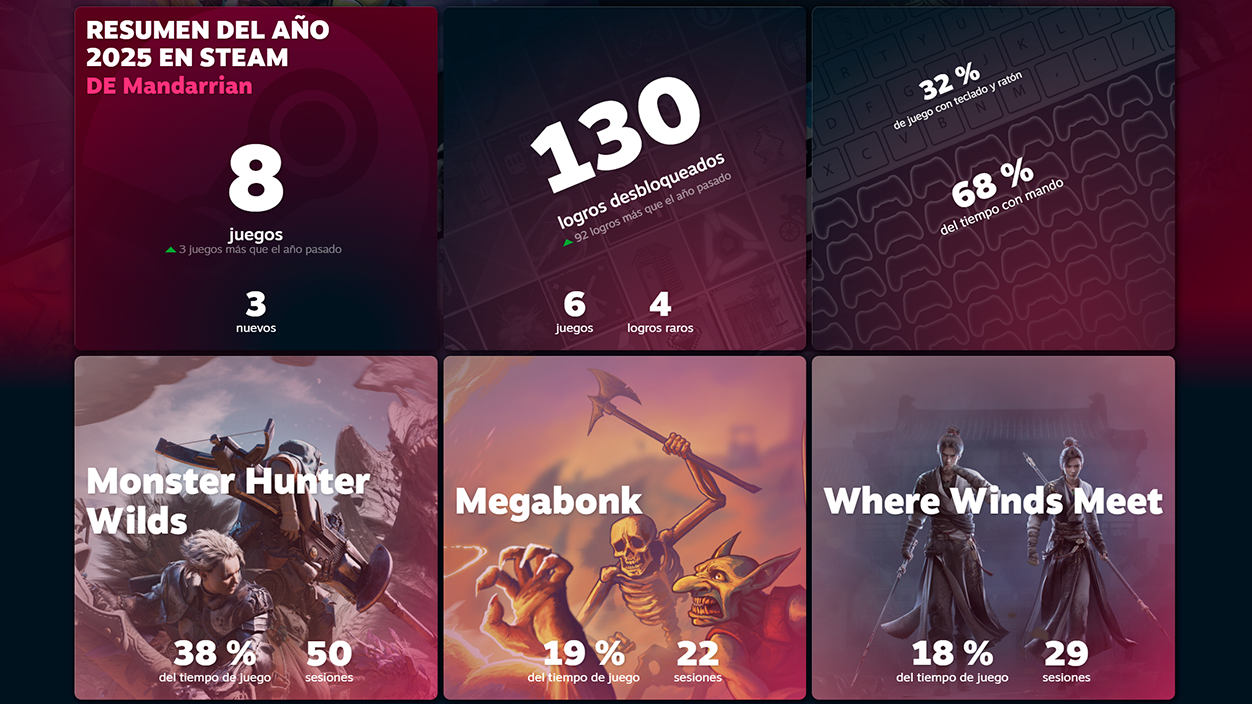
Once the replay is generated, you will encounter a extensive and highly visual infographic which breaks down virtually everything you've done on Steam during the year. At the top The total number of different games you have started is displayed.Whether they are full releases, early access, or demos you've only tried for a few minutes.
Along with that figure, the following are shown total hours played, achievements unlocked, and your three most played titles, showing the percentage of time spent on each. For many European users, this section often reveals striking data: It's not uncommon to find that a single game has taken up a huge portion of available time..
Another important section details the time allocation between keyboard and mouse versus controller useThis way you can see if your PC sessions are more like a classic computer experience or if you've been using a gamepad for action, sports, or platform games.
Also included is a Comparison to the Steam community averageThis helps put your habits into context. You can see if you try more games than the typical user, if you unlock more achievements than usual, or if you're someone who focuses on a few experiences but delves deeply into them.
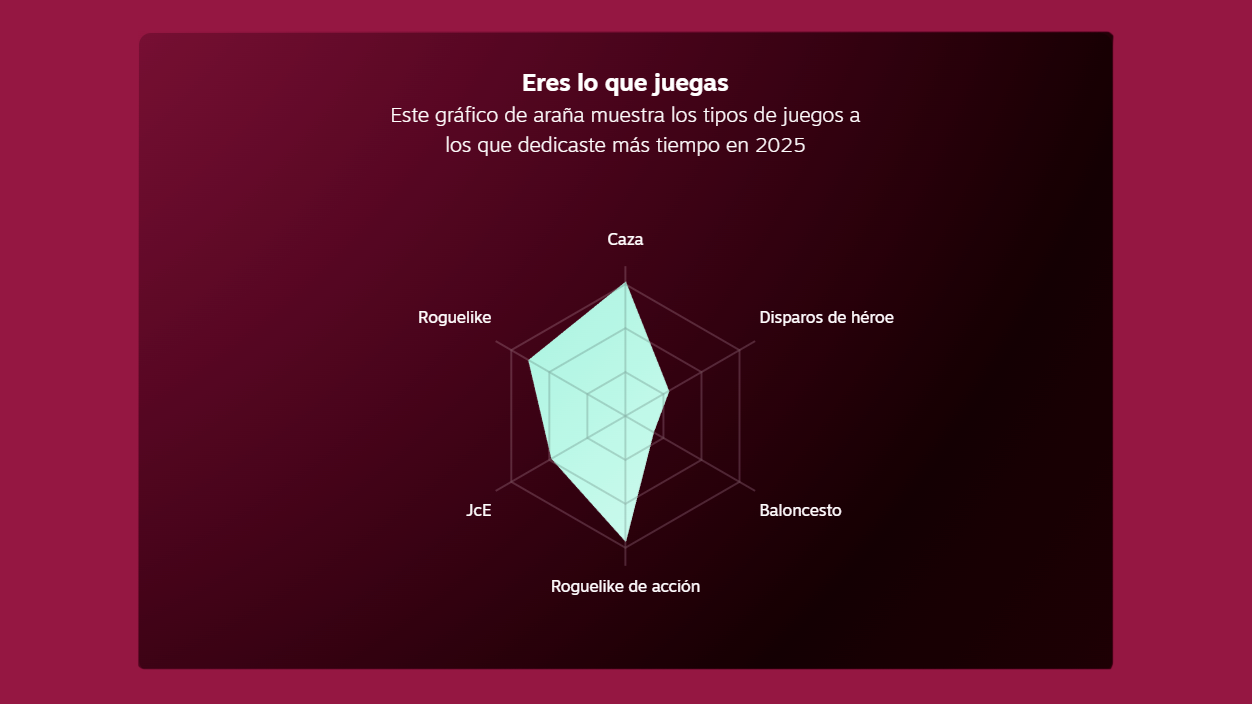
The summary places considerable emphasis on the genres that have hooked you the most, showing a graph with the types of games that have accumulated the most hours: strategy, action, role-playing, simulation, competitive multiplayer, etc. For many players it is a curious way to confirm tastes or discover that they have ended up dedicating the year to a genre that they were not so aware of..
Chronological view, monthly charts, and breakdown by platform
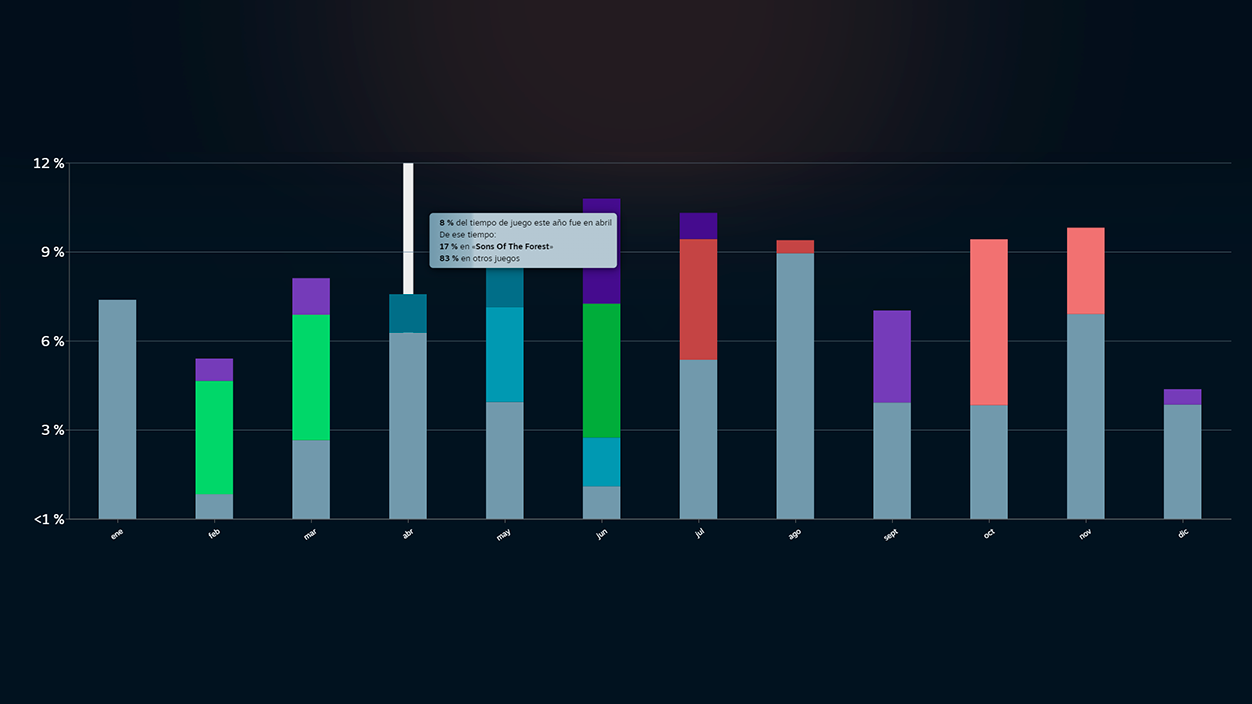
One of the most striking sections is the chronological view of the yearSteam organizes all the games you've played month by month into a calendar, indicating which titles were new to your account and which ones reappeared after a hiatus.
This part allows for easy location activity peaksMonths when you barely turned on your PC, or periods when you were completely absorbed in a single game. It's essentially an interactive diary: you see when you picked up that unfinished campaign again or when you got hooked on a particular multiplayer game.
In addition, Steam Replay offers monthly charts with playtime spread throughout the year. This makes it possible to detect periods such as summer holidays or Christmas holidays, when the playtime bars tend to increase significantly for a large portion of users in Europe.
The report also breaks down the activity by platform usedIn the case of PCs, the main operating systems (such as Windows) are differentiated, and for those who own Valve's laptop, a specific section is added for Steam deck with the number of games started, total sessions and percentage of hours on the go.
Finally, the tool classifies the titles into new, recent and classicThis way you can see what proportion of your time has been spent on 2025 releases, games from recent years, or titles that have been in the catalog for almost a decade (or more).
Limitations, privacy, and how to share the summary
When interpreting the data, it is important to remember some things. major limitationsSteam Replay does not take into account time played in offline mode, hours spent with titles marked as private, or tools or software that are not categorized as video games.
This means that if you are one of those who usually plays offlineThe summary is likely to be somewhat incomplete and not reflect all your actual activity. In such cases, some figures may seem strange, with fewer hours or sessions than you remember.
Regarding privacy, Valve allows you to adjust who can see your Steam ReplayWhen sharing it, you can decide whether to make it public, limit it to your Steam friends, or keep it completely private, using it only for personal reference without posting anything on social media.
The share button opens several options: copy a direct link to the summary, generate Images ready to upload to social media Or add Replay as a module to your public Steam profile. This way, other users can check your stats when they visit your page.
As an additional detail, the platform grants a specific 2025 badge simply by accessing the summary. This badge joins the usual ones that decorate the profile and serves as a reminder of having consulted the recap for that specific year.
Community behavior: many games in the catalog, few actually played
Beyond the individual data, Valve accompanies Steam Replay 2025 with some global community statisticsAmong them, it is noteworthy that a large part of the playtime is concentrated on veteran titles, especially in established multiplayer productions.
Steam players have dedicated around 40% of their time spent on games released eight years ago or moreA large part of that figure is explained by the continued popularity of games like DOTA 2, Counter-Strike 2, and PUBG: Battlegrounds, which continue to accumulate a huge user base worldwide, including in Europe.
The percentage of time spent on Releases from 2025 itself only hover around 14%.While the remaining 44% is divided between games released in the last seven years. In other words, most players prefer to stick with familiar or relatively recent titles rather than diving headfirst into new releases.
Another striking fact is the average number of games played per userwhich stands at just four titles throughout the year. This figure confirms a fairly widespread trend: although Steam libraries grow with sales, bundles, and promotions, ultimately only a few experiences are used extensively.
From a European perspective, where the PC has a notable presence In countries like Spain, Germany, or the Nordic countries, these patterns fit with a known reality: a community very loyal to certain benchmark games and a pace of adoption of new features which, with few exceptions, is more prudent than it might seem seeing the avalanche of launches.
A year full of releases… but with little visibility for many
The aggregated data accompanying Steam Replay 2025 also serves to highlight the enormous number of games that land in Valve's store each yearIn 2025, nearly 20.000 titles were published, a figure that maintains the upward trend of previous years.
However, a very significant part of those works goes virtually unnoticed. Thousands of games barely get more than ten reviews and several thousand don't even reach a single user review, indicating a very low level of visibility in the overall marketplace.
For many independent European studies, this reality presents a clear challenge: even with a carefully crafted product, stand out in such a saturated catalog It's extremely complicated. Steam offers recommendation systems based on tags, wishlists, and past behavior, but not all projects manage to get on that track.
Industry experts point out that if a game fails to achieve a minimum of traction in its first weeksWith a certain number of reviews and an initial sales base, it's very difficult for it to recover later on. At the same time, publishers are insisting on the The need to adjust budgets and expectations to prevent any outcome below massive success from being considered a failure.
In this context, Steam Replay data on the prevalence of veteran titles and the limited time dedicated to new releases reinforces a feeling shared by many developers: The competition isn't just the wave of releases this yearbut rather the back catalog of established games that They continue to monopolize the attention of millions of people.
Steam Replay 2025 has established itself as a useful tool to bring order to each user's game year And at the same time, it offers a fairly clear picture of how the PC gaming community behaves. Between hours accumulated on a few titles, recent releases struggling to gain traction, and a constant avalanche of new offerings, this yearly summary helps to to better understand what our screen time has really been doing.

I am a technology enthusiast who has turned his "geek" interests into a profession. I have spent more than 10 years of my life using cutting-edge technology and tinkering with all kinds of programs out of pure curiosity. Now I have specialized in computer technology and video games. This is because for more than 5 years I have been writing for various websites on technology and video games, creating articles that seek to give you the information you need in a language that is understandable to everyone.
If you have any questions, my knowledge ranges from everything related to the Windows operating system as well as Android for mobile phones. And my commitment is to you, I am always willing to spend a few minutes and help you resolve any questions you may have in this internet world.