- Google combines virtual fitting rooms in Shopping with a digital closet in Google Photos to try on your own clothes and clothes from stores.
- AI technology generates realistic images, but requires quality photos and does not guarantee exact size adjustments.
- Google promises high privacy control: the photos don't train models and you can delete them whenever you want.
- Adoption is still low, but engagement is high, which opens up a great space of opportunity for brands and startups.

La virtual clothing in Google Photos and Google Shopping Tools It's changing the way we choose what to wear, both for online shopping and for getting more out of the wardrobe we already have at home. Google has combined all its artificial intelligence, computer vision, and Shopping data to create Virtual fitting room experiences that go far beyond the typical clothing filter stuck on top.
This guide reviews in detail What exactly is Google launching?how it works try-on technologyWhat requirements do you need to meet to use it yourself or for your products to appear as likely in Shopping, what happens to your photos and your privacy, and also what implications all this has for brands, online stores and retail tech startups that want to ride this wave.
What Google is launching: virtual fitting rooms in Shopping and Google Photos
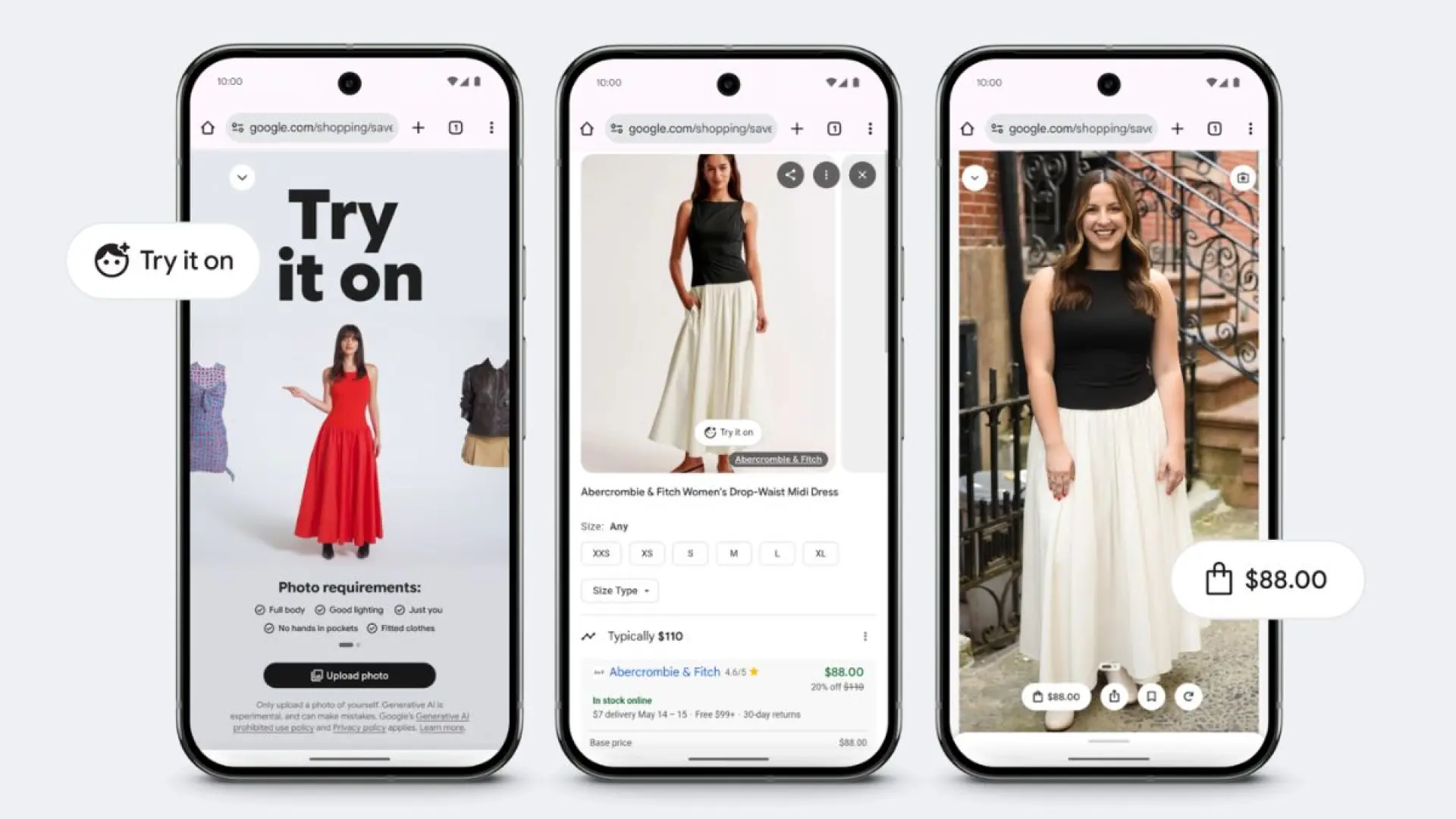
On one hand, Google has deployed a feature in its shopping products that allows try on billions of clothes simply by uploading a photo of yourselfThis experience is integrated into Google Shopping, Search results, and Google Images (see how Google's virtual fitting room works) and is designed to let you see how a garment fits your body before you hit the "buy" button.
The idea is simple: while browsing clothes on Google, you see a specific fitting room button on certain product listings. By clicking it, you can upload a picture of yourself or someone you have permission to upload. and let the AI generate a realistic version of how that garment would look on your figure, with folds, shadows, and fabric behavior that are quite faithful.
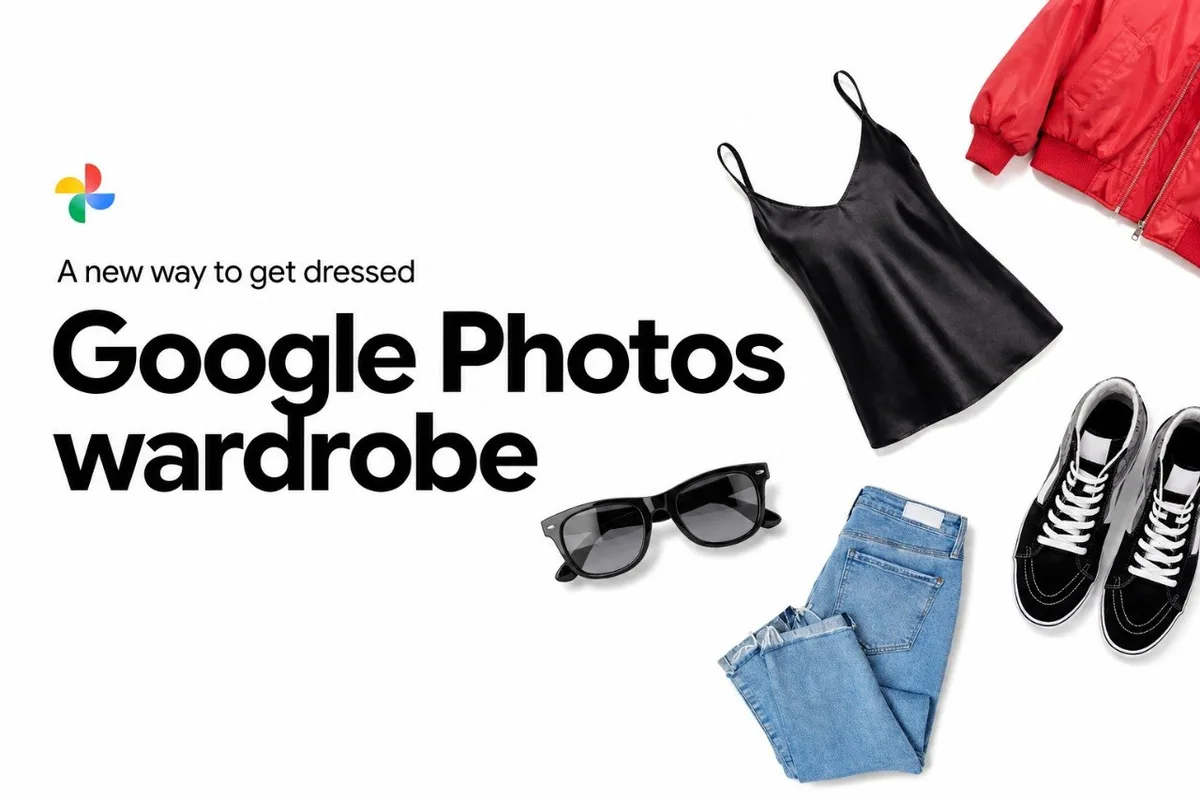
On the other hand, Google has begun to integrate a different experience into Google Photos: a A digital wardrobe is automatically built with the clothes shown in your photos.Using images from your gallery, the app identifies t-shirts, pants, dresses, and other garments, categorizes them, and lets you combine them to create outfits, save them, and share them without having to buy anything new.
In this second case, the AI doesn't focus on you buying, but on you experiment with clothes you already ownWhich pants go best with a certain shirt, how would a jacket you wore years ago look with new sneakers, etc. It's an interesting strategic shift: moving from "try before you buy" to "optimizing what you already have in your wardrobe."
Where is the clothing fitting room available and who can use it?
The virtual fitting room function linked to purchases is, for the moment, restricted to certain countries and users of legal ageIt's not something you can use everywhere in the world yet, and it also relies on certain Google account settings.
Currently, the photo-based clothing fitting room is available at Australia, Canada, the United States, India, Japan, and the United KingdomTo use it, you must be logged in with your Google account on both the mobile and desktop versions of Google Shopping, Search, and Google Images.
There are also age requirementsThis feature is only available to people who are at least 18 years old. Additionally, it's essential that the "Web & App Activity" and "Search Personalization" settings are enabled in your account, as the system uses this data to manage your experience.
It should also be clarified that this function does not apply to all types of clothing: Lingerie, swimwear, and accessories are not permitted. inside the virtual fitting room with your own photo. If you're looking for these types of items, you won't see the "Try On" button, even if the product is displayed in Shopping.
Additionally, the feature to test yourself with your photos It is not available in sponsored shopping ads.The tester button will not appear in the section labeled "Sponsored", although it may appear on the free listings for the same product that appears in organic results.
How to use Google's virtual fitting room with your photos
The workflow is fairly straightforward, but there are some important nuances if you want to get the most out of it. Basically, it consists of Search for clothes on Google, choose a suitable garment, and upload a suitable image. so that the AI can generate the assembly.
First, perform a clothing search on Google: it could be a top, a bottom, or a dress, for example, by typing "women's black t-shirt" or "wide-leg jeans." When you go to Shopping or see product results in Search or Images, Open the article that interests you.
If that product is enabled for a virtual try-on, you'll see the "Try On" button. If the button does not appear, that specific garment cannot be tried on that way.This could be because it doesn't meet the technical requirements or because it falls into excluded categories. There's no trick to it: in those cases, you have to find another similar part that does perform the function.
When you click "Try it", Google will ask you to upload a photo of yourself or of another person with whom you have explicit consentThe platform insists that you are responsible for having full permission to upload another person's image, and expressly prohibits creating montages with people who have not authorized this use.
Once the photo is uploaded and the image is generated, you will be able to save the result or share it Easily get feedback from others. For convenience, Google saves the original photo you uploaded so you don't have to repeat the process each time, although you can replace it with another or delete it from the tool at any time.
Photo requirements for the tester to work properly
The quality of the final image depends heavily on the photo you upload. Google details some clear guidelines to achieve the best possible result And if you skip them, it's quite likely that the garment will look deformed or unrealistic.
The photo must be yours or someone you have permission fromAnd no other people should appear in the frame. Ideally, it should be a full-body image, from head to toe, although selfies can also be used as long as they meet the other requirements.
It is very important that there be good lighting and a background that is as uncluttered as possibleBackgrounds with too many elements, strong shadows, or very harsh lighting can confuse the AI model and cause the generated garments to blend strangely with the environment or your body.
Regarding the pose, Google recommends Stand upright, with your hands visible and out of your pockets (consultation How to try on clothes with a poseThe clothes you wear in the photo should be relatively fitted, because overly loose garments can distort proportions and make it difficult for the AI to properly understand body volumes and contours.
Among the things to avoid, Google specifically mentions holding the mobile phone too close to the face or body When taking the photo, avoid sitting or crouching and shooting from a distance. All of this makes pose and measurement detection less accurate. Uploading photos of minors, even your own children, is also strictly prohibited.
AI models, possible errors, and the NanoBanana option

Google's virtual try-on technology relies on AI models capable of understanding the human body and the nuances of clothingFrom the way the fabric drapes to how it wrinkles or stretches when posture or body type changes. In the company's broader ecosystem, this capability is integrated with Gemini and the Shopping Graph.
In the United States, in addition to the standard workflow with a photo, an AI model called NanoBanana to generate a digital representation of yourself from a selfie. This kind of "avatar" allows you to virtually try on clothes without having to upload the same image every time, and can be selected from a module at the top of the fitting room summary screen (if you're interested in creating models, see How to create AI clothing models in CapCut).
When you generate this digital version, you can save it as the default image For future try-ons, the system will automatically use your information whenever you want to see how something looks on you. Google even lets you enter your usual clothing size during the process to improve the accuracy of the body shape.
Even so, the company itself acknowledges that the generated images may contain errors in body shape, personal features, or garment detailsFor example, a sleeve might look too short, a seam might not align properly, or certain shadows might not be entirely realistic.
If you detect discrepancies, Google encourages you to use the link from "Send feedback" which appears at the bottom of the tester. These reports are used to further refine the AI models and improve both visual quality and safety, as the system performs multiple checks to prevent problematic uses or harmful results.
What is the value of the generated image and how should it be interpreted?
The company insists that the images generated by the fitting room are a Visual estimate, not a guarantee of the actual resultIn other words, they help you get a reasonable idea of how a garment might fit, but they don't replace size information or the physical experience of trying it on.
Even if you see the article rendered on a model or over your own image, Size availability still depends on the retailerThe garment may appear in what seems to be your ideal size in the fitting room, but the store may only have one size larger or smaller in stock, and that's something the fitting room doesn't control.
That's why Google recommends always checking. the seller's standard size chart, reviews from other customers, and the detailed product description on the store page. The AI-powered fit is a powerful visual aid, but the final decision on which size to buy should be based on that additional information.
They also emphasize that It is an approximation, not a perfect reproduction. It doesn't replicate body shape or personal features. The goal is to guide you, not to be an exact copy of every curve or fabric texture. Even so, Google assures that it is continuously working to refine the experience and reduce errors.
If something doesn't fit—for example, errors keep appearing in the results even though your photo meets the guidelines—the recommendation is Try a different image or a different garment.Many of the issues are resolved simply by changing the visual font that the AI uses.
Privacy, security, and Google's use of photos
One of the most frequently asked questions is what Google does with the photos you upload of the fitting room. The company states that the images are used solely to generate the try-on assembly and that no biometric data is collected or stored during this specific experience.
Google declares that your photo It is not used to train AI models employees in the fitting room, and that is not shared with other products, services, or external partners. The images are processed in accordance with Google's general Privacy Policy and are protected by the company's security infrastructure.
To improve the quality of the experience, the results generated are evaluated, both from user comments as well as annotations made by specialized human reviewersHowever, the data these reviewers see is not directly linked to user accounts, and automated tools are used to remove sensitive personal information and various types of identifiers.
Regarding control, Google emphasizes that You decide what to do with the images you upload and those that are generated.You can save them to review later, share them with others, or delete them at any time from the try-on options or from your account's saved items.
If the photo you upload infringes the Google's generative AI security policies (For example, if it contains prohibited content), the system will ask you to replace it with another. And if you have problems unrelated to the image itself, you can always use Google's "Content Removal Requests" service to raise special cases.
Full control over your photos: how to delete them and what happens if they don't meet requirements
If your image doesn't fully conform to the guidelines, the try-on tool will still work but The results could be weak or unrealistic.Google makes it clear that it doesn't always block usage, but warns that the experience can worsen if you ignore recommendations regarding lighting, posture, or tight clothing.
When you want to delete the original photo you uploaded to try on clothes, you have to go to Camera icon located in the upper right corner From the fitting room, select the "Delete original photo" option. This erases the database on which future images were generated.
The images generated with the clothes you've tried on are saved in a "Recently Tested" tray which appears at the bottom of the interface. From there you can review history and delete any edits you no longer want to keep in your account.
Furthermore, it is possible Remove these contents also from the saved items section in your Google account. All of this is part of the same privacy control that the company promises: you choose what stays and what disappears.
If you simply cannot use this function with a specific garment—because the "Try On" button does not appear—the most common explanation is that That product does not meet the requirements for the tester.or that it belongs to an excluded category. In that case, Google recommends looking for a similar garment that is enabled.
Virtual fitting room with real models: sizes, brands and image requirements

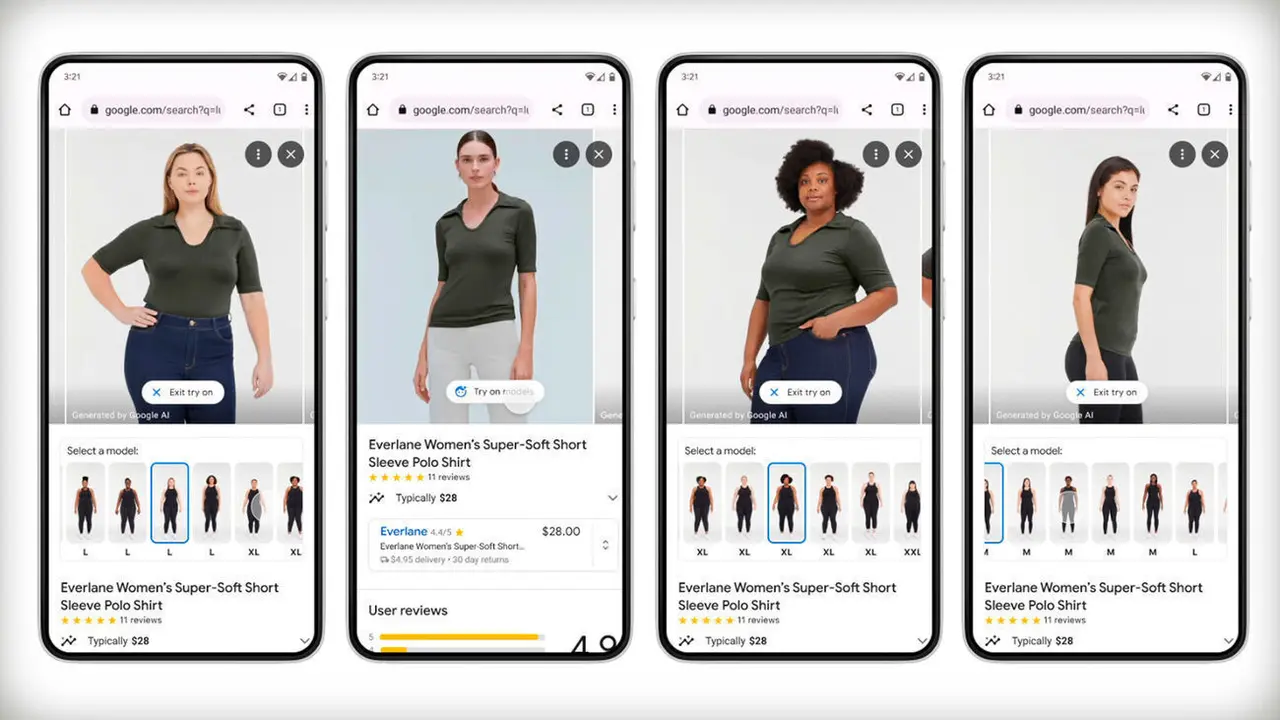
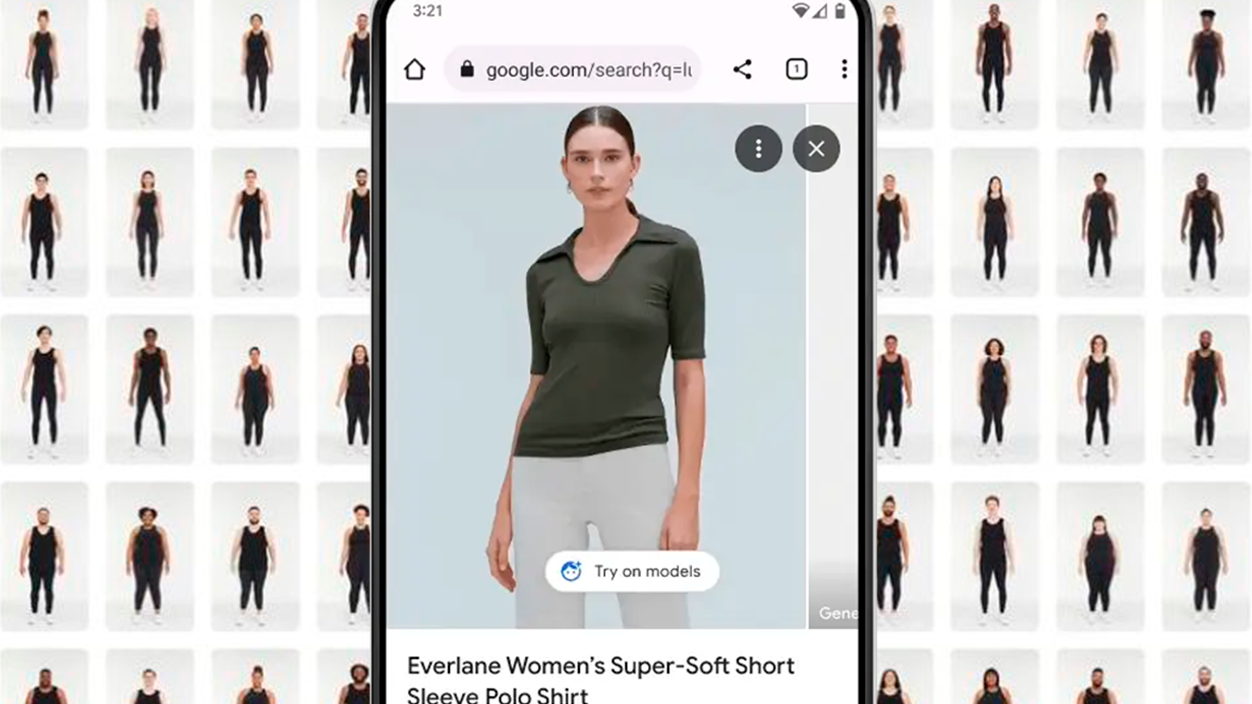
In addition to the try-on with your own photos, Google offers an experience of virtual test on real models of different sizes and body typesHere you don't upload your image, but you choose a model that resembles your physique within a range from XXS to XXXL.
Google's generative AI is responsible for simulate how the garment sits on that bodyThis functionality shows how the fabric stretches, how wrinkles and shadows form, and how the drape of the fabric changes depending on size and posture. It is available in both free listings and eligible shopping ads.
For a brand to participate in this tool without having to do anything extra, it is enough that Maintain an active shopping feed and provide high-quality product imagesGarments that meet the requirements may automatically appear with the virtual fitting room badge.
Specifically, the photos have to be high-resolution images, with a minimum of 512 x 512 pixelsHowever, Google recommends working from 1024 pixels to allow for more detail in the mock-ups. The garment should be shown on a model facing forward, on a mannequin in a simple pose, or placed horizontally on a surface.
Google also offers a range of Best practices to maximize the chances of your products being compatible: that the image only contains the garment in question, that it is seen in its entirety, that it is worn by a person or a mannequin (avoiding flat arrangements that may generate strange wrinkles), and that the model is facing forward, with arms down and without accessories covering key details.
Specific good practices for top garments
In the case of t-shirts, shirts, sweatshirts, and other upper garments, Google goes into a greater level of detail about how they should Present product images to the virtual try-onThe idea is to avoid any element that distorts how the piece actually fits.
First of all, the sleeves have to be completely unrolledArtificial hems or folds can confuse the AI model about the garment's actual length. Hoodies should be shown with the hood down so they don't cover part of the neck, back, or shoulders.
In the case of garments with zippers, the recommendation is that they be completely closedso that the intended fit is visible. It's also important that the top isn't tucked into trousers or skirts, as this would alter the perception of length and cut.
In addition, it is advised that the garment not present excessive folds or wrinkles in the original photo. Although AI can recreate folds when clothing adapts to the model's body, starting from an image full of unnecessary distortions complicates the task and can generate unnatural results.
Finally, Google asks that No key detail should be covered by hands, bags, or other accessories.If a pocket, a central print, or a relevant seam is covered, the algorithm has less information to work with, and the final appearance tends to be less accurate.
Virtual fitting room and paid shopping ads
All products that meet the virtual try-on requirements can also appear in paid shopping ad campaigns in Google Search. To do this, the basic requirement is to have the appropriate advertising campaigns set up from Merchant Center or Google Ads.
If you're an advertiser and have never launched shopping campaigns, Google recommends reviewing them first. documentation on standard shopping ads and on Maximum Performance, and verify that you comply with the general policies and conditions of participation.
An important nuance is that Disabling the tester feature on your ads does not prevent other merchants from viewing them. With equivalent products, you can display your own virtual trial in your listings. If you don't want your listings to include virtual trial assets, you can disable them by contacting Google Support through the Help Center or your Merchant Center account.
In any case, the presence of the virtual fitting room in advertisements is presented as a engagement and conversion leverListings that incorporate this feature in Google Shopping generate around 60% more user interaction, a significant figure that justifies the investment in quality images and technical integration.
What is Google Photos doing with virtual clothing and the digital wardrobe?
While the fitting room in Shopping focuses on helping you decide what to buy, the new feature in Google Photos points in another direction: transform your gallery into a smart digital wardrobeThe app analyzes your photos, detects clothing items, and generates an editable catalog of what you already own.
Using computer vision and advanced machine learning techniques, the system segments clothing within images, preserving material characteristics such as drape, elasticity, or fold patternsWith this information, create realistic representations that you can combine into new sets.
The rollout began at Search Labs on May 20, 2025, as an experiment focused on try on clothes before buying themWith its direct arrival in Google Photos, the focus expands: now it's also about experimenting with what you already have, creating outfits, saving them for later, and sharing results with your contacts.
All of this is also integrated with the Google Shopping GraphGoogle Photos is a massive database connecting billions of items from retailers worldwide. While Google Photos focuses on your wardrobe, the same technology allows you to, for example, find similar items to those you already own or suggest complementary purchases.
From a user experience perspective, the tool attempts to reduce friction: The results are generated in a matter of seconds. After uploading the photo, the interface for selecting and combining garments relies on fairly intuitive controls, requiring no technical knowledge.
The market context: competitors and actual adoption of the virtual try-on
Although it may seem like a radical novelty, the virtual fitting room ecosystem has been evolving for years. In fact, the market is much more competitive than it first appearswith large platforms and specialized startups fighting to carve out a niche.
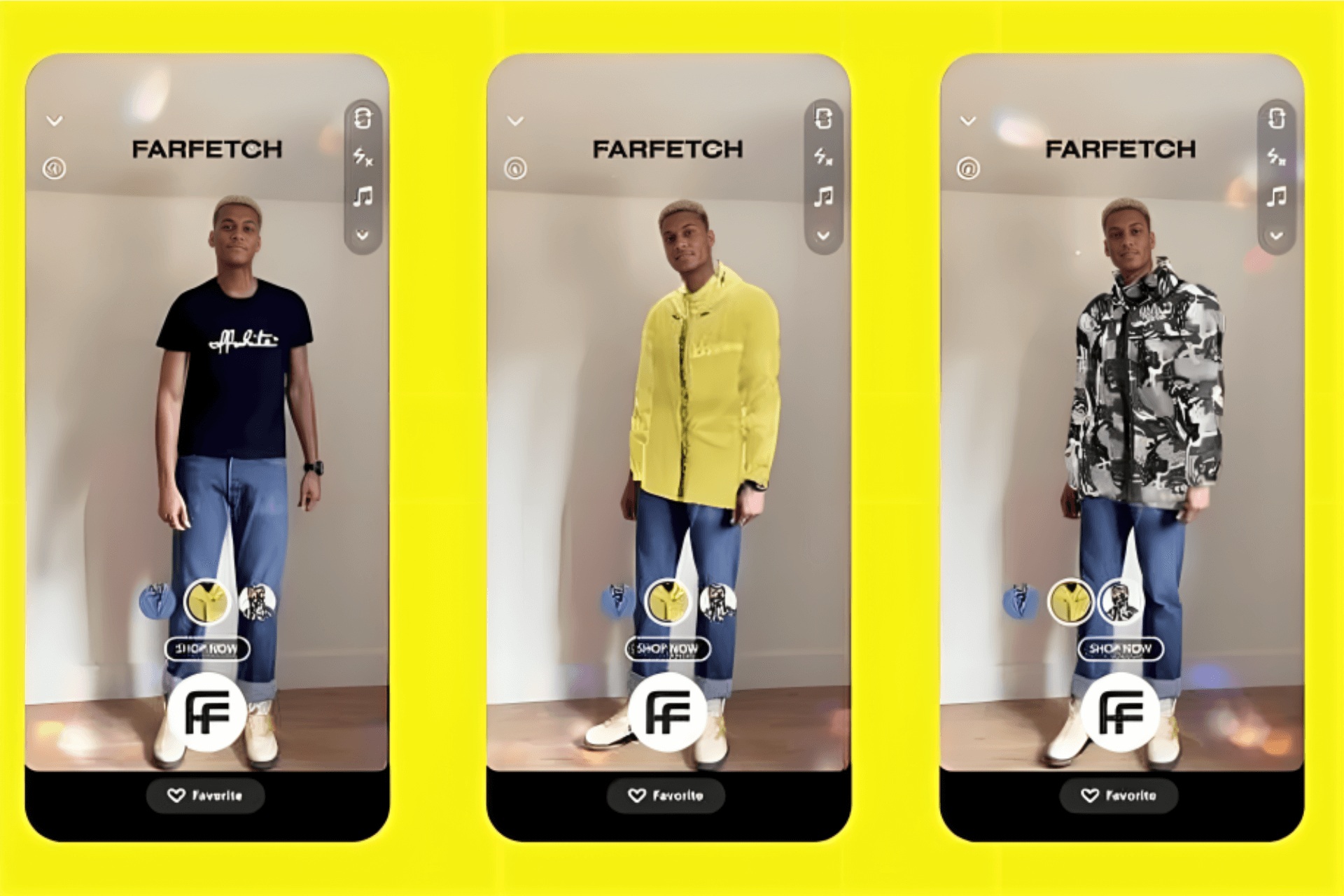
Snapchat is one of the leading examples: more than 250 million users have interacted with augmented reality glasses for shopping more than 5.000 billion times. In the beauty sector, for example, Ulta reported $6 million in incremental sales in just two weeks with a campaign based on this technology.
Pinterest offers makeup try-ons through its Lens tool, while Amazon decided in 2025 to close its physical "Try Before You Buy" program citing the emergence of AI tools, although it has not yet launched a complete alternative focused exclusively on clothing.
In the realm of pure fashion, ASOS presented its own solution in February 2026, supported by its AIUTA technology, and there is a whole range of B2B tools such as Genlook, Ayna, Veesual or CamClo3D that focus on integrating with ecommerce and platforms like Shopify to offer try-on as a service.
Despite all this effort, actual adoption figures are still modest: barely a 1,4% of online shoppers use virtual fitting room features todayHowever, where it is activated, the extra engagement—that 60% increase in Google Shopping—indicates that those who try it tend to value it, leaving the impression that there is enormous growth potential if frictions are reduced.
Implications for brands, online stores, and retail tech startups
For brands and retailers that sell clothing, what Google is doing sends several clear messages. First, that AI is no longer just a way to to drive new purchases and also become a tool to optimize what already existsThe case of the digital wardrobe in Google Photos is a good example: it doesn't so much seek to sell you another t-shirt, but to help you better combine the one you already have.
Secondly, the current low adoption rate of 1,4% indicates that The barrier to entry remains high for many usersRequesting specific photos, demanding particular poses, slow response times, or unrealistic results are all points of friction that hinder widespread adoption. This presents a clear opportunity for both Google and third-party providers.
The third big idea is that the increased engagement compensates for the effort: if an AI tool gets people to spend more time with your productsCompare sizes better and reduce returns; you have a strong argument to justify integration costs, both in B2B and B2C products.
For startups building solutions in retail tech, ecommerce, or any vertical where product visualization is key, it makes sense to do a internal audit of current functionalitiesIt may not be necessary to develop a fitting room from scratch, but it is necessary to integrate AI to show products in context, personalize outfits, or generate reference images.
Before developing your own technology, it is also wise to try existing APIs such as Genlook, Ayna or Veesual (or solutions like try on clothes with ClothMany providers offer startup plans that allow you to validate demand and measure return without a massive technical investment, which is very useful for deciding whether or not to build an in-house system later on.
Taken together, Google's move with virtual clothing in Photos and Shopping reflects that The virtual try-on is moving out of the niche phase and towards the mainstream.Those who are ahead in offering truly seamless, privacy-respecting, and visually compelling experiences will have an advantage when adoption moves beyond 1,4% and truly begins to take off.
All this setup, which combines try-ons on real models, mockups with your own photos, digital closets in Google Photos, and AI-based automated shopping agents, shows that The way we buy and use clothes online is entering a new stage: more visual, more personalized and, if done well, also more efficient for both users and brands.


I am a technology enthusiast who has turned his "geek" interests into a profession. I have spent more than 10 years of my life using cutting-edge technology and tinkering with all kinds of programs out of pure curiosity. Now I have specialized in computer technology and video games. This is because for more than 5 years I have been writing for various websites on technology and video games, creating articles that seek to give you the information you need in a language that is understandable to everyone.
If you have any questions, my knowledge ranges from everything related to the Windows operating system as well as Android for mobile phones. And my commitment is to you, I am always willing to spend a few minutes and help you resolve any questions you may have in this internet world.