- Anonymizing documents before using AI protects personal data, intellectual property, and competitive advantage, aligning the use of models with GDPR and the future AI Act.
- Effective anonymization goes far beyond simply erasing names: it requires dealing with direct and indirect identifiers, avoiding false "strikes" and clearly differentiating between pseudonymization and real anonymization.
- AI-based solutions combine automatic PII detection, advanced masking techniques, and human review, reducing the time spent cleaning contracts, files, and large volumes of documents by up to 80%.
- Labeling AI-generated content and establishing clear policies for its use, blocking trackers, and providing internal training allows AI to be leveraged transparently while minimizing legal and reputational risks.
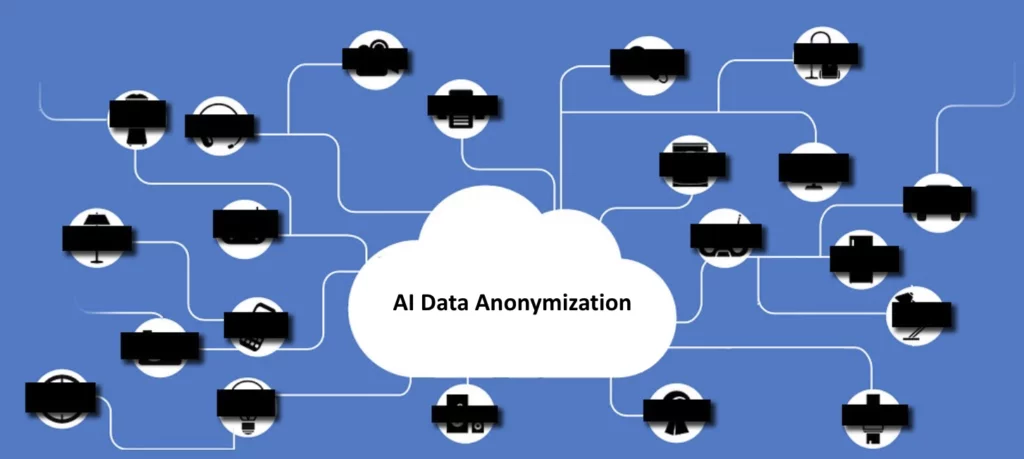
Uploading a contract, medical report, or business brief to ChatGPT without any editing, or simply copy and paste documents In a chatbot, this has become so commonplace that we sometimes don't even stop to think about what it implies. AI saves us hours of work, but every time we upload real documents to a model, we're teaching it snippets of our strategy, our customers, and, in many cases, our private lives. Therefore, in a context of GDPRLOPDGDD and the future European AI Act, anonymize documents It has become a very serious matter.
It's important to do this with our documents. before passing them on to an AI. This isn't some obsession of "privacy paranoids"; it's a business necessity, a matter of legal compliance, and a matter of pure competitive survival. Countless professionals copy and paste agreements, customer lists, purchase histories, or legal files into generative AI tools as if it were nothing. Then we're surprised when there's so much talk about leaks, training with third-party data, and loss of control over information.
Why it is critical to anonymize documents before using AI
The major AI platforms (OpenAI, Google, Anthropic, etc.) insist they don't use your data to train models on certain plans, but that doesn't mean there's no risk. Even if the provider promises not to store your information, The mere act of uploading documents containing personal data or internal know-how is already data processing that must comply with the GDPR. and it can expose your competitive advantage if not managed well.
En B2B and legal environments The problem is even more sensitive: contracts, minutes, lawsuits, reports, policies, internal HR documents, customer records… all of this includes names, ID numbers, addresses, emails, phone numbers, financial terms, and business strategies. If this information is uploaded as is to a public AI or a cloud-based model without safeguards, two issues arise: potential regulatory non-compliance and the leakage of critical information.
Proper anonymization allows working with AI without exposing real dataYou're still leveraging your document structure, negotiation style, contract templates, and customer service workflows, but you're disconnecting those texts from identifiable people and details that reveal your strategy. This is the difference between training an internal GPT (Global Practice Positioning) team for B2B sales using your proposal templates and uploading the entire PDF with client names, specific rates, and special conditions.
Besides, Proper anonymization fits perfectly with the GDPR and the upcoming AI ActThe GDPR makes it clear that properly anonymized data ceases to be personal data; it falls outside the scope of the regulation. The AI Act, for its part, encourages AI systems to use data minimization and anonymization techniques. It's not just about avoiding mistakes, but about demonstrating proactive diligence to clients, authorities, and partners.
Common mistakes when anonymizing documents (and why "XXX" is not enough)
One of the most frequent mistakes is thinking that anonymizing is equivalent to simply deleting names.Replacing “Juan Pérez” with “XXX” or “” is a step, but if you leave phrases like “the manager of the Seville branch who signed the agreement with Iberdrola in March 2023” in the text, anyone with context (and certainly a powerful model) can deduce who it is.
The problem isn't just the direct identifiers (name, ID number, email), but the set of elements that, combined, allow for re-identification: position, location, specific dates, key clients, highly unique projects, references to family members ("the mayor's brother"), etc. Anonymizing requires reviewing the entire context, not simply running a search and replace function on proper names.
Another mistake is hiding only personal data and leaving the business strategy exposedMany companies conceal customer names but keep billing models, special discounts, success clauses, and pricing structures visible. From a privacy standpoint, this might be acceptable, but from an intellectual property and competitive advantage perspective, you're giving away gold.
It is also common confusing “visually crossing out” with anonymizingPlacing a black box over a paragraph in a PDF, without actually removing the underlying text, is a false anonymization: often, simply copying and pasting is enough to reveal the original information. This kind of shoddy workaround has been seen far too often in public documents and can lead to serious exposure of personal or strategic data.
Finally, Many organizations stop at pseudonymization, thinking that it is sufficient.They change names to codes, but keep the key that links them in another table. Legally, that's still processing personal data. If you want the document to be exempt from the GDPR and shareable without restrictions, the anonymization must be irreversible according to the standard in Recital 26 of the regulation (not re-identifiable by reasonable means).
Impact on business, compliance, and risk management
When it is systematically anonymized with AI support, The benefits are noticeable on several levels.On the one hand, you gain enormous speed: you can prepare entire batches of documentation for training, due diligence, internal audits, data projects or collaboration with third parties without blocking the legal team for weeks.
On the other hand, It drastically reduces the rate of human error.The AI doesn't tire on page 42, doesn't skip a name in a footnote, and doesn't forget that Annex VII contained a list of telephone numbers. If the model is well-tuned, it detects patterns, tax identification number formats, postal addresses, emails, cross-references… and it does so just as well in the first document as in number 300.
All of this has a direct impact on regulatory and reputational riskThe Spanish Data Protection Agency imposes hundreds of fines each year for improper data processing; many stem from poor document management practices, data leaks, or inadequate anonymization. A robust anonymization process provides an extra layer of security and demonstrates due diligence should you ever need to explain to a regulator what you did to protect the information.
Besides, Automation opens the door to better responding to the rights of stakeholders. Under the GDPR (access, erasure, restriction of processing, etc.), when someone requests access to their file, it often involves reviewing a large amount of documentation that also includes third parties. If you have a tool capable of fast and reliable anonymization, deadlines are met more easily and with less stress for the teams involved.
Finally, from a corporate perspective, Well-implemented anonymization frees up data for innovationYou can train internal models, perform advanced analytics, test sales or compliance co-pilots, share cases with technology partners… all using context-rich but neutral documents in terms of personal or strategic identification.
Key technologies and techniques for anonymization with AI
Underlying these solutions are two major components: powerful language models and specific privacy techniquesLarge Language Models (LLMs) such as GPT-4, Llama 2, or specialized legal models understand natural language, detect entities, and maintain coherent text after deleting portions. Layers of rules, entity recognition (NER), and masking engines are then built on top of these models.
In practice, anonymization relies on several complementary techniques:
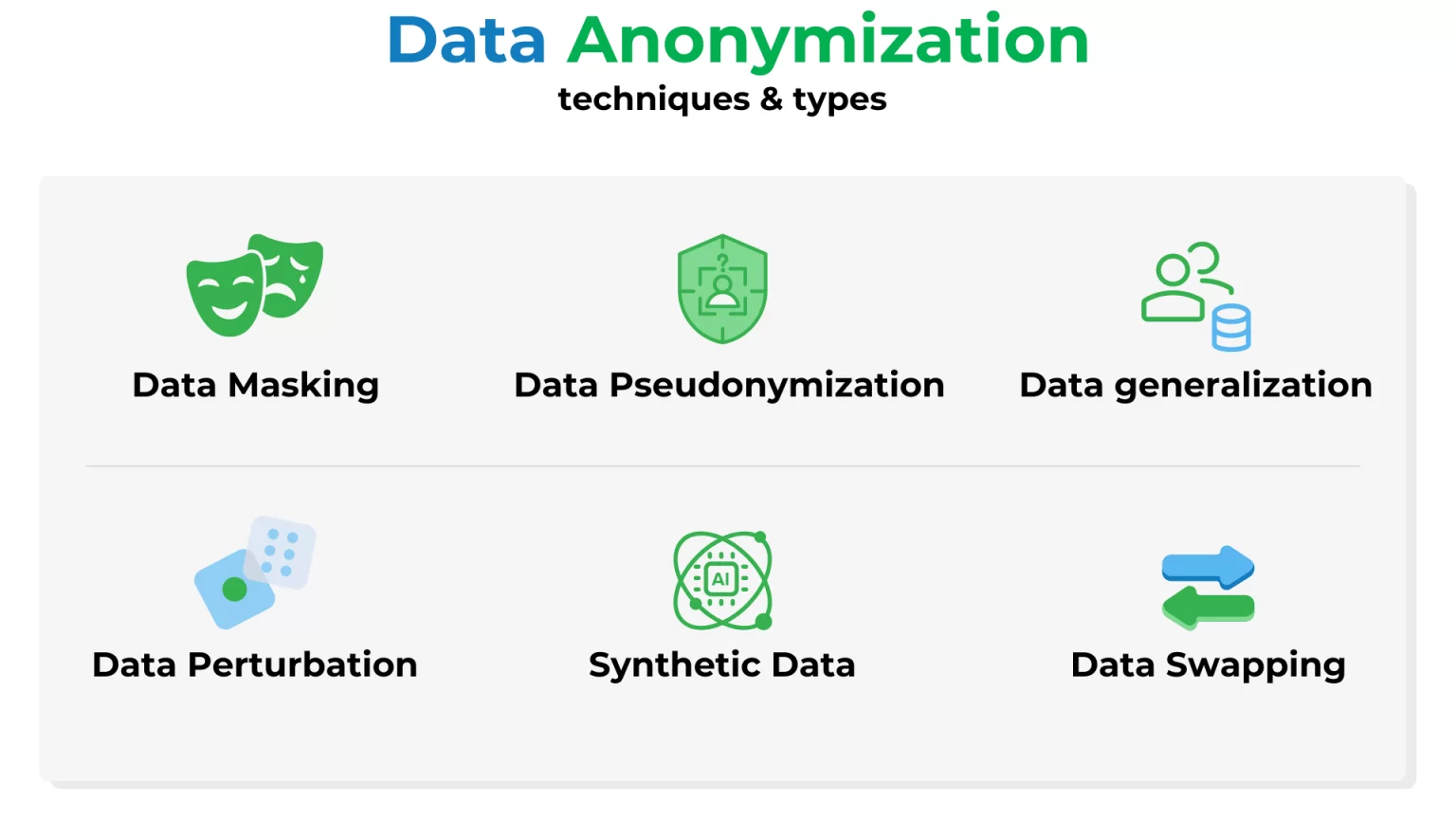
- Data masking: replace sensitive information with fictitious but consistent values (for example, change ID numbers for others with the same format, or replace a name with a code).
- Pseudonymization: replace direct identifiers with pseudonyms or codes, maintaining a separate equivalence table (useful when you need to re-identify within the organization).
- Generation of synthetic data: create artificial datasets that retain the statistical properties of the original, but without containing real records.
- Differential privacy: add mathematical noise to the data or results to prevent individual identification while preserving general patterns.
- Generalization and suppression: reduce the level of detail (exact age → age range, specific address → city) or completely eliminate certain high-risk attributes.
Alongside these techniques, there is a small “zoo” of professional anonymization toolsSome are highly geared towards data warehouses and Big Data environments (K2view, Privitar, ARX, Anonos, IBM InfoSphere Optim), while others focus on legal and textual documentation (Nymiz, Vincent AI, solutions like Maite or Legora, etc.). In all cases, the key lies in combining automation with custom business rules and human review.
In the field of legal texts, what works best today is a two-phase architectureFirst, automatic detection of PII (personally identifiable information) using NER models and patterns; second, controlled rewriting or masking with an LLM that respects the original structure. Microsoft Presidio is an example of a widely used detection component, which many solutions integrate to identify names, addresses, identifiers, cards, etc.
All of this only makes sense if it is deployed in a technically secure environmentMany law firms and companies opt for private clouds or dedicated instances (for example, Azure OpenAI with contractual guarantees against data reuse) or even on-premises models based on open-source LLMs (Llama 2, Mistral, etc.). The idea is to keep documents within the organization's controlled perimeter and prevent them from being mixed with other clients' data.
Legal framework: GDPR, pseudonymization, anonymization and AI Act
Legally, the use of AI for anonymization has Two major issues: how you handle the data during the process and what happens to the resultWhen you upload documents containing personal data to an AI platform, you are processing data subject to the GDPR. This means analyzing whether the provider acts as a data processor, signing the appropriate contractual clauses, and verifying where the data is stored (international transfers, sub-processors, etc.).
Many voices in the legal sector insist on Do not enter protected data into general consumer tools until there are clear guarantees. Some professional associations recommend using only solutions specifically designed for the legal sector, with data processing agreements, logs, access control, and, where possible, local deployments or deployments in European clouds.
Regarding the result, The main distinction is between pseudonymization and anonymization.The GDPR defines pseudonymization as reversible processing if you have the additional information (code table, keys). It's a good security measure, but the data remains personal. Anonymization, on the other hand, breaks the link irreversibly: if implemented correctly, the document is no longer considered personal data and falls outside the scope of the GDPR.
Recital 26 of the GDPR makes it clear that The key lies in re-identification “by reasonable means”It is not enough for it to be somewhat difficult; it must be impractical without a disproportionate effort. Hence, true anonymization is not limited to changing names, but rather involves neutralizing combinations of data that, when cross-referenced with other sources, could point to a specific person.
In parallel, the European Union is deploying the AI Regulation (AI Act)While it doesn't prohibit the use of AI for these tasks, it does require principles of transparency, data governance, and data minimization. Interestingly, many of the obligations for high-risk systems involve designing them to use pseudonymized or anonymized data whenever possible.
The AI Act also touches on the labeling of AI-generated contentIn contexts such as disinformation, political advertising, deepfakes, or synthetic content that could confuse the public, organizations will have to clearly indicate that AI is behind it. Furthermore, technical standards such as C2PA (Coalition for Content Provenance and Authenticity) and watermarking technologies like SynthID for images and videos are being promoted.
Tagging AI-generated content: what to tag and why
The regulatory trend is clear: Users need to know when they are dealing with content generated or manipulated by AI.The AI Act, along with the Digital Services Act (DSA), promotes obligations for platforms and large online services, but it is also becoming established as a good practice for companies and professionals who use AI in their daily work.
In practice, It is advisable to label any relevant content that has been created wholly or partially using AI.Especially if it can influence third-party decisions (reports, training materials, marketing materials, audiovisual content, etc.). We're not talking about correcting a single accent mark with Grammarly, but rather entire reports, creative assets, or videos generated from prompts.
For text, the simplest way is Indicate somewhere in the document something like "content generated with the help of AI"In images and videos, the ideal is to combine that visible mention (for example, in the description of a social media post) with technical metadata embedded using standards such as C2PA or Adobe Content Credentials.
The reason is not only to comply with Brussels: it is also a matter of trustCustomers, students, readers, and users have the right to know the degree of human intervention. And for companies, transparency reduces reputational risk if the origin of content is ever questioned or if deepfakes are misused.
The penalties for failing to meet these requirements can be significant for large platforms.But even for smaller organizations, it's easy to end up with blocked content, withdrawn campaigns, or regulatory warnings if it's deemed that the user is being misled about the nature of the material.
How to protect your data against “AI that tracks” the web
Beyond what you voluntarily upload to an AI, there is the problem of mass tracking of public contentMany models are trained using large amounts of text and images obtained through web crawlers. If you have a website, blog, or visual portfolio, it's quite likely that some of your material is already in the training datasets of a generative model.
To limit this, the following have emerged: specific exclusion mechanisms for AI botsJust as you do with Googlebot in the robots.txt file, you can block agents like GPTBot (OpenAI), Google-Extended (Gemini and Vertex AI), CCBot, Anthropic-ia, Cohere-ai, etc. This doesn't delete what's already been trained, but it can prevent future use.
Another line of defense is the privacy settings in services you already useAdobe, Google, OpenAI, Anthropic, and others offer exclusion options to prevent your interactions or files from being used to train new models. These aren't always enabled by default, so it's a good idea to carefully review each control panel.
In the world of image and audio, they are beginning to proliferate Tools to check if your works have been used in datasetsServices like “Have I Been Trained?” allow you to search for your visual work in well-known training collections and, in some cases, request to be excluded. It’s not perfect, but it puts some control in the hands of creators.
For businesses, all of this should be integrated into a responsible AI policyWhat is shared with which providers, what is blocked via robots.txt and firewalls, which channels are authorized to upload sensitive documents, which AI accounts are used (Free, Plus, Teams, Enterprise) and under what conditions. Employee training on this point is key; an impeccable policy is useless if the salesperson on duty keeps uploading customer lists to the first chatbot they find.
Practical strategies for anonymizing documents with AI without losing usefulness
When working with generalist models like ChatGPT, Gemini, or Claude, the trick is to "teach" them exactly what you expect.A good prompt can make the difference between a shoddy anonymization and a truly clean and usable document.
- Define the scope clearlyAsking for something like “anonymize this document” is too vague. Something like this (adapted to your case) makes much more sense: specify that all personal data of individuals (names, surnames, ID numbers, addresses, emails, phone numbers, registration numbers, dates of birth, etc.) be removed or replaced with bracketed labels, and that everything else remain unchanged.
- Provide legal or business contextClarifying that it is a Spanish employment contract, a criminal sentence, a civil opinion, a confidentiality agreement, a medical file, etc. and even mentioning reference standards (“complying with definitions of art. 4 GDPR”) makes the model take the task with a more rigorous bias.
- Break the task down into stepsYou can first ask the model to list all the personal data it detects, with a brief explanation of why it considers them sensitive. Once that list is validated, you request the final anonymized version. This double pass greatly increases reliability and, incidentally, serves as a review checklist.
- Set the output formatIt's advisable to explicitly tell them to return the entire text, respecting paragraphs, headings, bullet points, and numbering, and to only change what is strictly necessary. The more they act like an "editor" and less like a "creative writer," the less risk there is of them fabricating content or altering the legal meaning of the document.
Finally, However good the AI is, the closing should always be done by a human.A quick review looking for typical patterns (ID numbers, emails, phone numbers, names, postal codes, etc.), checking that no data remains in the file's metadata, and ensuring that the tags used do not provide any inappropriate information, is an essential part of the process. For audit purposes, it is also very useful to document the workflow (tool used, rules applied, date of anonymization).
The combination of technical anonymization, good organizational practices, and respect for the new transparency rules in AI-generated content It makes the difference between using artificial intelligence as a dangerous shortcut or as a solid strategic ally, both to comply with the law and to protect what makes each company unique: its information, its expertise, and its way of working.

Index
- 1 Why it is critical to anonymize documents before using AI
- 2 Common mistakes when anonymizing documents (and why "XXX" is not enough)
- 3 Impact on business, compliance, and risk management
- 4 Key technologies and techniques for anonymization with AI
- 5 Legal framework: GDPR, pseudonymization, anonymization and AI Act
- 6 Tagging AI-generated content: what to tag and why
- 7 How to protect your data against “AI that tracks” the web
- 8 Practical strategies for anonymizing documents with AI without losing usefulness

Editor specialized in technology and internet issues with more than ten years of experience in different digital media. I have worked as an editor and content creator for e-commerce, communication, online marketing and advertising companies. I have also written on economics, finance and other sectors websites. My work is also my passion. Now, through my articles in Tecnobits, I try to explore all the news and new opportunities that the world of technology offers us every day to improve our lives.