- SecurityHealthSystray.exe controls the Windows Security icon and alerts.
- It is not the process that analyzes files, nor is it the main engine of Microsoft Defender.
- The legitimate file is usually located in C:\Windows\System32.
- A valid Microsoft Authenticode signature is more reliable than checking the size.

If you have found SecurityHealthSystray.exe If it appears in Task Manager or among the applications that run when Windows starts, you usually have no reason to worry. It's a legitimate Microsoft component related to the Windows Security notification icon that appears in the system tray.
Its function is to display the overall status of your security and alert you when Windows detects a problem with your antivirus, firewall, account protection, or other security features. However, SecurityHealthSystray.exe It's not the antivirus engine. and it does not directly handle file analysis or threat removal.
The process usually starts when you log into your Windows account and uses very few resources. If it appears in an unusual location, doesn't have a valid signature, uses too much CPU, or displays an error such as "Bad Image," it's worth checking before attempting to remove or replace it.
What is SecurityHealthSystray.exe and what is it used for?
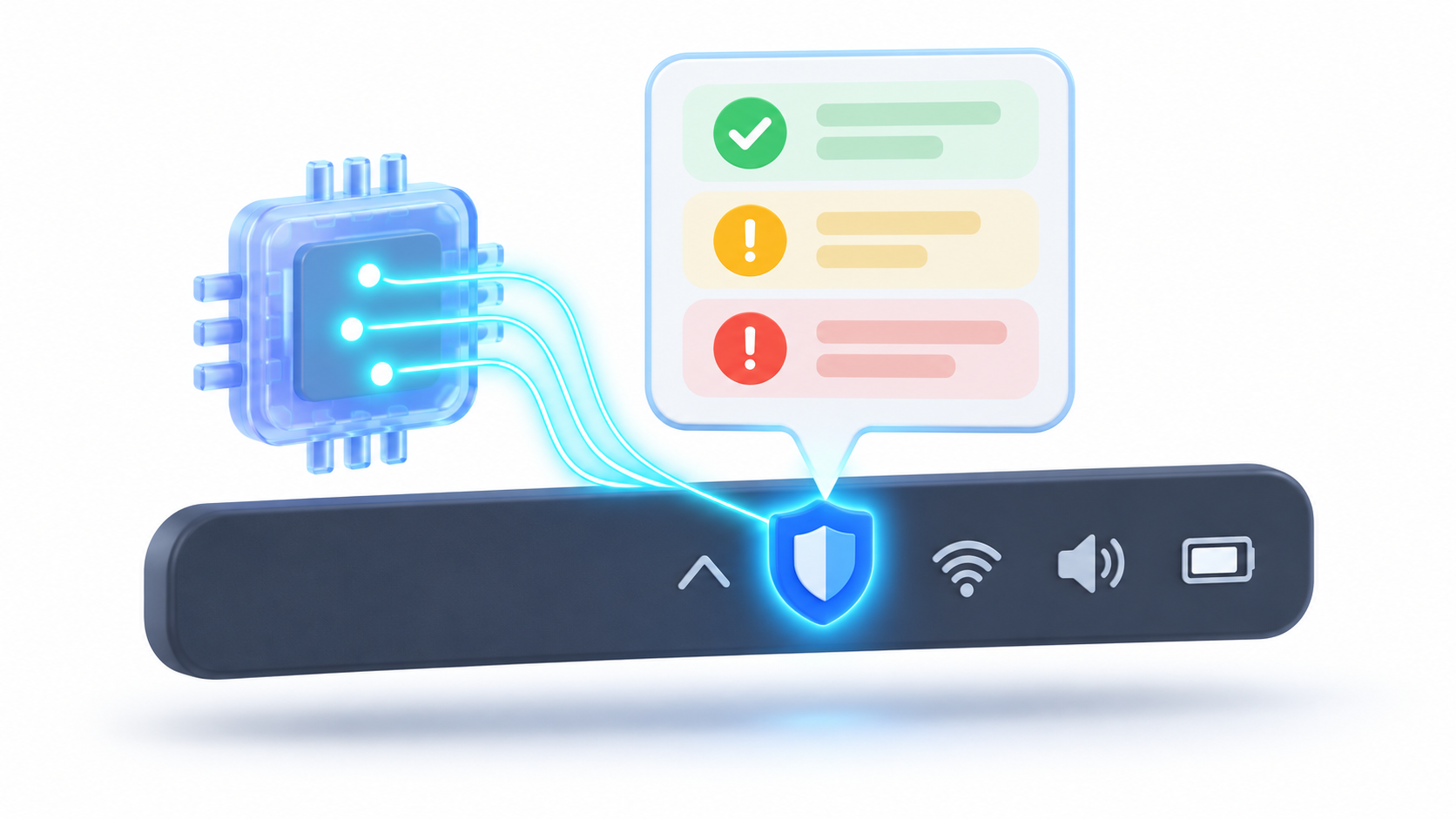
SecurityHealthSystray.exe is the executable that manages the Windows Security notification iconThis icon allows you to quickly check if the main protection areas are working correctly.
Depending on the equipment's status, it may display different indicators:
- Green checkmark: No problems requiring attention have been detected.
- Yellow alert: There is a recommendation, a deactivated function, or a pending action.
- Red indicator: A problem has been detected that may require immediate intervention.
Clicking the icon opens the Windows Security app, from which you can check antivirus protection, firewall, device security, application control, and other features.
The executable primarily acts as interface and notification systemEven if you close or disable it from startup applications, Microsoft Defender may continue protecting your computer in the background. What you might lose is quick access to the dashboard and the visibility of certain alerts.
Differences between SecurityHealthSystem, Windows Security, and Defender
Several processes and services are involved in protecting the system, but they do not all perform the same function:
| Component | Main function |
|---|---|
| SecurityHealthSystray.exe | Displays the Windows Security icon and alerts in the system tray. |
| Windows Security | It is the application from which the device's protection is viewed and configured. |
| SecurityHealthService.exe | Collects and communicates information on the status of the various security areas. |
| MsMpEng.exe | It is the main process of the Microsoft Defender Antivirus antimalware service. |
| SmartScreen | Check the reputation of potentially dangerous websites, downloads, and applications. |
For this reason, closing SecurityHealthSystray.exe does not mean the antivirus is disabled. Nor should you use the presence or absence of the icon as the sole proof that Microsoft Defender is running.

How to tell if SecurityHealthSystray.exe is genuine
The legitimate executable is usually found in this location:
C:\Windows\System32\SecurityHealthSystray.exe
You can check it from the Task Manager:
- Press Ctrl + Shift + Esc to open Task Manager.
- Go to the tab Details.
- Seeks SecurityHealthSystray.exe.
- Right click on the process and select Open file location.
- Check that it is inside C:\Windows\System32.
Location is an important indicator, but you should also check the digital signature:
- Right-click on SecurityHealthSystray.exe and open Properties.
- Go to the tab Digital signatures.
- Select the Microsoft logo and press Details.
- Verify that Windows indicates that the digital signature is correct.
You can also verify it from PowerShell:
Get-AuthenticodeSignature "$env:windir\System32\SecurityHealthSystray.exe" | Format-List Status, StatusMessage, SignerCertificate
The field Status should show ValidThe exact name of the signer may vary slightly between versions, but it must correspond to Microsoft and the certificate chain must be valid.
Why hash and size are not enough to verify it
The size of SecurityHealthSystray.exe can change after a Windows update, between different architectures, or depending on the installed build. Therefore, you shouldn't consider a file malicious simply because it doesn't have a specific size.
Something similar happens with its hash. You can calculate it using PowerShell:
Get-FileHash "$env:windir\System32\SecurityHealthSystray.exe"
However, the result only serves to identify that exact version of the file. There isn't a single hash valid for all Windows installations. To perform a comparison, you would need a reference corresponding to the same system version, architecture, and update.
For a home check, the most useful combination is:
- Location within System32.
- Valid Microsoft digital signature.
- No detections in Microsoft Defender.
- Behavior consistent with a notification icon.
Signs that it could be a malicious file

Malware creators may use names similar to those of known processes to try to avoid detection. The name SecurityHealthSystray.exe, by itself, does not guarantee that the file is legitimate.
You should investigate the process if you detect any of these situations:
- The file is located in AppData, Temp, Downloads, or a user folder.
- The name contains minor alterations, duplicate letters, or additional extensions.
- It does not have a digital signature or the signature appears as invalid.
- It runs from a location other than the one shown by the legitimate startup application.
- It maintains a high consumption of CPU, memory, disk or network.
- It opens windows, ads, or consoles without the user having performed any action.
- Microsoft Defender detects changes or suspicious behavior related to the file.
These signs alone do not confirm an infection, but they warrant further investigation. Do not manually delete the original System32 file, as this could corrupt Windows Security notifications.
How to analyze a suspicious SecurityHealthSystray.exe
If the location or signature is incorrect, first use the built-in Windows tools:
- Open Windows Security.
- Enter Protection against viruses and threats.
- Press Exam options.
- Run a full exam.
- If suspicions persist, use the Microsoft Defender offline scan.
The offline scan restarts the computer and analyzes the system before Windows fully loads, which can help detect threats that try to hide during a normal session.
You can also perform a second scan with a reputable anti-malware tool. Avoid downloading purported EXE or DLL file repairers from websites that claim to replace system components.
Is it possible to disable SecurityHealthSystray.exe?

Yes, it is possible to prevent the icon from loading when logging in, although it is not usually recommended because you will immediately stop seeing the overall protection status.
To deactivate it:
- Open the Task Manager.
- Enter Startup applications.
- Seeks Windows Security notification icon o Windows Security notification icon.
- Right-click and select Disable.
This hides the icon after logging back in, but You should not disable Microsoft Defender Antivirus, the firewall, or any other protection services..
To display it again, return to the same section and select EnableYou can also manage it from Settings, within Apps and Startup apps.
What to do if the Windows Security icon does not appear
If the shield has disappeared from the system tray, first check if it is hidden in the additional icons menu of the taskbar.
Next, follow these steps:
- Open Task Manager and go to Startup applications.
- Check that the Windows Security notification icon is enabled.
- Sign out and sign back in, or restart your computer.
- Manually open Windows Security and check if its sections load correctly.
- Install any pending Windows updates.
You can also try manually running the component by pressing Win + R and introducing:
%windir%\System32\SecurityHealthSystray.exe
If the icon only reappears after the next restart, the startup entry may be disabled or corrupted. Avoid creating manual entries in the Registry before repairing the application and system files.
How to fix SecurityHealthSystray.exe errors
If the executable does not start, closes, or displays an error message, apply the solutions from the least invasive to the most advanced.
1. Restart the process and the equipment
Open Task Manager, locate SecurityHealthSystray.exe, and end the task. Then, run it from its original location or restart your computer.
A full restart also allows you to finish installing updates that have replaced Windows Security components.
2. Check Windows Update
Enter Settings > Windows UpdateIt checks for updates and installs both pending patches and security platform updates available for the computer.
If the problem started immediately after updating, check the history to identify which package was installed, but do not uninstall security updates as a first measure.
3. Repair or reset Windows Security
Search for Windows Security in the Start menu, right-click it, and open its settings or application options. If your version of Windows offers these options, try them first. Fix.
The repair attempts to fix the app without erasing your data. If it doesn't work, use RestoreThen, restart your computer and check the icon.
As an advanced alternative, you can open PowerShell as administrator and run:
Get-AppxPackage Microsoft.SecHealthUI -AllUsers | Reset-AppxPackage
If PowerShell cannot find the package or returns an error, do not download a copy from third-party websites. Continue with the Windows component repair.
4. Repair the system image and files
Open Terminal or Command Prompt as administrator and run the following first:
DISM.exe /Online /Cleanup-Image /RestoreHealth
When DISM finishes, run:
sfc /scannow
Wait until both processes reach 100%, restart Windows, and check Windows Security again.
How to fix the Bad Image or 0xc000012f error

The message SecurityHealthSystray.exe – Bad Image This may refer to SecurityHealthSSO.dll or another component of the security platform. The code 0xc000012f usually indicates that Windows cannot properly load one of the required files.
Manually registering SecurityHealthSSO.dll with regsvr32This library is part of Windows-managed components and can be found within a versioned folder.
To fix this error:
- Install all pending updates and restart your computer.
- Repair or reset the Windows Security app.
- Run DISM and then SFC.
- Check if the error also appears in a new user account.
- Check the Reliability Monitor to locate when the failure started.
If the problem affects multiple accounts and persists after repairing the files, it may be necessary to perform a Windows repair reinstallation through an official image or through the recovery options available in the system.
What to do if it uses a lot of CPU or memory
SecurityHealthSystray.exe should use very few resources during normal operation. A brief spike when logging in or updating the security status is usually not a cause for concern.
If consumption remains high:
- Verify that the process is running from System32 and that its signature is valid.
- Finish the task and run it again.
- Open Windows Security and check for any pending warnings.
- Install Windows updates.
- Run a full Microsoft Defender scan.
- Repair the Windows Security app.
- Run DISM and SFC if the behavior continues.
If the file is located outside of System32 and also maintains high resource usage or unexpected network connections, treat it as a possible case of spoofing and perform an offline examination.
Frequently Asked Questions about SecurityHealthSystray.exe

Is SecurityHealthSystray.exe a virus?
The original file included with Windows is not a virus. However, a malicious program may use the same name. Check its location and digital signature to distinguish between them.
Where should the legitimate file be located?
Its normal location is C:\Windows\System32\SecurityHealthSystray.exeA copy executed from a user folder, Temp, or Downloads should be investigated.
Can I end the process?
Yes. Ending it normally only closes the icon and system tray notifications for the duration of the session. It is not the same as disabling the antivirus, although the process may restart.
Does disabling it at startup disable Microsoft Defender?
No. SecurityHealthSystray.exe is primarily a notification interface. Antivirus protection and other controls rely on different services and processes.
Why isn't the shield icon showing up?
It may be hidden, disabled as a startup application, or affected by a Windows Security vulnerability. First, check the taskbar and startup applications.
Should I check the file size?
The size can vary between versions and updates, so it's not a reliable test. It's more useful to check the location, the Authenticode signature, and the results of an antivirus scan.
Is it safe to download another copy from the internet?
No. System executables and DLLs must be recovered using Windows Update, DISM, SFC, or an official Windows repair. An external download might contain malware or belong to a different version.
SecurityHealthSystray.exe is a legitimate component that displays the Windows Security icon and alerts, but it does not perform antivirus protection itself. Its authentic file is typically located in System32 and has a valid Microsoft digital signature.
If the icon disappears or an error appears, start by checking your startup applications, updating Windows, and repairing Windows Security. Use DISM and SFC if you suspect corrupted files, and reserve a repair reinstall for cases where the previous solutions don't work.

I am a technology enthusiast who has turned his "geek" interests into a profession. I have spent more than 10 years of my life using cutting-edge technology and tinkering with all kinds of programs out of pure curiosity. Now I have specialized in computer technology and video games. This is because for more than 5 years I have been writing for various websites on technology and video games, creating articles that seek to give you the information you need in a language that is understandable to everyone.
If you have any questions, my knowledge ranges from everything related to the Windows operating system as well as Android for mobile phones. And my commitment is to you, I am always willing to spend a few minutes and help you resolve any questions you may have in this internet world.