- Google will completely shut down its dark web report in February 2026 after less than two years in operation.
- Scans will stop on January 15, 2026, and all service data will be deleted on February 16, 2026.
- The company will focus on integrated features such as Gmail, Security Checkup and Password Manager, with clearer and more actionable steps.
- In Europe and Spain, users will need to combine Google tools with external services and good cybersecurity practices.

Google has decided to put an end to its dark web report, one of the most discreet but relevant security functions for the protection of personal dataAfter being available to all users for less than two years, the company has announced that The service will cease operating in early 2026 and? All linked information will be deleted from their systems.
This withdrawal comes at a time when the data exposure in massive leaks And the number of underground forums continues to rise, also in Spain and the rest of Europe. Google's move doesn't mean it's abandoning the fight against these threats, but it does It changes the way users can check if their data has ended up on the dark web.
What exactly was the Google Dark Web Report?
The so-called Google Dark Web Report It was a feature first integrated into Google One and later into Google accounts in general, designed to alert the user when their personal information appeared in stolen and shared databases on the dark webThis environment, accessible only with special browsers, is frequently used for buying and selling of credentials, documents and sensitive data.
The tool analyzed leak repositories and underground markets looking for data such as email addresses, names, phone numbers, postal addresses or identification numbersWhen it found matches associated with the user's monitoring profile, it generated a report accessible from the Google account.
Over time, the service expanded: what started as a premium benefit of Google One It ended up being extended free of charge to all Google account holders in July 2024For many people, it became a kind of “control panel” regarding potential leaks related to your data.
In Europe, where the GDPR has strengthened both data protection and breach notification obligations for companies, this function It fit as a useful complement to monitor whether Spanish or European personal information ended up circulating outside of legitimate channels..
Key closing dates: January and February 2026
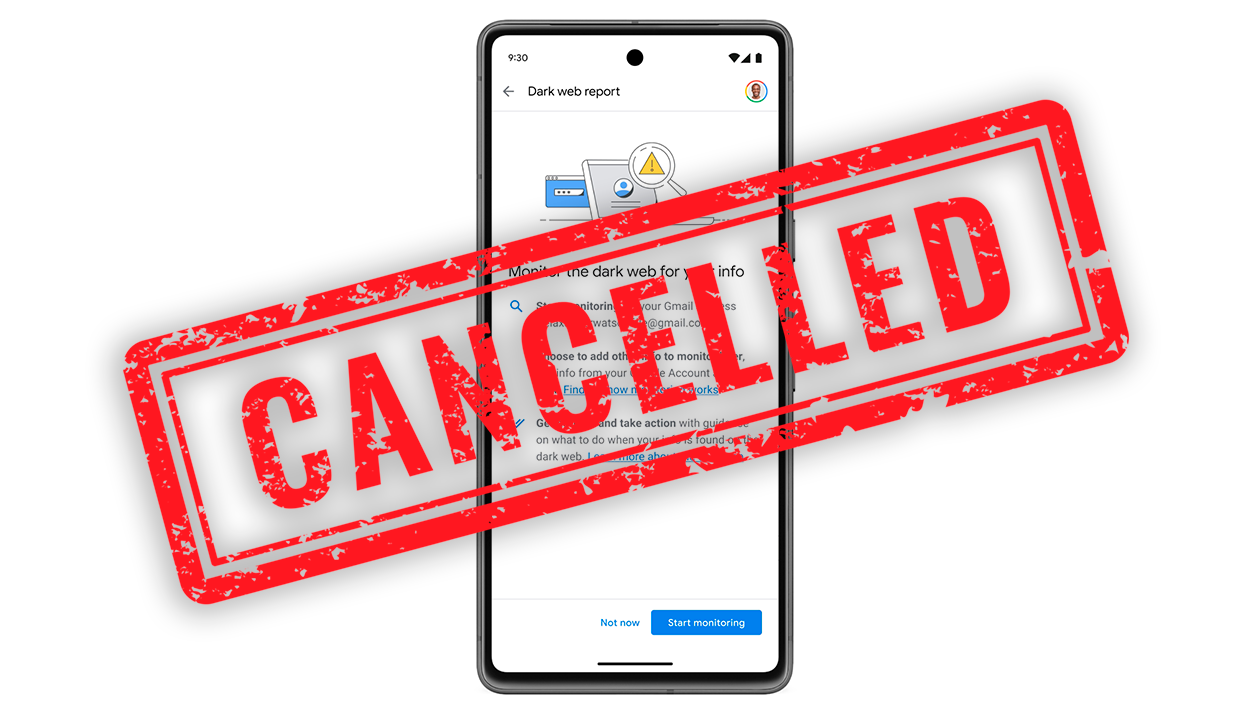
Google has set two very clear milestones for the shutdown of the Dark Web Reportwhich affect users in Spain, the European Union and the rest of the world equally:
- January 15, 2026The system will stop performing new scans on the dark web. From that point on, no further results will appear in the report, nor will any new alerts be sent.
- February 16, 2026The function will be completely deactivated and all data related to the report They will be deleted from Google accounts. On that day, the specific section of the dark web report will no longer be accessible.
Between those two dates, the report will only be available in a limited format. consultativeThe user will be able to review what has already been detected, but no new findings will be added. Google has also emphasized that all information associated with the service will be deleted on February 16, which is relevant in terms of Privacy and regulatory compliance in Europe.
Why is Google turning off Dark Web Report?
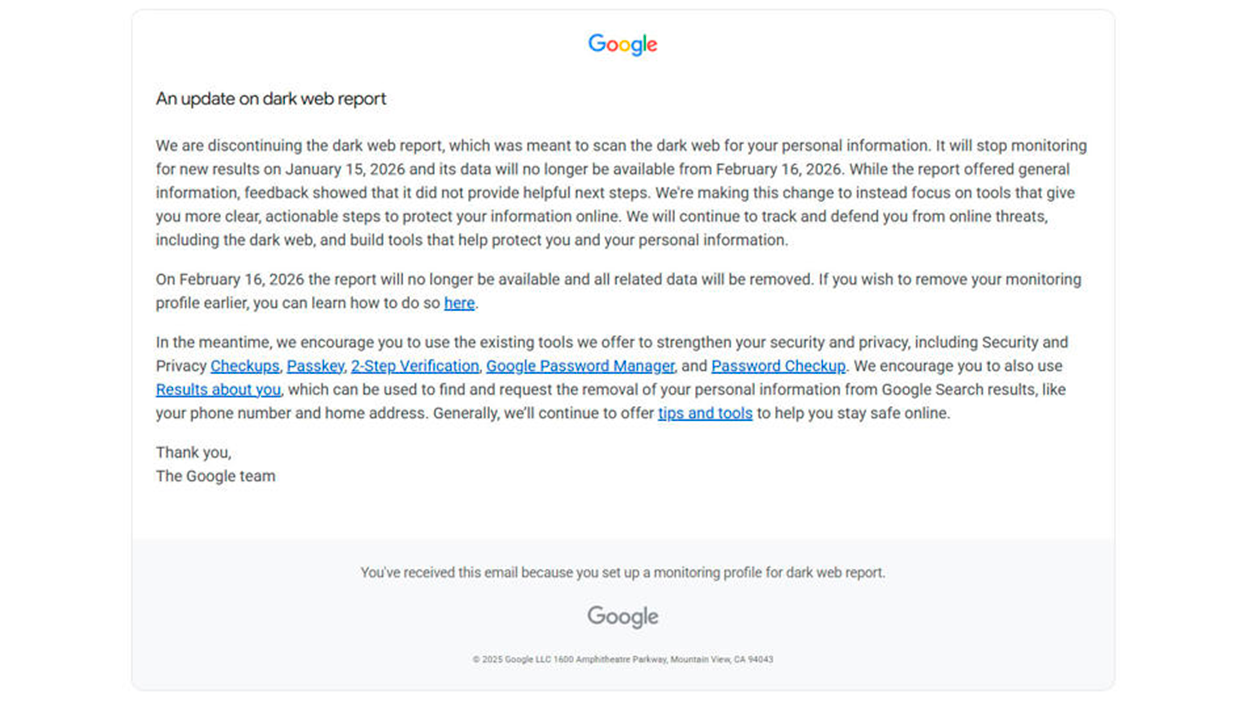
The company explained that the dark web report offered General information on data exposuresBut many users didn't know what to do with it. On its help page, Google acknowledges that the main criticism was the lack of “useful and clear next steps” after receiving an alert.
User experience confirms this: upon seeing their email or phone number appear in a data breach, most people were often confronted with a list of vulnerabilities. old, incomplete, or poorly explainedIn many cases, beyond changing passwords or enabling additional measures, there was no detailed guidance on which specific services to review or what procedures to initiate.
Google maintains that, instead of keeping a report that generated this feeling of "And now what?", prefers to focus on integrated tools that offer automatic defense and actionable recommendationsThe official message insists that it will continue to monitor threats, including the dark web, but it will do so "behind"to reinforce their security systems without maintaining this separate panel.
At the same time, Google itself acknowledges that many users They were not taking full advantage of the potential of the function, something that weighed heavily in the decision to withdraw it. Industry sources also point to the cost of maintaining tracking infrastructure on the dark web and the legal and technical complexity of operating these types of services on a global scale.
What will happen to the data and monitoring profiles?
One of the points that generates the most concern is the fate of the information gathered According to the Dark Web Report, Google has been adamant: when the service is retired on February 16, 2026, It will delete all data related to the report..
Until that time comes, users who wish to do so can delete your monitoring profile manuallyThe process, as detailed by Google in its help documentation, involves accessing the results section with your data, clicking on edit monitoring profile, and selecting the option to delete that profile.
This option may be particularly interesting for users in Spain and other European countries, where the concern for the digital footprint and the processing of personal data It is growingAlthough the service was already limited to security purposes, there are those who prefer not to keep more tracking or histories than necessary.
It's also advisable not to leave everything until the last day: if someone uses this report as a reference to check email addresses, aliases, phone numbers, or tax IDs, it might be a good time to download or note down the most relevant findings before the panel disappears.
What Google offers instead: more integrated security
El The end of the Dark Web Report does not mean that Google will abandon its users. in the face of data leaks; rather, it points to a shift in focus towards "default" and integrated protections in products already massive ones like Gmail, Chrome or the search engine itself.
In the emails and support pages announcing the closure, Google suggests several tools that are still active and which, in many cases, are already available to Spanish users at no additional cost:
- Security Checkup: reviews Google account security settings, detects suspicious logins, unrecognized devices, and excessive permissions granted to third-party apps.
- Google Password Manager: a password manager integrated into Chrome and Android that generates strong passwords and submits them to gap checksalerting when one has been leaked.
- Password Checkup: specific function to check if saved passwords have been compromised in leaked databases.
- Passkeys and two-step verification: strong authentication mechanisms that make unauthorized access difficult even if a password is leaked.
- Results about you: tool to locate and request the removal of personal data in search resultssuch as telephone numbers, postal addresses or emails, very much in line with the right to be forgotten in the EU.
In the specific case of GmailGoogle has already indicated that some of the logic from the old Dark Web Report will be integrated into its internal systems. threat detection and security alerts, without requiring the user to have a Google One subscription or actively consult reports.
Impact in Spain and Europe: privacy, GDPR and security culture
For users and businesses in Spain and the rest of the European Union, the end of the dark web report opens a small gap that will have to be filled with good practices and alternative solutionsAlthough the service was never a legal obligation or a market standard, it did act as an interesting complement to the protection framework offered by the GDPR.
In practice, monitoring the dark web will remain key for banks, insurers, e-commerce businesses, and technology startups that manage sensitive data of European customers. The difference is that they will no longer be able to rely on this Google tool as single alert channel at the end-user level.
From a regulatory perspective, Google's commitment to delete data associated with the report It complies with the minimization and limitation of the storage period required by European regulations. However, it obliges those who relied on this panel to review your own incident response policies and the way they inform their customers or employees.
In a context where notifications of breaches by large platforms, public services, and private companies are becoming increasingly frequent, the disappearance of this tool reinforces the idea that true protection lies in combining automation with an established safety culture in organizations and users.
Alternatives for monitoring the dark web and your data
Although the closure of Google Dark Web Report leaves a symbolic void, it does not mean that Spanish or European citizens will be left without ways to check if their data is circulating on clandestine forums. There are several external tools that cover part of that function, with different levels of detail and costs.
Among the most cited options They are found:
- Have I Been Pwned: one of the oldest services for quickly check if an email It appears in filtered databases. It allows you to configure alerts and check which specific breaches a given address has been involved in.
- Mozilla Monitor (formerly Firefox Monitor): a free tool that offers email scans and suggestions for steps to take when it detects leaks associated with an account, with a pedagogical approach designed for non-expert users.
- Password managers with data breach scanning, such as 1Password and other similar services, which include a component of dark web monitoring within their payment plans.
In the business sector, especially for European SMEs and startups, there are also SaaS solutions that combine surveillance of stolen credentials, monitoring of brand mentions on the dark web and incident management dashboards. The level of depth and coverage is usually greater, but at the cost of specific subscriptions and a certain complexity of integration.
Even with all these options, it's still difficult to locate. all the personal information that has been leaked over the years. Once sensitive data is exposed online, completely removing it is very difficult, hence the need to focus efforts on limit its reuse and tighten access.
Best practices following the end of the dark web report
The disappearance of Google's report is a reminder that no user or company should rely on it. a single tool to manage your digital security. Especially in Spain and Europe, where the level of digitalization is high, it makes sense to adopt a broader approach.
Some basic measurements The following areas should be reinforced:
- Periodically review account securityUse Google Security Checkup, review app permissions, close old sessions, and check which devices have access.
- Implement multi-factor authentication (2FA) or, where possible, passkeys on critical services (email, online banking, social networks, work tools).
- Avoid password reuse and rely on key managers to generate robust and unique combinations per service.
- Provide basic training in cybersecurity in companies, especially startups and SMEs that handle customer data, to reduce the risks of phishing, malware and credential theft.
- Activate alerts for unusual activity in banks, payment services and critical platforms, so that any unusual use of financial data is detected as soon as possible.
For those who have used the Dark Web Report extensively, it may be useful to dedicate some time, before its final closure, to review the notifications received and ensure that all affected passwords have been changed, older accounts have been closed, and strong authentication is enabled on the most sensitive services.
The end of the Google Dark Web Report doesn't eliminate the risk of our data ending up circulating on underground markets, but it does mark a change in how we deal with it: from now on, protection will depend more on the defenses integrated into the platforms that we use daily, combining different monitoring tools and, above all, maintaining consistent security habits both individually and within companies and organizations in Spain and the rest of Europe.

I am a technology enthusiast who has turned his "geek" interests into a profession. I have spent more than 10 years of my life using cutting-edge technology and tinkering with all kinds of programs out of pure curiosity. Now I have specialized in computer technology and video games. This is because for more than 5 years I have been writing for various websites on technology and video games, creating articles that seek to give you the information you need in a language that is understandable to everyone.
If you have any questions, my knowledge ranges from everything related to the Windows operating system as well as Android for mobile phones. And my commitment is to you, I am always willing to spend a few minutes and help you resolve any questions you may have in this internet world.