- GRU Space plans to open an inflatable hotel on the Moon around 2032, with an initial capacity for four guests.
- Applications and deposits of between $250.000 and $1.000.000 are now being accepted, in addition to a non-refundable fee of $1.000.
- The technical plan is based on inflatable habitats and converting lunar regolith into bricks using geopolymers.
- Luxury tourism is envisioned as an engine to finance a future lunar economy and broader infrastructure.

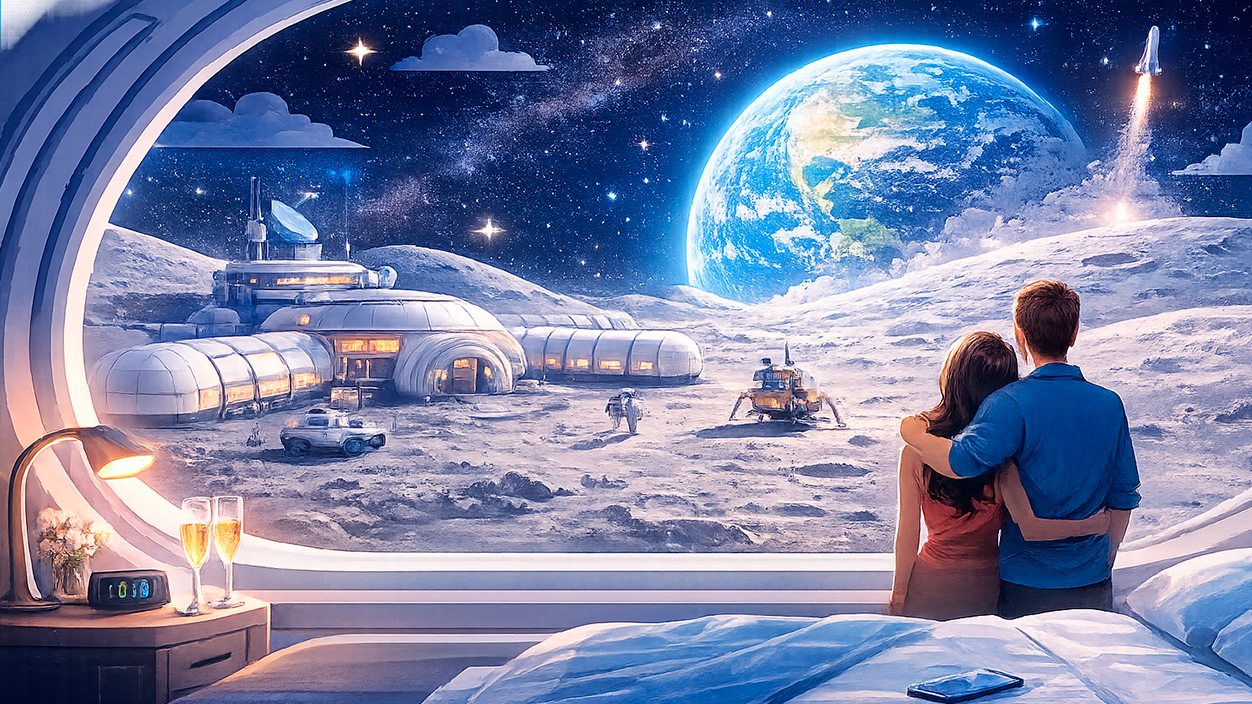
Looking at Earth from a window on the lunar surface is no longer just the plot of a science fiction novel. A young American company, GRU Space, has launched a plan to build a hotel on the Moon and begin testing whether luxury tourism can serve as the initial spark for a future off-planet economy.
For now There are no rooms available and no firm date set for the first tour trip., but Yes, there is a commercial structure in place.The company has opened a early access program which allows you to apply for a place And, if accepted, a deposit to secure a spot on the first missions. The project combines a high degree of ambition, a timeline riddled with conditions, and many technical and regulatory unknowns to resolve.
Who is behind the hotel on the moon and what are their intentions?
GRU Space stands for Galactic Resource UtilizationA California-based startup founded by Skyler Chan, an engineer trained at the University of California, Berkeley. Chan, who is in his early twenties, developed the idea within accelerators such as Y Combinator and Nvidia's Inception programand claims to already have capital from investors linked to SpaceX Anduril defense firm already.
The company presents itself as a private player that wants to go beyond simple space transportation. In its vision, companies like SpaceX or Blue Origin will be the "FedEx" that takes people and cargo to lunar orbit and the surfaceGRU Space, meanwhile, aims to provide the destination: habitats, hotels and, later, stable infrastructure on the Moon and, in the distant future, on Mars.
According to the company's public documents, the hotel would be the first accommodation structure for tourist use on the surface of another celestial body. It is not intended as a government-run scientific base, but as commercial accommodation offering short stays to a very limited number of clients willing to pay multimillion-dollar sums; the marketing and channels, including the hotel comparison sites, will be relevant to selling those places.
Chan argues that tourism is a logical way to boost the so-called lunar economy: the first guests would pay a good part of the bill. infrastructure, energy, communications and life support systems which could later be used for scientific, logistical, or industrial activities. In other words, the hotel would be both a commercial attraction and a testing ground for living and working off-Earth.
Booking a room on the Moon: fees, deposits and conditions
The access mechanism is structured in several layers. The first is a application fee of $1.000A non-refundable fee is used to initiate the selection process. From there, the company reviews the application: in addition to financial capacity, other factors are considered. medical, psychological and background evaluationssince we are talking about an extreme environment and complex routes.
If the applicant passes that initial filter, GRU Space offers two deposit options: $250.000 or $1.000.000These amounts will be applied to the final price of the trip if the hotel becomes operational. The company states that these deposits are refundable after the first 30 days, provided the project does not progress or the participant decides to withdraw, although the fine print and specific deadlines will be key in practice.
Don't be misled by the figures: the deposit is only a fraction of the total estimated cost. The company itself admits that the The final price of the stay will likely exceed $10 million per person, well above the first tourist tickets to the International Space Station, which were already around 30 to 40 million dollars per trip.
In practice, whoever pays today is not buying a specific room in an already built hotel, but what the company itself recognizes as a preferred position in the queue for a product that doesn't yet exist. It's a very long-term bet where the technical, regulatory, and financial risks still largely depend on the project's viability.

Planned timeline: from technology testing to operational hotel
The timeline published by GRU Space outlines a carefully crafted sequence, full of assumptions. The company describes a phased process that would begin with the selection of participants and extend to the possible opening of the first lunar hotel around 2032provided that everything goes according to plan and the transport partners meet their own objectives.
In the first phase, during 2026 and 2027, the firm plans to focus on the application analysisThis period also serves to refine medical requirements and training protocols. It involves defining the profile of the first clients and establishing a system of invitations and private bids to allocate places on the initial missions.
The real technical leap would come with the mission of 2029GRU Space plans to send a payload of about 10 kilograms on a commercial lunar lander, likely through programs like NASA's Commercial Lunar Services (CLPS). The primary objective will be to validate a small inflatable habitat and test a system to transform lunar regolith into bricks using geopolymer processes.
That first demonstration would be followed, around 2031, by a second mission with a larger inflatable moduleThis time, the lander is installed inside a lunar pit or crater. These cavities offer natural protection against radiation and extreme temperature fluctuations. In parallel, the company wants to expand its In Situ Resource Use (ISRU) demonstration, that is, to utilize local materials to reduce reliance on shipments from Earth.
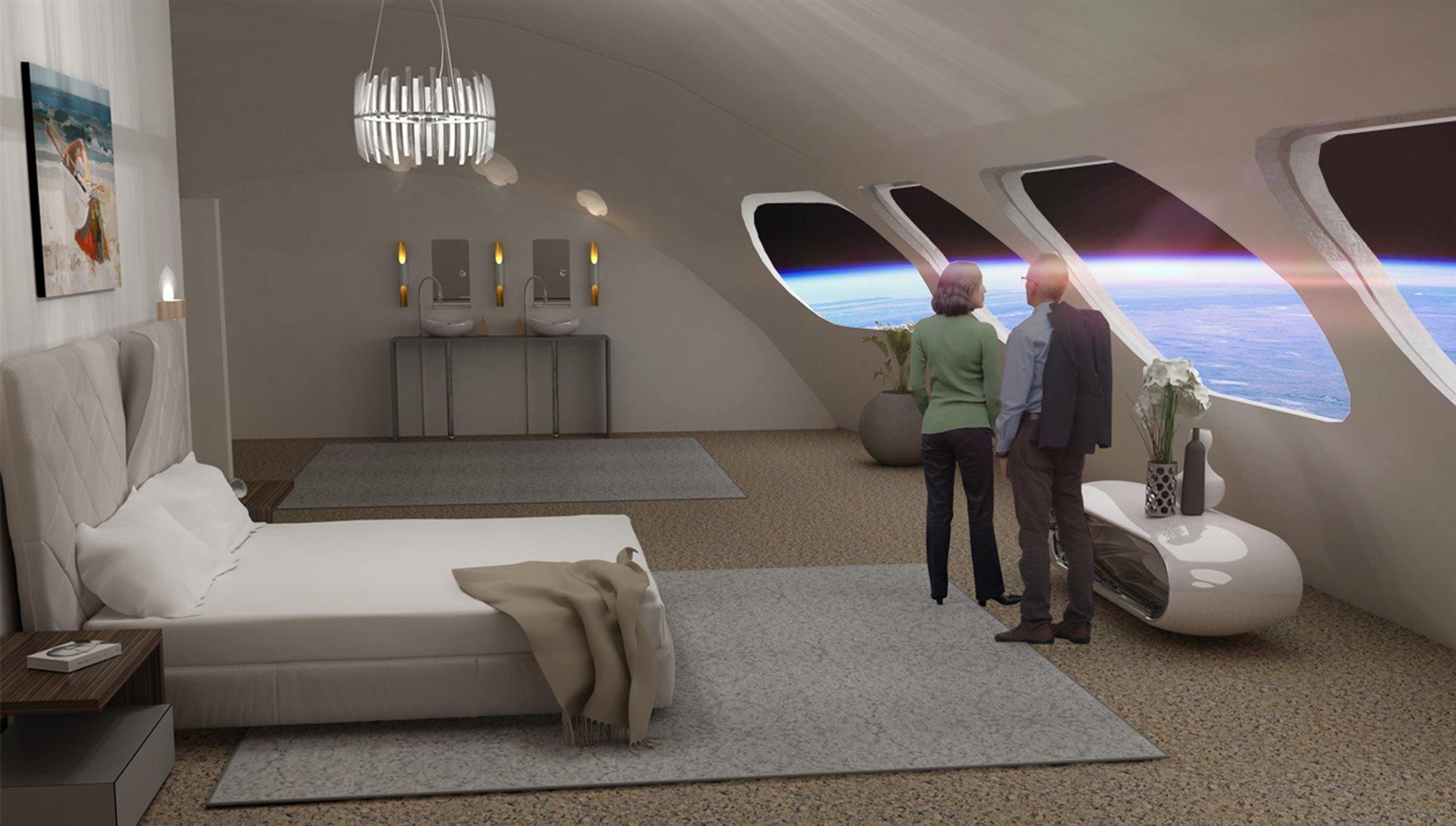
The third piece of the plan would be the 2032 mission. At that time, if everything has worked out, GRU Space aims to send a first generation inflatable hotelManufactured entirely on Earth and transported in a heavy lunar lander (options such as SpaceX's Starship or Blue Origin's Blue Moon Mk2 are mentioned). This first hotel, or v1 according to the company's terminology, would offer accommodation for four guests for stays of about five nights and a projected lifespan of at least a decade.
In the medium term, the roadmap envisions evolving towards a hotel v2With a capacity for about ten guests and an extended lifespan of around twenty years, thanks to greater integration of materials obtained from the Moon itself, this step is linked to a significant reduction in launch costs, which the company considers practically a given in the next decade but which, to this day, remains a hypothesis.
How the lunar hotel will be built: inflatables, regolith and geopolymers
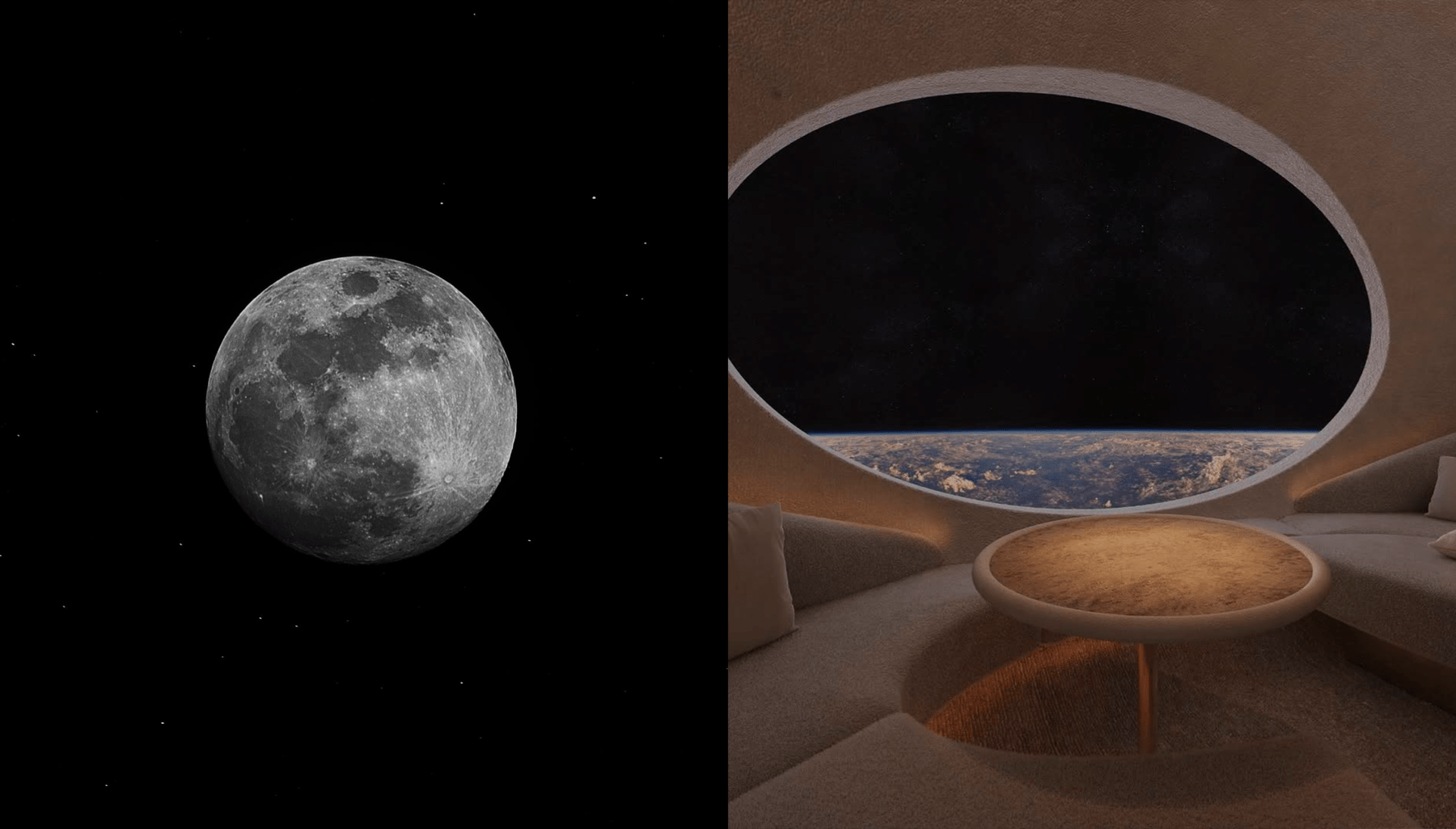
Far from spectacular models, the technical plan starts with something more modest. The first hotel will not be a monumental lunar concrete dome, but a pressurized inflatable habitat, similar in concept to the experimental modules that have already been tested in low orbit, but adapted to the conditions of the lunar surface.
GRU Space's key focus is on the outer shell. Instead of bringing all the structural material from Earth, the company wants to to manufacture bricks in situ from lunar regolithThe dust and rocks that cover the surface are removed. This is achieved through geopolymer processes, which mix this material with small amounts of water and chemical agents to obtain resistant blocks.
This type of technology has been studied in laboratories and research centers, supported by entities such as the International Geopolymer InstituteBut it has not yet been tested on an industrial scale on the Moon. GRU Space plans to use robotic equipment to produce and stack these bricks around the inflatable modules, creating a shell that improves protection against radiation, micrometeorites and temperature changes.
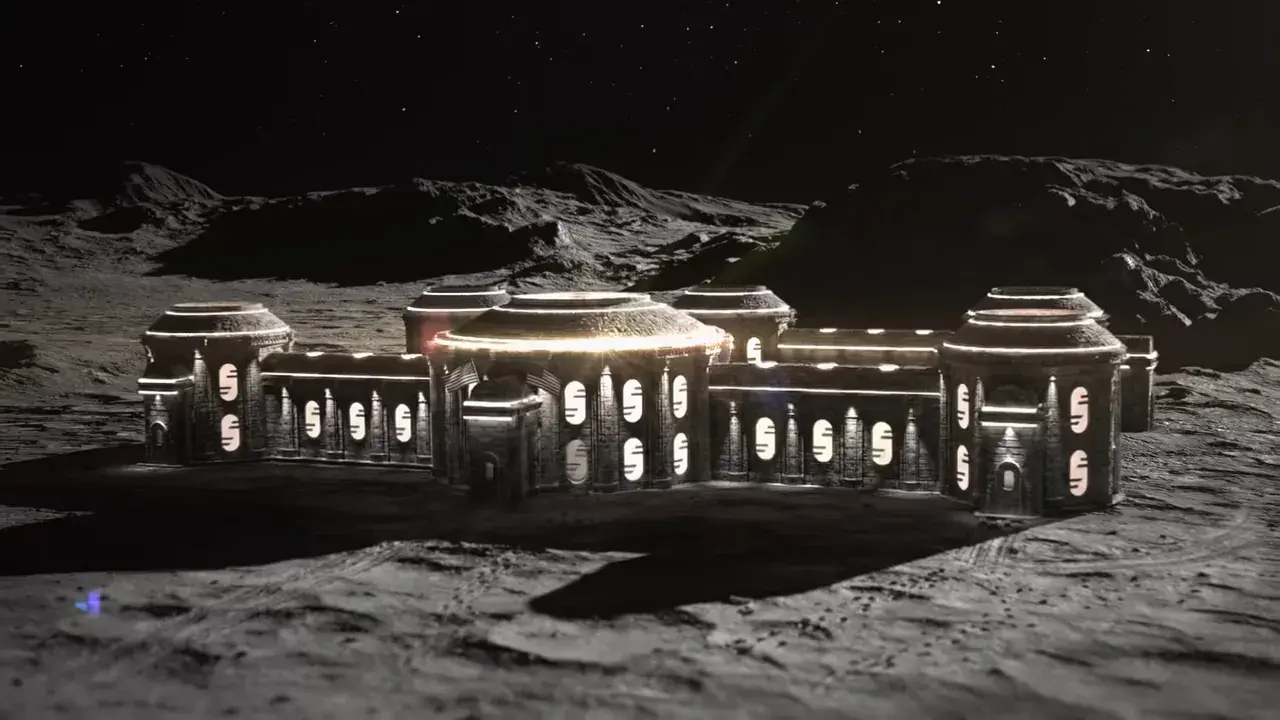
Aesthetics are not a minor detail in the business proposal. The company has mentioned its intention to draw inspiration from the San Francisco Palace of Fine Arts And in Beaux-Arts architecture, for exterior design, once a solid layer of lunar bricks exists. Beyond the visual appeal, the regolith envelope has a practical function: allowing for longer stays, reducing the total radiation dose received by guests, and lessening the demands on the internal inflatable materials.
The strategy also relies on the use of lunar waterThe ice present in craters and in the regolith itself is considered an essential resource: It would serve as a reserve for human consumption, as a shield against radiation, and, in later phases, as raw material to manufacture propellant (hydrogen and oxygen) to power new missions or expand the infrastructure.
With this combination of inflatables, regolith bricks, and local water, GRU Space aims to progressively reduce the mass that must be sent from Earth. This reduction is key to making the numbers work: the company itself uses this as a benchmark. rates of around $100.000 per kilo of cargo to the lunar surface starting in 2028, which It would cost close to $1.000 billion just to transport a 10-ton habitatAny significant savings have a direct impact on the project cost.
Who will be taking the guests and what kind of experience is being offered?
GRU Space does not plan to build its own rockets or crewed spacecraft. The idea is to rely entirely on commercial operators such as SpaceX or Blue OriginWithin the US regulatory framework, the company sees itself as the mission integrator: it would coordinate transportation, define traveler profiles, and handle operations on the lunar surface.
The standard itinerary would include a launch from Earththe journey to lunar orbit, the descent to the surface using a lunar lander, and the hotel staywhich should already be deployed and operational. Then, the The return journey would follow a similar pattern in reverse., with a strong component of prior training and specific safety protocols.
On paper, the experience on the Moon would go far beyond just looking out the window. The company mentions activities such as walks on the surfaceRover missions and more exciting proposals, such as trying sports adapted to low gravity, are all part of the plan. Of course, all of this is contingent on the evolution of spacesuits, safety regulations, and the limits imposed by regulatory agencies.
The profile of potential clients includes tourists who have already participated in commercial spaceflights, Newlyweds with very large bank accounts and adventurers willing to take risks and costs far beyond those of a conventional vacationGRU Space is confident that a few stays a year, with million-dollar rates, will be enough to balance the accounts of the first hotel and finance subsequent expansions.
Relationship with lunar exploration by the United States, Europe and other powers
The GRU Space project is not developing in a vacuum. It arrives at a time when The United States and other space powers They have once again set their sights on the Moon as a strategic objective. NASA is working on the Artemis program, which includes returning astronauts to the surface and establishing an Artemis Base Camp with a sustainable human presence, although the timelines have been delayed several times and remain subject to review.
Europe, through the European Space Agency (ESA), participates in multiple elements of ArtemisFrom service modules for the Orion spacecraft to contributions to the future Gateway station. Although ESA is not involved in GRU Space's private project, it shares the interest in experimenting with habitats, using local resources, and developing life support technologies that would allow for extended stays on the Moon.
China, for its part, plans to implement a first crew to the lunar south pole around 2030 and has spoken of a joint base with other partners by the middle of the next decade. This context places the idea of a private hotel within a broader competition to establish who controls the infrastructure and the rules of the game in the lunar environment.
In this context, GRU Space's approach adds a very marked commercial dimension: it openly proposes using the luxury tourism as a lever to finance permanent structures and, in theory, complement the state presence. It is an approach that fits with the increasing privatization of space and raises questions about how access, ownership, and use of resources on the Moon will be regulated.
Risks, doubts, and the boundary between vision and marketing
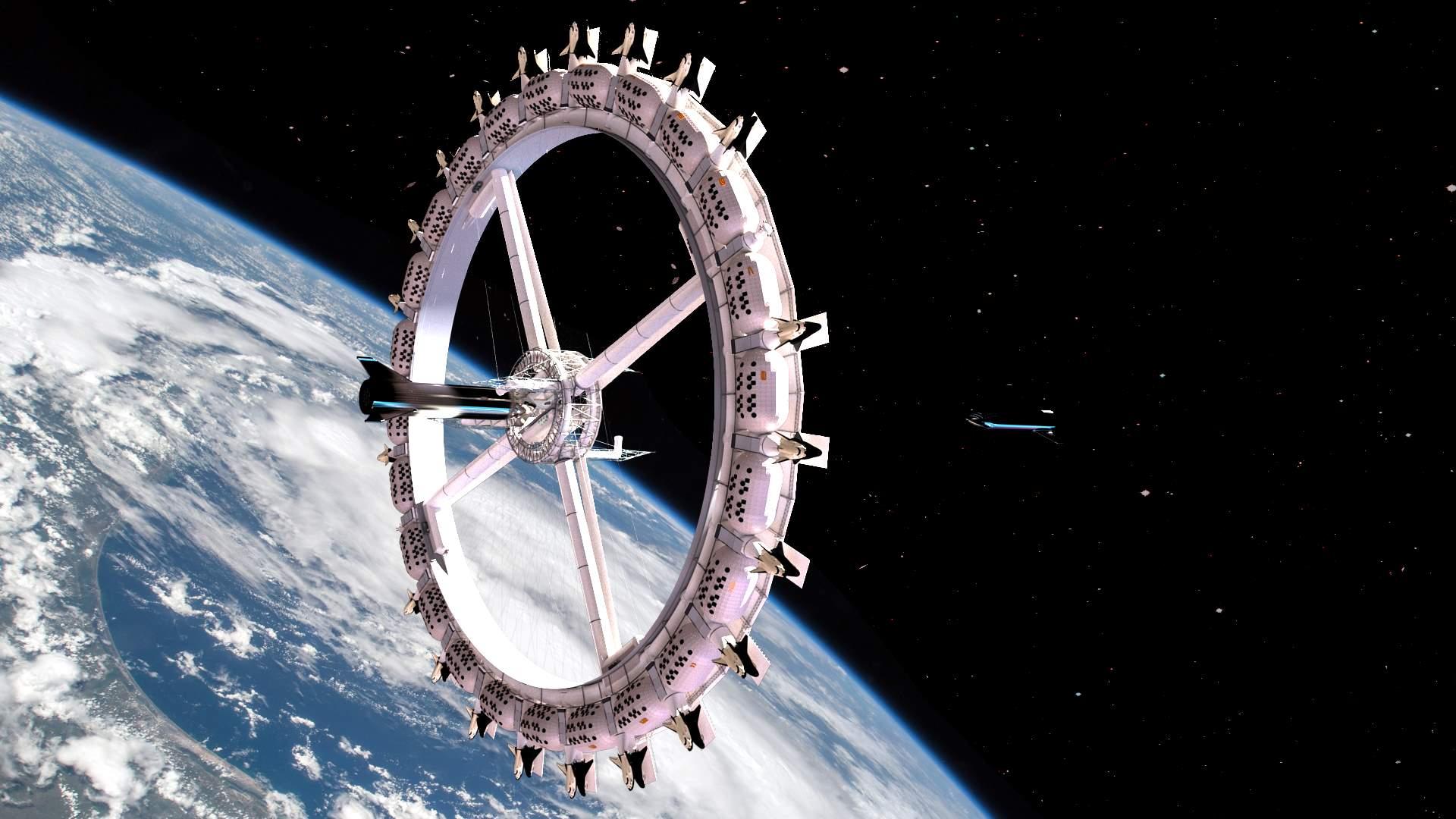
Beyond the eye-catching numbers and spectacular renderings, the lunar hotel project faces a long list of challenges. Technically, it doesn't yet exist. Industrial production of geopolymers on the Moonnor large-scale printing or construction systems that operate on the lunar surface, nor a routine, certified tourist transport service for civilians.
Added to that are the classic environmental problems: radiation, micrometeorites, abrasive dust, and extreme temperature variationsNot forgetting the medical risks associated with low gravity for extended periods. Although progress is expected in suits, life support systems, and passive protection, many of these challenges are still in the experimental phase.
The regulatory component is also significant. Any mission involving passengers will have to go through [the relevant regulatory process]. multiple layers of monitoring in the United States and, foreseeably, coordinate with agencies like NASA and with international frameworks that regulate space activity. The coexistence of state infrastructure (such as the Artemis Base Camp) and predominantly tourism-oriented private projects is not yet fully defined.
On the economic front, the model relies on optimistic forecasts: it is assumed that Costs per kilo will drop drastically. sent to the lunar surface, that there will be enough customers willing to pay for multimillion-dollar stays, and that investors will continue to back the project for years without clear operating income. These are reasonable assumptions for a roadmap, but far from guaranteed.
Therefore, rather than talking about a hotel on the Moon as something imminent, many observers prefer to describe it as a concept of tourist habitat which is already being monetized. The project serves to gauge public interest, gain media visibility, and send signals to the markets, but it leaves the central question unresolved: whether the technology, regulation, and funding will arrive in time and in the necessary form for the first customers to actually sleep on the regolith.
With the rise of initiatives like GRU Space, the Moon is beginning to emerge not only as a scientific or strategic objective, but also as commercial product aimed at an eliteThe Californian company has managed to bring into the conversation the idea of booking a room in a lunar hotel for hundreds of thousands of dollars many years before the building exists, relying on a mix of real advances, cost projections and a carefully crafted narrative; time will tell if that story ends up materializing in an inhabited complex or remains just another one of the great space projects that never made it past the drawing board.

I am a technology enthusiast who has turned his "geek" interests into a profession. I have spent more than 10 years of my life using cutting-edge technology and tinkering with all kinds of programs out of pure curiosity. Now I have specialized in computer technology and video games. This is because for more than 5 years I have been writing for various websites on technology and video games, creating articles that seek to give you the information you need in a language that is understandable to everyone.
If you have any questions, my knowledge ranges from everything related to the Windows operating system as well as Android for mobile phones. And my commitment is to you, I am always willing to spend a few minutes and help you resolve any questions you may have in this internet world.