- Claude's system combines IP address, device fingerprinting, and behavior to detect risky accounts and automatically disable them.
- Using stable IPs, consistent log data, and human usage patterns greatly reduces the chances of being blocked.
- In unsupported regions, relying on personal accounts is very risky; API proxies and third-party platforms offer a more stable approach.
- It's wise to have a plan B: data backups, alternative access methods, and providers that integrate various AI models.

If you use Claude daily for programming, writing, or managing your work, you should suddenly receive this message. “Your account has been disabled after an automatic review” It's the worst possible nightmare. Not only do you lose access to the chat, but your workflow is disrupted, projects are halted, and if you pay for a subscription or use the API, you'll likely lose money along the way.
In recent months it has become almost a classic: users who enjoy Claude Code for a few days and, suddenly, see their account deactivated without prior notice. The combination of automated controls, geographical restrictions, and increasingly stringent policies This makes the risk of blocking especially high in certain regions, with mainland China as the extreme case, but with implications for anyone using VPNs, dubious accounts, or unusual usage patterns.
Why Claude might block you: real causes and how the system detects them
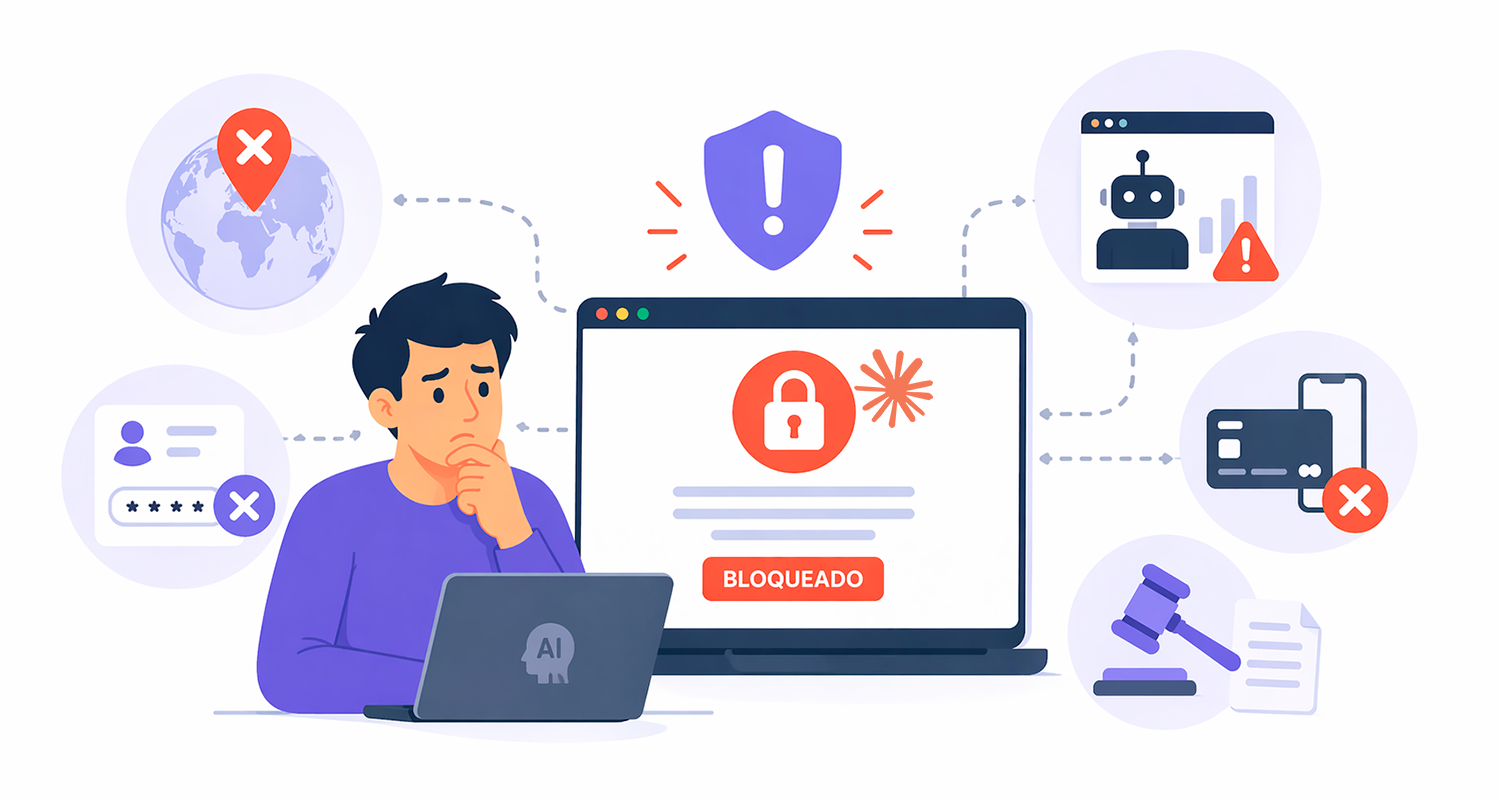
To minimize the chances of getting stuck, the first thing to understand is How does Claude decide that an account is risky?It's not a single factor, but rather an automated review system that cross-references hundreds of technical and behavioral signals. Based on the cases accumulated in 2025-2026 and Anthropic's official policies, the main causes can be grouped into four categories.
1. IP, network and technical footprint: 60% of the problems
Most of the deactivations reported by users are related to the IP address and network environment from which the account connectsAnthropic doesn't just look at the IP address's country, but performs a multi-layered verification:
- IP address and regionThe system checks if the IP address originates from an unauthorized country or region. Connecting directly from mainland China or other unsupported territories increases the risk of immediate blocking.
- IP typeThere's a difference between residential IPs (the typical ones in your home) and data center IPs. Many VPNs, open proxies, and cloud servers generate IPs categorized as data center IPs; these are associated with automated or massive use and are much more likely to be flagged.
- DNS resolutionThe system monitors which DNS servers you're using and where they appear to be resolving from. A configuration that suggests you're actually in a banned country may result in your account being flagged.
- WebRTC and IP leaksIn browsers and applications, WebRTC can reveal your local IP address or real network even if you're using a VPN. If what the API sees doesn't match what WebRTC sees, the automatic check interprets it as an attempt at concealment.
- Sudden changes of location: jump in a matter of minutes from a New York IP to one in London, then to Tokyo, and then to a different region It is not suitable for normal human use.. This “teleport” pattern is typical of poorly configured VPNs.
- Time zone and languageThe system time, device time zone, operating system language, and preferred browser language are compared with the IP address location. For example, a US IP address with the UTC+8 time zone and a browser set to zh-CN is a highly suspicious combination.
The conclusion is clear: “Just setting up a VPN and being done with it” is not enough.If the rest of the digital footprint reveals that you are actually in an unsupported region or that you are masking your location, the risk control system may automatically ban your account.
2. Registration, phone numbers, and payments that don't match
A second major source of blockages comes from accounts incorrectly registered or linked to unreliable dataThe automatic and manual inspection checks primarily for:
- Virtual or temporary numbersAccounts created with disposable SMS services or cheap virtual phones tend to be shut down quickly. This is one of the clearest indicators of a "suspicious" account.
- Multiple accounts per personRegistering multiple accounts with similar data or from the same environment causes them all to be associated with each other. If one is flagged, it's likely that the rest will also be flagged due to "guilt by association."
- Shared accountsWhen multiple people access the same account from different networks, devices, and countries, the algorithms interpret it as shared or resold access, which clashes with the terms of use.
- Payment methods that don't fitIf you pay with a card from one country, browse with an IP address from another, and registered the account with a phone number from a third region, the mix is very obvious.
Whenever possible, it is advisable to phone number, IP address, payment method, and billing information belong to the same countryWhen all the elements tell the same story, the system trusts that account more.
3. Use that resembles abuse: patterns that trigger risk control
Even with a perfectly legal and properly registered account, your use of Claude can trigger internal protection mechanisms. Some typically problematic behaviors include:
- Massive bursts of requestsIf in a short period you send a volume of queries typical of a bot or a scraper, the system labels it as aggressive automation.
- Simultaneous login from different sitesConnecting to the same account from multiple devices, networks, and countries simultaneously is considered a high risk of account sharing or hacking.
- Use of unauthorized third-party toolsUnofficial clients, aggressive wrappers, crawlers, or integrations that pretend to be a real user but behave like a robot are clear candidates for deactivation.
- Jailbreak attempts and bypassing protectionsInsisting on breaking security barriers, forcing prohibited responses, or circumventing content policies can result not only in conversation blocks, but in a global account ban.
The general guideline is simple: Claude uses it like a normal person would.With pauses, varying the type of queries, without wild automations and without fighting with security limitations.
4. Political restrictions and identity-based blocks
There is a much more delicate type of lock: the one that It doesn't depend on what you do day to day, but on who you are and where you operate from.In September 2025, Anthropic reinforced its sales and use policy in non-supported regions, with a key point for businesses:
- Ban on companies controlled by ChinaIf more than 50% of a company's capital belongs to entities from China, Russia, Iran, or North Korea, that organization cannot use Claude's services, either via the web or via API, even if it registers in another country.
- Cascading applicationThe restriction applies to both direct API customers and those who access it indirectly through cloud providers or intermediaries.
Meanwhile, mainland China It is not listed among the more than 195 officially supported countries and regionsThis means that registering directly from there starts with a fundamental compliance problem: even if it works for a while, the risk of automatic review cutting off the account is always present.
In this context, trying to live solely with a personal Anthropic account from an unsupported region is playing with fire. That's why [unclear - possibly "other options" or similar] have gained prominence. API proxy solutions and the third-party services that Claude integrates and are responsible for complying with territorial rules.
Timeline of recent lockdowns: what has happened between 2025 and 2026

The scares with Claude didn't come out of nowhere; they are a response to a a series of policy changes and waves of implementation that have gradually hardened the environment Step by step. Broadly speaking, the recent map can be summarized as follows:
- September 2025Anthropic publishes an update to its sales restrictions to non-compliant regions and explicitly introduces a ban on companies controlled by China. This forms the legal and enforcement basis for many subsequent bans.
- September 2025 (acceptable use → usage policy)The usage policy is renamed and expanded, adding more specific clauses on prohibited conduct, API abuse, sensitive content, and automated risk controls.
- November 2025A massive wave of deactivations has arrived, especially painful for developers who were exploiting Claude Code. Many accounts that seemed "safe" stopped working overnight.
- February 2026Anthropic is taking a more aggressive approach to combating the invocation of Claude models through unauthorized third-party tools. Several unofficial clients are no longer functioning or are generating authorization errors.
- March 11, 2026A service failure occurs that prevents many users from logging in; many of them think they have been banned, when in reality it is a temporary infrastructure outage.
- After March 2026: a pattern of continuous execution of the September 2025 policy is maintained, with automatic reviews and periodic cleanups of accounts considered to be at risk.
This history explains why today “Behaving well” is not enoughThere are cases where the account is deactivated not because the user is doing anything unusual, but because, in the eyes of the compliance system, the combination of country, company, or access type does not match what is allowed.
8 practical strategies to minimize the risk of blocking in Claude
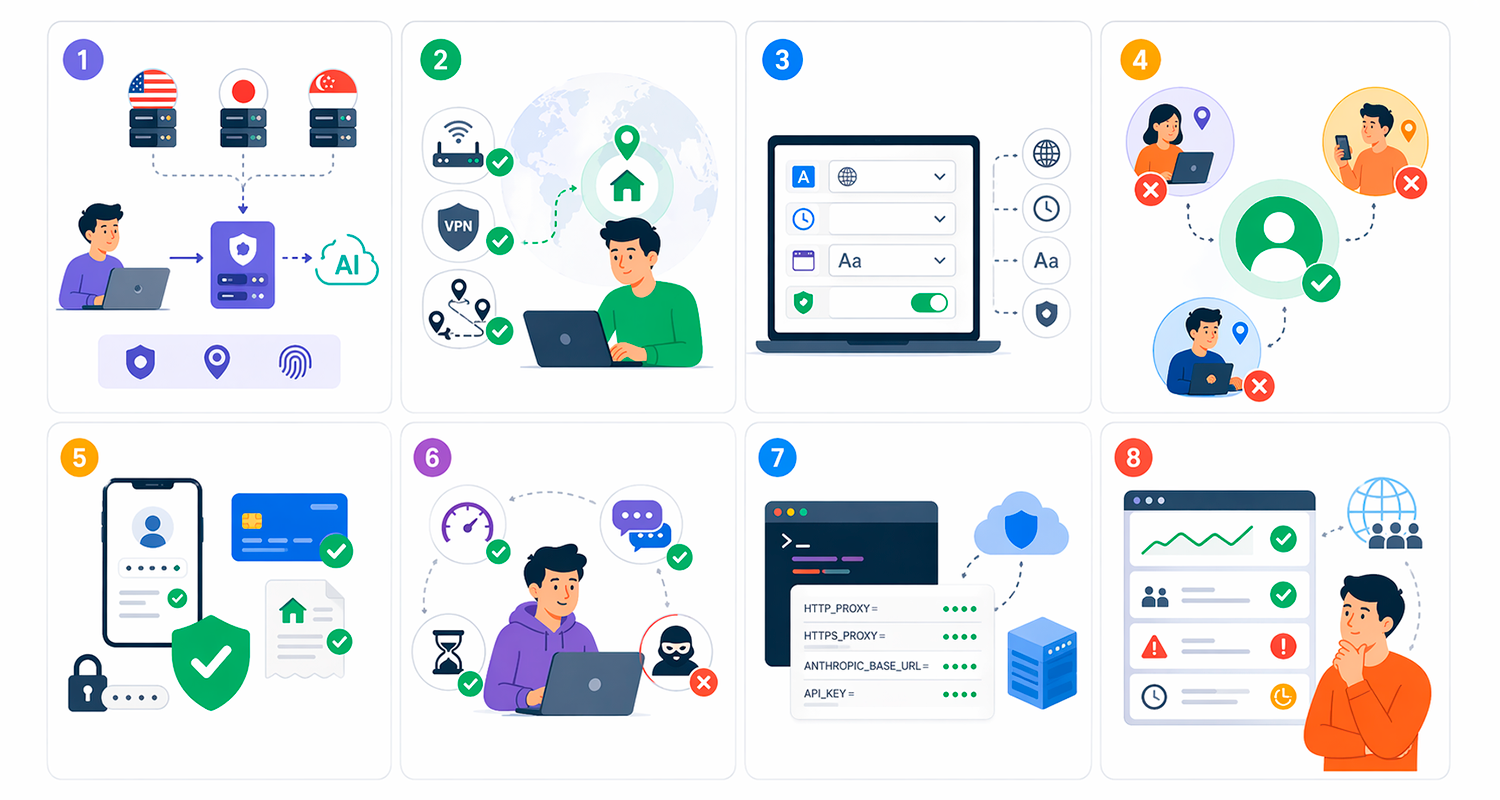
Given the above scenario, the priority is clear: Minimize risk signals and, where possible, delegate to solutions designed to comply with Anthropic's policiesBased on real-world cases and guides already circulating among developers, these are the eight most effective strategies.
Strategy 1: Use a compatible API proxy instead of a personal account
For those who live or work in troubled regions, the safest option is to stop relying on an individual Anthropic account and switch to an API proxy service that operates in supported countriesThe basic scheme is:
- The proxy platform maintains its own business accounts and servers in places like the United States, Japan, or Singapore.
- You call that platform's API; it in turn calls the Anthropic API on your behalf.
- Your client never directly “touches” Anthropic’s infrastructure, so IP address, digital footprint, and end-user region are not included in the risk control radar..
Furthermore, modern proxies are usually compatible with the OpenAI formatSo, migrating in code is as simple as changing the API key and base URL. In many cases, pricing is also competitive—sometimes even below the official rate—without you having to deal with registrations, foreign credit cards, or VPNs.
Strategy 2: If you use a personal account, keep your IP address consistent.
When you are in a supported country and prefer to continue using your own Claude account, the goal is that Your connection pattern resembles that of a normal person living in a specific location.. This implies:
- Always connect from the same region and, if possible, from a stable residential IP addressAvoid switching from the United States to Japan overnight without a reason.
- Don't overuse VPNs. If you need them, make sure they're high-quality, with clean and consistent IPs, and try not to switch nodes frequently.
- Reduce network hopping between work, home, mobile, etc. If you connect from multiple locations, try to ensure they are all in the same country and use a reasonable pattern.
Ultimately, the idea is not to appear as a user who is hiding. The more organic and predictable your network environment is, the less likely you are to end up with a negative automated review..
Strategy 3: Align the device footprint (language, time zone, browser)
Another key element that many people overlook is the consistency of the device itself. For security systems, it's suspicious to see a IP address from one country but a laptop configured as if you lived in anotherTo avoid it:
- Adjust the operating system language to one reasonable for the IP region (for example, English if you use a US or UK IP).
- Change the device time zone to match the primary location from which you are browsing.
- Configure the browser language preferences (Accept-Language) in accordance with that same region.
- Deactivate or limit WebRTC in the browser to prevent leaks of your real IP address when using any type of tunnel or proxy.
They are small changes, but, combined, they can make the difference between appearing to be a consistent user or someone who is forcing the machine to bypass regional restrictions.
Strategy 4: One person, one account, and no sharing
As convenient as it may seem, sharing your username and password with colleagues or friends is a bad idea. From a risk management perspective, the ideal is that Each person should have their own account and only use it themselves.In practice, this translates to:
- Do not reuse credentials between people, not even within the same team.
- Do not log in at the same time from devices located in different countries.
- If an account is deactivated, do not attempt to register a new one using the same phone number, email address, card, or similar data combination.
Sharing an account causes the system to observe parallel logins from very different networks and therefore trigger alarms. It is preferable that each person organize their own access or that an organization-wide team solution be used.
Strategy 5: Legitimate phones and payment methods
Disposable numbers and opaque cards are tempting shortcuts, but they often end up costing you more in the long run. To ensure your account has a low-risk profile, make sure you also activate the two-step authentication when possible:
- Registration is done with a real phone number from the country where you supposedly resideavoiding temporary two-cent SMS platforms.
- Payments are made with credit cards from recognized institutions and from the same country as your main IP address.
- The billing address, card country, and usual access region match.
In other words, if a human auditor were to review your case, they would see an account that "smells" legitimate and stable, not something set up in five minutes with recycled data.
Strategy 6: Use Claude reasonably and without pushing the limits
Regarding usage patterns, you can greatly reduce the risk if you get used to a behavior that matches that of a person working with the tool, not that of a robot in production 24 hours a day.
- Avoid sending thousands of messages or API requests in very short burstsIf you have a resource-intensive use case, add waits, queues, and limits.
- Introduce natural variability into conversations: edit prompts, switch tasks, alternate long dialogues with short questions.
- Don't waste your time trying to break through the filters or get Claude to say things you know he shouldn't answer.
- Be wary of third-party applications that present themselves as a "magic client to use Claude without limits" and that demand your token or credentials: they may violate the terms of use.
Think of the platform as being designed to detect massive, repetitive, or abusive patternsIf your activity doesn't fit that description, you're less likely to end up in the spotlight.
Strategy 7: Extra precautions with Claude Code
Claude Code is a very powerful programming tool, but it has its own unique feature: It runs in the terminal and does not always respect the system's proxy settings.This means that if you're working behind a VPN or proxy, you might be leaking your real IP address without realizing it.
To avoid surprises:
- Explicitly configure the HTTP_PROXY and HTTPS_PROXY environment variables when using local proxies, so that all requests go through where you want.
- If you want to reduce the risk even further, consider Point Claude Code directly to an API proxy service using variables such as ANTHROPIC_BASE_URL and a vendor key instead of your official Anthropic token.
With this change, you continue to enjoy the Claude Code experience on your terminal, but the "dangerous" layer of communication with the official servers is assumed by the proxy provider.
Strategy 8: Learn to distinguish a service failure from a real blockage
Finally, it's important to know when you've actually been blocked and when you're simply dealing with a technical glitch. It's not uncommon for a global outage to be mistaken for a banSome helpful guidelines:
- In an infrastructure failure, Many people have problems at the same time And there's usually activity on social media or the official status page. Furthermore, the service typically returns to normal within a few hours.
- In a genuine account block, the message is much clearer: texts like “Your account has been disabled after an automatic review” or codes like account_banned They indicate a risk management decision, not a one-off drop.
- When in doubt, it's worth checking the status panel and waiting a while before making drastic decisions.
Recognizing these situations correctly prevents you from creating a drama every time there is a temporary interruption and allows you to Reserve appeals and support efforts for truly critical cases.
What to do if Claude has already deactivated your account

If you encounter a message upon trying to log in that your account has been deactivated following an automatic review, it's normal to panic. However, there are some organized steps you can follow to maximize your options and, above all, to limit the damage in your daily life.
Most common types of blocking messages
The most frequent errors related to deactivated accounts are usually:
- “Your account has been disabled after an automatic review of your recent activity”This indicates that the automated system has detected an anomaly and has blocked access. This is not a bug, but a deliberate decision.
- account_banned: is a more direct variant, typical of the API or some clients, which makes it clear that the account is not authorized to continue operating.
- “Invalid authorization” or similarSometimes, a credential error is actually due to a deactivation. If your credentials were correct and suddenly stop working, it's a good idea to check if there's an associated block.
In all these cases, what has happened is that A lock has been placed at the account levelThat's not always reversible, but there's room for maneuver if you act quickly and provide clear information.
How to appeal: options and probabilities
If you are convinced that you have not violated the terms of use, the official channel to try to regain access is the manual appealIt usually happens in two ways:
- Fill out a security form or support ticket from the official help center, explaining your case in detail, the type of use you made, where you connected from and why you believe it is a false positive.
- Send an email to the support address specified for account issues, attaching relevant screenshots, proof of payment, and any data that demonstrates that your use was legitimate.
It's best to be realistic: when the cause of the block is related to geographical or political restrictionsThe chances of success are low. If there is a clear zone violation, the terms of service usually state that payments are non-refundable and the account may be permanently closed.
However, when it's a technical error or a misunderstanding (for example, a rare but legitimate connection pattern), there's more room for support to review the case, restore access, or at least unlock the remaining balance.
Damage management: how to keep working without Claude (official)
While you sort out the bureaucratic part, the most important thing is that your workflow doesn't fall apartSome sensible steps are:
- If you can still log in somehow, back up your conversations, artifacts, code snippets, and anything else you need for your projects.
- Consider migrating to a API proxy or third-party platforms that already integrate Claudeso you can continue using compatible models without being tied to your old account.
- Avoid opening multiple new accounts with the same information; they will usually all end up being shut down, and you will lose more time and money.
- Keep proof of payment and communications in case you need to pursue the appeal or claim a partial refund.
After going through a deactivation, the lesson many users take away is that The biggest loss is not the fee, but the hours of work that are left hanging.That's why it makes so much sense to build an infrastructure from the beginning where Claude is a modular, replaceable piece, and not the bottleneck of your entire system.
Alternatives to continue using Claude without depending so much on your account
If your personal account is up in the air or if you simply don't want to take the risk, there are several ways you can continue to enjoy Claude's capabilities while reducing your user's risk control exposure.
Platforms that integrate Claude for direct use
There are apps and services that offer Claude-based chat or work environment experiences without having to create an account on the official Anthropic website or manage tokens yourself. Among the advantages they usually offer are:
- There is no direct restriction at the individual account level for Claude; the provider is the one who maintains the relationship with Anthropic.
- You can use not only the Claude model series, but also other important LLMs (GPT, Gemini, open models, etc.) from the same panel.
- Some platforms replicate advanced features such as artifacts, pre-configured assistants, or project management, giving you an experience very close to the official one.
The nuance is that, in this model, You depend on the reliability and security of the supplierIt's key to choose one with a good reputation, clear privacy policies, and a reasonable track record.
Access via third-party APIs and specialized proxies
If you develop software or integrate AI into your own systems, what usually gives you the most freedom is contract third-party API services that expose Claude's modelsThe logic is similar to that of the proxy discussed earlier, with several additions:
- Many of these services are compatible with the OpenAI SDK, so migrating your code only requires change the key and base URL and, at most, adjust the model identifier.
- The connection is made directly from your server or local environment to the proxy, without VPN or juggling regions.
- It is common for them to also offer access to dozens or hundreds of other modelsThis allows you to switch model providers without rewriting your entire backend if Claude ever becomes unviable.
In this scenario, if Anthropic further tightens its policies, the impact is mitigated: as long as the provider continues to operate with compliant business accounts in supported regionsYour integrations can continue to function with minimal changes, and you'll always have alternative models if something breaks.
Claude.ai, direct API or proxy: which option suits you best
When deciding how to use Claude, it makes sense to compare the three main routes: personal web account, own direct API and API proxy service.
- With a personal account at claude.aiIt has a very polished chat interface, a flat-rate subscription, and zero programming required. It's convenient, but in conflict zones the risk of being blocked is very high, and you're tied to a single access point.
- La Anthropic Direct API It gives you more control, scalability, and advanced options (production use, automation, integration with your own backend). In return, you need a foreign credit card, clear identification, and strict adherence to supported regions and usage policies.
- El API proxy service It introduces an intermediate layer that assumes compliance requirements, simplifies registration (often just an email), reduces the need for a VPN, and tends to have a very low risk of individual account blocking.
If you work from a fully supported country and in a moderate way, the first two options may be sufficient, provided you take care of the details mentioned. But If you're in mainland China or similarly restricted environments, API proxying is almost the only reasonable way to achieve medium-term stability..
In short, for those who depend on Claude in their daily lives, the important thing is not to win a war against the risk management system, but design a workflow that fits the rules of the game and can survive policy changes or occasional blockagesUse consistent networks and devices, avoid fragile accounts, rely on intermediary services when the region requires it, avoid the memory lock-in in AI and always have a technological backup plan B ready in case your official account stops working tomorrow.

I am a technology enthusiast who has turned his "geek" interests into a profession. I have spent more than 10 years of my life using cutting-edge technology and tinkering with all kinds of programs out of pure curiosity. Now I have specialized in computer technology and video games. This is because for more than 5 years I have been writing for various websites on technology and video games, creating articles that seek to give you the information you need in a language that is understandable to everyone.
If you have any questions, my knowledge ranges from everything related to the Windows operating system as well as Android for mobile phones. And my commitment is to you, I am always willing to spend a few minutes and help you resolve any questions you may have in this internet world.