- Gauth combines AI, photo recognition, and human tutors to solve exercises with step-by-step explanations across multiple STEM subjects.
- The app covers everything from basic arithmetic to calculus, statistics, and science, with extra features such as simplified reading, writing assistance, and a study toolbox.
- There are powerful alternatives such as Mathos AI, MathGPT Pro, Mathway, and Symbolab, with deeper focuses on advanced calculation, dedicated calculators, and PDF management.
- Using Gauth as a tool to understand procedures and check solutions, and not just to copy, is key to truly improving learning.

If you've ever stared at a math problem and not known where to begin, you're not alone. Between equations, deadlines, and the pressure of keeping up with the curriculum, it's normal to be searching for answers. digital support to make studying more bearableOne of the apps that is making the most noise in this field is Gauth, also known as Gauthmath in its web version.
In this article we will break it down in depth how to solve exercises with GauthLearn what its artificial intelligence actually offers, how it compares to alternatives like Mathos AI, MathGPT Pro, Mathway, or Symbolab, and who it's worth it for. You'll see its features, limitations, pricing, and even practical use cases in detail, all explained in clear, direct language geared towards students in Spain.
What is Gauth and what is it used for?

Gauth is, basically, a AI-powered study buddy designed to help you with homeworkEspecially in science subjects: Mathematics, Physics, Chemistry, Biology, and even some business and social science courses. Its philosophy is very simple: you take a picture of the problem or type it in, and the app gives you the solution step by step in a matter of seconds or a few minutes.
The app combines its own artificial intelligence (Gauth AI / Gauth AI Pro) with 24/7 available human tutors. This means that when the AI can't handle a particularly tricky exercise, you can Connect with an expert who will review the solution, verify it, and explain it to you in more detail.Gauth boasts of having tens of thousands of verified tutors to reinforce the accuracy of its answers.
It's available on both mobile and web. On iPhone, you need iOS 15 or later; it also works on iPadOS 15 or later, iPod touch, and even Apple Vision with visionOS. The app It can be used in Spanish and many other languages. (English, French, German, Italian, Portuguese, Korean, Japanese, Turkish, Thai, Vietnamese, Indonesian, Malay and Filipino, among others), so if you study in several languages it can be great for you.
One of Gauth's strengths is its focus on the student experience: a very intuitive interface, automatic recognition of the problem statement when taking the photo, animated explanations, an active student community, and a mix between quick resolution and deeper support with live tutors when you need it.
Gauth's main functions for solving exercises
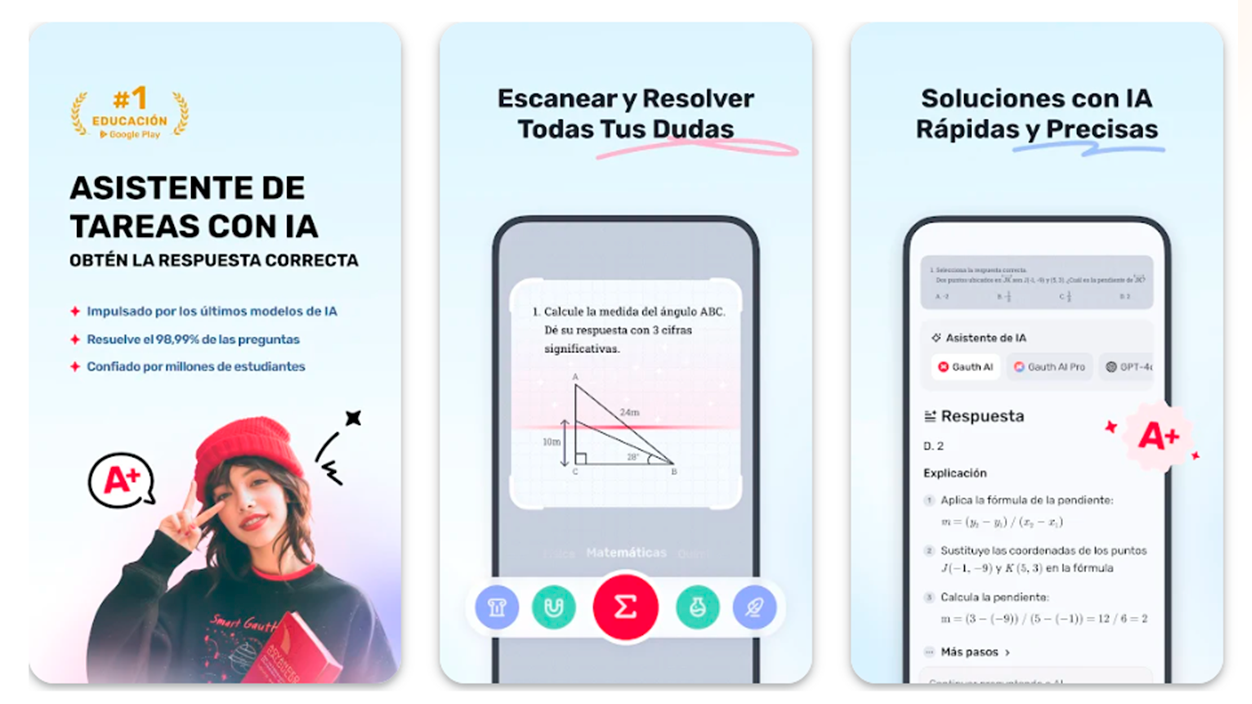
The beauty of Gauth isn't just that it gives you the answer, but how it gets there. The app is designed so you don't have to struggle with complicated menus: you open it, point the camera, and that's it. From there, its combination of AI and experts comes into play.
Among its most important functions for solving exercises, there are several key elements that should be understood in order to get the most out of it and, above all, to use it as a learning tool and not just as a "homework copying machine".
AI-powered photo recognition
El Photo recognition is at the heart of GauthSimply take a photo of the problem with your phone's camera: the app automatically detects the problem area, crops the problem statement, and processes it with its AI. It doesn't matter if it's printed text from a book or more or less legible handwritten notes.
Once the image has been analyzed, Gauth identifies the type of question (equation, word problem, derivative, system of equations, physics question, etc.) and applies the appropriate mathematical or scientific principles to solve itNormally, in less than three minutes you have the answer on screen, with the steps organized and, often, with animated instructions to guide you through the reasoning.
Step-by-step and animated explanations
Almost all of Gauth's solutions are broken down into steps, not just the final result. For each step, the app indicates what operation is performed (for example, "isolate the variable," "apply the perimeter formula," "differentiate the polynomial function," etc.) and tries to make the process easy to follow even if you have limited theoretical knowledge.
In many math questions, The explanations include animations These sections show how expressions are transformed or how elements of a geometric problem are manipulated. This part is especially useful for more visual learners who get lost in long blocks of text.
AI Live Tutor: Live Voice and Whiteboard
When simply reading a solution isn't enough, Gauth offers an AI Live Tutor It allows you to ask questions by voice and see the explanations on an interactive whiteboard in real time. It's an experience similar to having a private tutor: you speak, it answers, guides you, and draws on the screen everything it explains.
This feature is useful when you're stuck on a particular step and need someone to explain it to you "like you're 10 years old." The AI tutor can rephrase the solution, change the level of detail, give you more examples, and suggest similar exercises for you to practice.
Study toolbox: reading, writing, focus, and calculator
Gauth doesn't just focus on solving specific exercises; it also integrates a small study "toolbox": reading mode with text simplification, a writing assistant for drafting essays or papers, a concentration mode to minimize distractions, and an advanced calculator.
These features allow you to use the app as an all-in-one study centerSimplify a science text, check the grammar of an essay, perform a statistical calculation, or check an integral—all within the same environment. For students who want everything centralized, this is a significant advantage.
Subjects and topics covered by Gauth
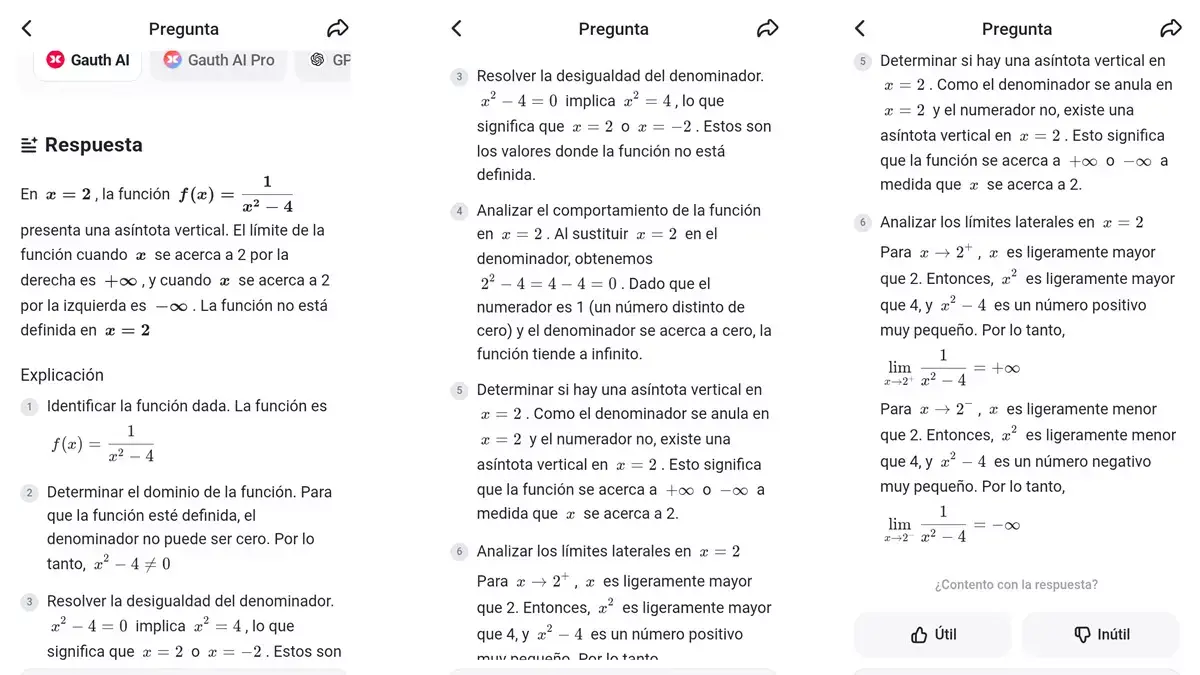
Although Gauth started out as a math solver, today he is much more versatile.It covers a mix of subjects from secondary school, high school and even the first years of university, with remarkable depth in each of them.
Mathematics: from elementary school to advanced calculus
In math, Gauth covers practically everything you're going to encounter in primary and secondary school.and a good portion of basic university content. Some of the most important topics it covers are:
- Word problemsTypical exercises where you have a text (for example, dimensions of a rectangle, mixing solutions, percentage problems or movement) and you have to set up the equation.
- Algebra: arithmetic, real numbers, set theory, algebraic expressions, logarithms, complex numbers, systems of linear equations, factorizations, etc.
- Functions: linear, quadratic, polynomial, exponential, rational, logarithmic and inverse functions, with representation, domain, range and transformations.
- GeometryPlane and solid geometry, lines and planes, distances, angles, areas, volumes, geometric transformations and problems combined with algebra.
- TrigonometryTrigonometric ratios, basic identities, Law of Sines, Law of Cosines and reciprocal properties, as well as applications in triangle problems.
- Calculation: limits, derivatives, integrals, geometric interpretation (tangent, area under the curve), optimization and typical physics problems with functions.
- Statistics and probabilityData representation, basic probability, distributions (Poisson, normal), descriptive analysis, and concepts such as geometric mean.
- Matrices: matrix algebra, systems of linear equations solved with matrices and basic operations.
- Logic and proof: logical reasoning, proofs by contradiction, logical equivalences, and simple formal arguments.
If you're in secondary school or high school, Gauth can handle virtually any standard math problem. For more challenging topics (like Laplace transforms, advanced series, or highly theoretical calculus), it might fall a bit short compared to more technical alternatives like Mathos AI, but it's more than adequate for everyday use.
Physics, Chemistry and Biology
Besides math, Gauth solves quite a few Physics exercisesChemistry and BiologyYou can photograph statements of kinematics, dynamics, energy, chemical reactions, stoichiometry, chemical equilibrium or general biology questions (cell, basic genetics, simple physiology).
The app It interprets the problem, identifies the magnitudes, the necessary formulas, and guides you through the steps.In Physics, for example, it can break down the formulation of a uniform rectilinear motion problem, substituting data and solving for the unknown. In Chemistry, it helps with chemical equations, moles, molar mass, concentrations, and electronic distribution.
Other subjects and writing aid
Gauth is positioning itself as a generalist academic assistant, which is why it also integrates help with essay and paper writing at various levels (high school, undergraduate, master's). You can ask it to help you. Generate drafts, improve existing text, or check grammar and style.
It's not a substitute for a professional proofreader, but it can be a lifesaver for polishing schoolwork or generating ideas for an essay. It competes with other writing assistants, though its strength clearly remains its numerical and problem-solving capabilities.
How to use Gauth step by step to solve an exercise

Using Gauth is quite simple, but Getting the most out of it involves following a small routine. that will help you avoid very common mistakes, such as taking blurry photos or not specifying the subject matter properly.
1. Registration and login
The first thing is Create an account on GauthYou can do this from the official website (gauthmath.com) or by downloading the app to your mobile device. Once installed, tap "Log in" or "Register" and choose whether you want to log in with your email, Google account, Apple account, or other options available in your country.
2. Access to AI-powered task help
After registering, you'll reach a kind of "task panel" where you can start new queries. Here you'll see the options for introduce the exercise: write it by hand, paste text, upload a photo or, in some versions, upload a PDF with several questions.
For more complex math exercises, The usual thing is to use the cameraMake sure the photo is clear, well-lit, and that the entire problem statement is visible. Avoid shadows that obscure numbers or symbols, as this can cause the AI to misinterpret the problem.
3. Choosing the right subject
Before submitting the question, Select the correct category (Mathematics, Calculus, Physics, Chemistry, Biology, Business, etc.). In this way, Gauth applies the appropriate set of tools and avoids confusion with units, notation, or formulas.
If you are unsure between two subjects (for example, a Physics problem with many equations), it is usually better to select the Physics option so that it takes into account the physical quantities, although mathematically it could also be interpreted from the math module.
4. State the question clearly
When you write the exercise in text, You should be as specific as possibleState all the data, units, and what is being asked (“calculate the length,” “find the area,” “find the derivative,” etc.). The clearer it is, the less likely the AI is to interpret it differently.
In open-ended or reasoning problems, you can add contextual details to make the answer more meaningful and not just a generic formula. And if you upload a PDF, make sure each problem displays correctly on its page.
5. Interpret the answer step by step
Once you submit the exercise, Gauth usually respond in seconds This applies to relatively simple questions. For more complex problems or when a tutor's review is involved, the time may be extended to several minutes.
Besides looking at the final result, The important thing is that you review each step.For example, in a typical problem involving the perimeter of a rectangle, Gauth shows you how to define the variables, how to formulate the equation, how to group terms, and how to solve for the unknown. Carefully reading through these steps is what truly strengthens your understanding.
6. Ask for clarification or a live tutor
If something doesn't seem right to you, You can ask follow-up questions within the same exerciseGauth AI's chat allows you to ask it to simplify an explanation, give a similar example, or better explain a jump from one step to another.
In the most complicated cases, you have the option to connect with a human tutorThese experts typically handle problems in the most difficult 5% of the syllabus: Olympic exercises, highly complex integrals, unusual proofs, etc. Keep in mind that this type of support is usually part of paid plans.
Gauth plans, pricing, and usage limits

Gauth can be used for free, but with limitations.The free version allows you to solve a limited number of exercises per day, view basic explanations, and use the camera to scan problems, all with ads integrated into the app.
If you need intensive use, Gauth Plus and premium plans come into play. Prices may vary slightly depending on the region and platform, but as a guideline, the monthly subscription is around $11,99, with quarterly and annual options that lower the monthly cost.
With Gauth Plus you get, among other advantages:
- Unlimited answers and explanations in the question bank.
- Greater accuracy and priority in the processing of your queries.
- Full access to the advanced AI tutor and Live Tutor features with clearer and more detailed explanations.
- Access to millions of video tutorials and a bank of over 100 million questions resolved.
- 24/7 tutor support and an ad-free experience.
On iOS, the app displays various in-app purchase options: monthly, quarterly, annual, limited free trials, and specific packages like "Super Gauth AI." It's important to carefully review the trial terms (for example, 3-day periods) to avoid surprises with automatic renewals.
Regarding technical limitations, Gauth's AI works very well on simple and moderately complex exercisesHowever, its accuracy decreases if you tackle extremely advanced problems, those with many steps, or those using unusual notation. It's always advisable to mentally review or consult with a teacher before working through solutions to very delicate problems.
Advantages and disadvantages of using Gauth for studying
Gauth has gained popularity among millions of students precisely because of its balance between speed and ease of use, but like any tool, it has its pros and cons. If you're planning to use it regularly, it's a good idea to be aware of both its strengths and limitations.
Gauth's strengths
Among Gauth's clearest advantages are several aspects that make it especially attractive to secondary school students, high school students, and first-year university students:
- SpeedIt solves many exercises in seconds, and the most complex ones in a few minutes.
- Step-by-step explanationsIt doesn't just vomit up the result, but tries to show the whole process.
- Ease of use: simple interface, automatic recognition of the statement when taking the photo, and a very smooth experience.
- Coverage of multiple subjectsMathematics, physics, chemistry, biology, and some social sciences and business.
- Community and live tutors: access to human experts and a community of students for questions and mutual support.
- Multiplatform and language availabilityIt works on different devices and has support in Spanish and other languages.
Limitations and aspects to consider
Not everything is perfect, and it's important to keep your eyes open so you don't get frustrated if you expect the app to do absolutely everything flawlessly.
- Explanations that are sometimes superficialIn certain exercises, the app doesn't delve as deeply into the concepts as it could, especially if you use the free version.
- Limited scope of action in very advanced mathematicsHighly theoretical or high-level university exercises may be beyond your reach.
- Possible errorsAlthough accuracy is generally good, the AI can make mistakes, especially if the statement is poorly scanned or very convoluted.
- Dependence on image recognitionIf the photo is bad or the text is difficult to read, the results suffer.
- Advertising in the free versionThe app includes ads if you don't have the paid plan, which can be annoying if you use it a lot.
Gauth vs Mathos AI: the great alternative for solving exercises

When we talk about solving exercises with AI, Mathos AI is one of the most serious alternatives to GauthBoth tools are designed to make your life easier with math, but they have quite different approaches and it's worth knowing them to choose well.
Similarities between Gauth and Mathos AI
At a basic level, Both Gauth and Mathos AI offer similar features that any student will value:
- Step-by-step solutions for math problems.
- Simple and intuitive interfacedesigned to make it easy to start using the app.
- Broad coverage of mathematics topics, from basic levels to advanced content.
- Synchronization between devices without losing your progress, ideal if you're switching between mobile, tablet and computer.
Key differences: speed vs depth
The main difference lies in the type of experience each tool offers. Gauth is more focused on quick solutions from photos and the connection with a community and human tutors, while Mathos AI is betting on an extremely detailed AI tutor and customizable.
Gauth focuses on image recognition and speedIt's perfect for scanning the exercise with the camera, getting a fairly quick solution (around 3 minutes at most) and, if necessary, calling on a human tutor in real time.
Mathos AIFor its part, It goes beyond the photosIt lets you write, draw, use voice input, upload and edit entire PDFs, and directly manipulate on-screen expressions. It has an AI tutor that adapts to your pace, detects where you're stuck, and offers personalized explanations, similar problems, and direct access to YouTube videos from trusted math channels.
Calculators and graphing support
In terms of calculation tools, Mathos AI has a head start. It includes a collection of dedicated calculators for complex areas of mathematics: a matrix calculator, a systems of equations calculator, a Desmos-based graphing calculator, among others. The calculators have been thoroughly tested to ensure high accuracy. and, furthermore, They are free and accessible without record.
Gauth has a built-in AI calculator, but it usually requires you to be able to enter expressions with a certain degree of symbolic precision, and it lacks a graphing calculator as powerful and visually appealing as Mathos AI. If your daily work involves a lot of graphs, complex functions, and visual representation, you'll find Mathos AI more convenient.
PDF Homework Helper and annotations
One of the most distinctive points of Mathos AI is his PDF Homework HelperYou can upload an entire homework document in PDF format, circle the questions you want answered, and get step-by-step explanations without losing the context of the document.
Besides, It allows you to write notes, highlight, and organize your material within the PDF itself.This transforms the file into an interactive notebook. All your progress is saved, so you can return days later and pick up where you left off. Gauth, as of today, does not offer this type of integrated note-taking system within PDFs.
Communities and tutoring model
Gauth strongly believes in community and human mentors.It has a very active community on Discord and other networks, with study groups, events, and collaborative activities. Furthermore, its double-checking system (AI + human tutor) aims to minimize errors in difficult exercises.
Mathos AI relies primarily on its AI tutorGauth is available 24/7 and focuses on providing a consistent and adaptive learning experience, without relying on the availability of a real person. If you highly value the human element and community life, Gauth will be a better fit; if you prefer absolute flexibility at any time without relying on tutors, Mathos AI makes more sense.
Other alternatives to Gauth: MathGPT Pro, Mathway and Symbolab
Apart from Mathos AI, There are other very popular tools for solving exercises. that compete directly with Gauth and that you should keep on your radar if you're looking for the solution that best suits your study style.
MathGPT Pro
MathGPT Pro is Aimed at those who want to understand math in depthIt doesn't just get you through the task. Its AI behaves more like a digital tutor: it asks Socratic questions, gives you hints, lets you try steps on your own, and tracks your progress.
In complex problems in algebra, higher calculus, or other advanced areas, MathGPT Pro typically offers very high accuracy, with a more pedagogical approach than many "quick answer" apps. If your goal is to master the subject thoroughly, it may make more sense than Gauth, which excels in speed and photo-scanning.
Mathway
Mathway is one of the veterans of the industry. It can handle practically anything. the entire spectrum of mathematicsFrom basic arithmetic and algebra to advanced calculus and statistics. You enter the problem and it returns the answer almost instantly.
Its main drawback is that Detailed step-by-step explanations require a subscriptionIt sometimes struggles with geometry problems involving complicated diagrams. It also offers live tutoring as an extra, but its main focus remains the automatic solver.
If you're looking for a very quick tool for almost any type of exercise and don't mind paying to unlock all the steps, Mathway is a very solid option. If you prefer something more focused on student success, with community, photos, and live tutors included, Gauth is usually a better fit.
Symbolab
Symbolab has gained fame for its A nearly endless collection of specialized calculatorsThey cover everything from basic algebra and equations to integrals, derivatives, limits, physics problems, finance, and even curious topics like calculus for cooking.
It offers very detailed solutions, It guides you step-by-step and allows for personalized practice that syncs across devices. However, to see all the steps and access the full experience, a paid subscription is usually required.
In comparison, Gauth stands out primarily for its photo-based solver and its real-time tutoring support.For someone who lives surrounded by photocopies, screenshots, and handwritten notes, Gauth's way of working may seem much more natural than entering expressions into a traditional web calculator.
Who is Gauth better for when it comes to solving exercises?
Gauth is clearly geared towards a specific user profile, although the app is useful for almost anyone studying STEM subjects.
- Primary, Secondary and High School Students: especially those in the middle and upper grades (approx. 6th to 2nd year of Baccalaureate), who deal with daily math, physics and chemistry assignments.
- Students in vocational training programs and first years of university who is looking for additional help to review standard problems without getting into overly theoretical mathematics.
- Generation Z and students accustomed to mobile apps who prefer to take a picture of the exercise rather than type it all out.
- Students who need "on-demand" help, at any time of day, with the possibility of human support when AI is not enough.
- People with a visual learning style who appreciate animated explanations, well-designed steps, and the use of whiteboards and graphics.
Yes indeed, Gauth should be used as a learning tool and not as a permanent crutch.Ideally, you should try to solve the exercise on your own first, and then use the app to check your answer, understand where you went wrong, and reinforce the concepts. If you just copy, it will eventually hurt your chances on exams and tests where you can't use your phone.
Overall, Gauth has established itself as one of the most comprehensive solutions for solving exercises quickly and relatively accurately, with an interesting balance between AI, human tutors, community, and additional study tools. Compared to alternatives like Mathos AI, MathGPT Pro, Mathway, or Symbolab, its greatest strength is how convenient it is to take a photo and, in very little time, receive a step-by-step explanation that you can follow without getting overwhelmed—something that is more appreciated than you might think during exam season.

Index
- 1 What is Gauth and what is it used for?
- 2 Gauth's main functions for solving exercises
- 3 Subjects and topics covered by Gauth
- 4 How to use Gauth step by step to solve an exercise
- 5 Gauth plans, pricing, and usage limits
- 6 Advantages and disadvantages of using Gauth for studying
- 7 Gauth vs Mathos AI: the great alternative for solving exercises
- 8 Other alternatives to Gauth: MathGPT Pro, Mathway and Symbolab
- 9 Who is Gauth better for when it comes to solving exercises?