- Mistral 3 brings together ten open models, from a multimodal frontier to the compact Ministral 3 series.
- The Mixture of Experts architecture enables high accuracy with lower power consumption and efficient edge deployments.
- Smaller models can run offline on a single GPU or low-resource devices, reinforcing digital sovereignty.
- Europe is gaining ground in AI thanks to Mistral's open approach and its partnerships with public bodies and companies.
The French startup Mistral AI It has placed itself at the center of the debate on artificial intelligence in Europe with the Mistral 3 launchA new family of open models designed to work in both large data centers and devices with very limited resources. Far from entering a blind race for model size, the company It advocates for distributed intelligence that can be implemented wherever needed.: in the cloud, at the edge, or even without an internet connection.
This strategy places Mistral as one of the few European alternatives capable of standing up to giants like OpenAI, Google or Anthropic, and offer alternatives to ChatGPTBut from a different perspective: open-weight models under permissive licenseadaptable to the needs of companies and public administrations, and with a strong focus on European languages and sovereign deployments within the continent.
What is Mistral 3 and why is it relevant?

The family Mistral 3 It's formed by ten open weight models released under Apache License 2.0This allows for its commercial use with virtually no restrictions. It includes a flagship Frontier-type model. Mistral Large 3and a line of compact models under the brand Ministerial 3which come in three approximate sizes (14.000, 8.000 and 3.000 million parameters) and several variants depending on the type of task.
The key innovation is that the large model is not limited to text: Mistral Large 3 is multimodal and multilingualIt is capable of working with text and images within the same architecture and offers robust support for European languages. Unlike other approaches that combine language and vision models separately, this one relies on a single integrated system that can analyze large documents, understand images, and act as an advanced assistant for complex tasks.
At the same time, the series Ministerial 3 It is designed to work in scenarios where cloud access is limited or nonexistent. These models can run on devices with as little as 4 GB of memory or on a single GPU, which opens the door to its use in laptops, mobile phones, robots, drones, or embedded systems without depending on a constant internet connection or external providers.
For the European ecosystem, where the conversation about digital sovereignty and data control This combination of an open frontier model and locally deployable lightweight models is very much present and particularly relevant, both for private companies and public administrations seeking alternatives to the large US and Chinese platforms.
Architecture, Mixture of Experts, and Technical Approach
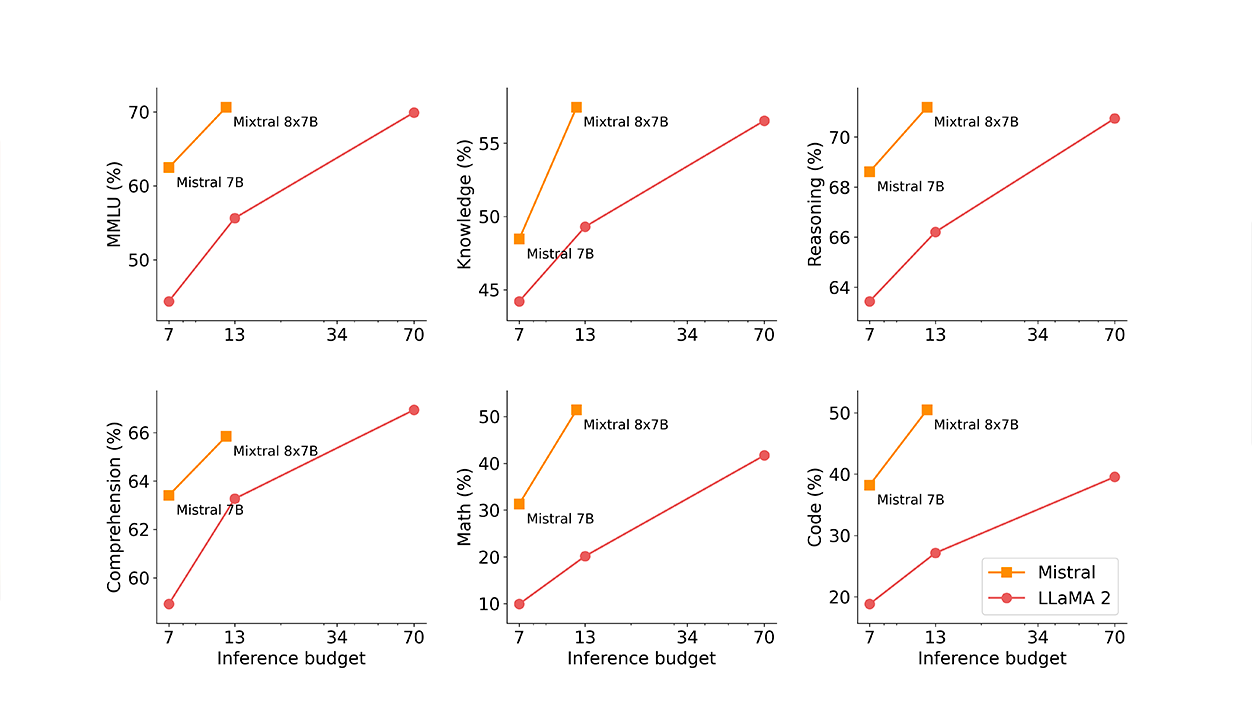
The technical heart of Mistral Large 3 is an architecture of Mixture of Experts (MoE), a design in which the model It has multiple internal "experts"., but only activates a portion of them to process each tokenIn practice, the system handles 41.000 billion active parameters out of a total of 675.000 millionThis allows for combining high reasoning capacity with more controlled energy and computing consumption than an equivalent dense model.
This architecture, combined with a context window of up to 256.000 tokensThis allows Mistral Large 3 to process very large volumes of information, such as lengthy contracts, technical documentation, or large corporate knowledge bases. The model is geared towards use cases such as document analysis, programming assistance, content creation, AI agents, and workflow automation.
In parallel, the models Ministerial 3 They are offered in three main variants: Base (generic pretrained model), Instruct (optimized for conversation and assistant tasks) and Reasoning (Adjusted for logical reasoning and deeper analysis). All versions support vision and they handle broad contexts —between 128K and 256K tokens—, while maintaining compatibility with multiple languages.
The underlying idea, as explained by co-founder and chief scientist Guillaume Lample, is that in "more than 90%" of enterprise use cases, A small, well-tuned model is sufficient. and, moreover, more efficient. Through techniques such as the use of synthetic data for specific tasksThe company argues that these models can approach or even surpass larger, closed options in very specific applications, while reducing costs, latency, and privacy risks.
This entire ecosystem is integrated with a wider range of the company's products: from Mistral Agents APIwith connectors for code execution, web search, or image generation, up to Mistral Code For programmer assistance, the reasoning model Masterly and the platform AI Studio to deploy applications, manage analytics, and maintain usage logs.
Collaboration with NVIDIA and deployment in supercomputing and edge computing

A highlight of the launch is the alliance between Mistral AI and NVIDIA, which positions Mistral 3 as a family of models fine-tuned for the supercomputing systems and edge platforms of the American manufacturer. Mistral Large 3combined with infrastructure such as NVIDIA GB200 NVL72, according to NVIDIA performance improvements of up to ten times compared to the previous generation based on H200 GPUs, taking advantage of advanced parallelism, shared memory via NVLink, and optimized numerical formats such as NVFP4.
The collaborative work doesn't stop at high-end hardware. The series Ministerial 3 It has been optimized to run quickly in environments such as PCs and laptops with RTX GPUs, Jetson devices, and edge platformsfacilitating local inferences in industrial, robotics, or consumer scenarios. Popular frameworks such as Llama.cpp and Ollama They have been adapted to take advantage of these models, which simplifies their deployment by developers and IT teams.
Furthermore, integration with the ecosystem NVIDIA NeMo —including tools like Data Designer, Guardrails, and Agent Toolkit— enables companies to perform fine-tuning, security control, agent orchestration, and data design based on Mistral 3. At the same time, inference engines such as TensorRT-LLM, SGLang and vLLM to reduce the cost per token and improve energy efficiency.
The Mistral 3 models are now available at major retailers cloud providers and open repositoriesand they will also arrive in the form of NIM microservices within the NVIDIA catalog, something especially interesting for European companies that already operate on this manufacturer's stacks and want to adopt generative AI with greater control over deployment.
All this framework allows Mistral 3 to live both in large data centers and on edge devices, reinforcing its narrative of a truly ubiquitous and distributed AI, less dependent on remote services and more adapted to the specific needs of each client.
Small models, offline deployment, and edge use cases

One of the pillars of Mistral's discourse is that Most real-world applications don't require the largest possible model.but one that fits well with the use case and can be fine-tuned with specific data. That's where the nine models in the series come in. Ministerial 3dense, high-performance, and available in different sizes and variants to suit cost, speed, or capacity requirements.
These models are designed to work in a single GPU or even on modest hardwareThis allows for local deployments on in-house servers, laptops, industrial robots, or devices operating in remote environments. For companies handling sensitive information—from manufacturers to financial institutions or government agencies—the ability to run AI within their own infrastructure, without sending data to the cloud, is a significant advantage.
The company cites examples such as Factory robots that analyze sensor data in real time without an internet connection, drones for emergencies and rescues, vehicles with fully functional AI assistants in areas without coverage or educational tools that offer offline help to students. By processing the data directly on the device, the privacy and control of information of the users.
Lample insists that accessibility is a central part of Mistral's mission: there are Billions of people with mobile phones or laptops but without reliable internet accesswhich could benefit from models capable of running locally. In this way, the company is trying to dispel the notion that advanced AI must always be tied to large data centers controlled by a small group of companies.
In parallel, Mistral has begun working with international partners in the area of what is known as Physical AIAmong the collaborations mentioned are Singapore's HTX science and technology agency for robots, cybersecurity, and fire protection systems; and the German Helsing, focused on defense, with vision-language-action models for drones; and automotive manufacturers seeking AI assistants in the cabin more efficient and controllable.
Impact in Europe: digital sovereignty and public-private ecosystem
Beyond the technical aspects, Mistral has become a benchmark in the debate on Digital sovereignty in EuropeAlthough the company defines itself as a "transatlantic collaboration" —with teams and model training spread between Europe and the United States—, its commitment to open models with strong support for European languages has been well received by public institutions on the continent.
The company has closed deals with the French army, the French public employment agency, the government of Luxembourg, and other European organizations interested in deploying AI under strict regulatory frameworks and maintaining control of the data within the EU. In parallel, the European Commission has presented a strategy to boost European AI tools that strengthen industrial competitiveness without sacrificing safety and resilience.
The geopolitical context is also pushing the region to react. It is recognized that Europe has fallen behind the United States and China In the race for next-generation models, while in countries like China open alternatives such as DeepSeek, Alibaba, and Kimi are emerging and beginning to compete with solutions like ChatGPT in certain tasks, Mistral is trying to fill part of that gap with open, versatile models aligned with European regulatory requirements.
Financially, the startup has raised around $2.700 million and has moved within valuations close to 14.000 millionThese figures are far lower than those of giants like OpenAI or Anthropic, but significant for the European ecosystem. A large part of the business model involves offering, beyond open weights, customization services, deployment tools, and enterprise products such as the Mistral Agents API or the Le Chat suite with corporate integrations.
The positioning is clear: to be a provider of open and flexible AI infrastructure that allows European (and other regional) companies to innovate without being completely dependent on US platforms, while maintaining some control over where and how the models are run, and facilitating integrations with tools already implemented in their systems.
Debate on real openness and pending challenges
Despite the enthusiasm that Mistral 3 is generating in part of the technology community, there is no shortage of critical voices that question to what extent can these models truly be considered "open source"The company has opted for an approach open weightIt releases the weights for use and adaptation, but not necessarily all the details about the training data and internal processes needed to reproduce the model from scratch.
Researchers such as Andreas Liesenfeld, co-founder of the European Open Source AI Index, They point out that the major bottleneck for AI in Europe is not just access to models, until large-scale training dataFrom that perspective, Mistral 3 contributes to improve the range of usable modelsHowever, it does not fully solve the underlying problem of a European ecosystem that continues to struggle to generate and share high-quality massive datasets.
Mistral itself admits that its open-plan models are "a little behind" the more advanced closed solutions, but He insists that the gap is narrowing rapidly. and that the key point is the cost-benefit ratioIf a slightly less powerful model can be deployed at low cost, fine-tuned for a specific task, and run close to the user, This may be more interesting for many companies than a top model which can only be accessed via remote API.
Even so, challenges remain: from the fierce international competition This extends to the need to guarantee security, traceability, and regulatory compliance in contexts such as healthcare, finance, and government. The balance between openness, control, and responsibility will continue to guide Mistral and other European players in the coming years.
The launch of Mistral 3 It reinforces the idea that cutting-edge AI doesn't have to be limited to giant, closed models.and offers Europe — and any organization that values technological sovereignty — a palette of open tools that combine a multimodal frontier model with a range of lightweight models capable of working at the edge, offline, and with a level of customization difficult to match by purely proprietary platforms.


I am a technology enthusiast who has turned his "geek" interests into a profession. I have spent more than 10 years of my life using cutting-edge technology and tinkering with all kinds of programs out of pure curiosity. Now I have specialized in computer technology and video games. This is because for more than 5 years I have been writing for various websites on technology and video games, creating articles that seek to give you the information you need in a language that is understandable to everyone.
If you have any questions, my knowledge ranges from everything related to the Windows operating system as well as Android for mobile phones. And my commitment is to you, I am always willing to spend a few minutes and help you resolve any questions you may have in this internet world.