- The United States proposes making it mandatory for tourists traveling with ESTA to submit up to five years of social media history.
- "High-value" data would be added: phone numbers, emails, family information, and new biometric data.
- The measure would particularly affect citizens of Europe and Spain covered by the Visa Waiver Program.
- Experts warn of a possible deterrent effect on international tourism and risks to privacy and civil liberties.
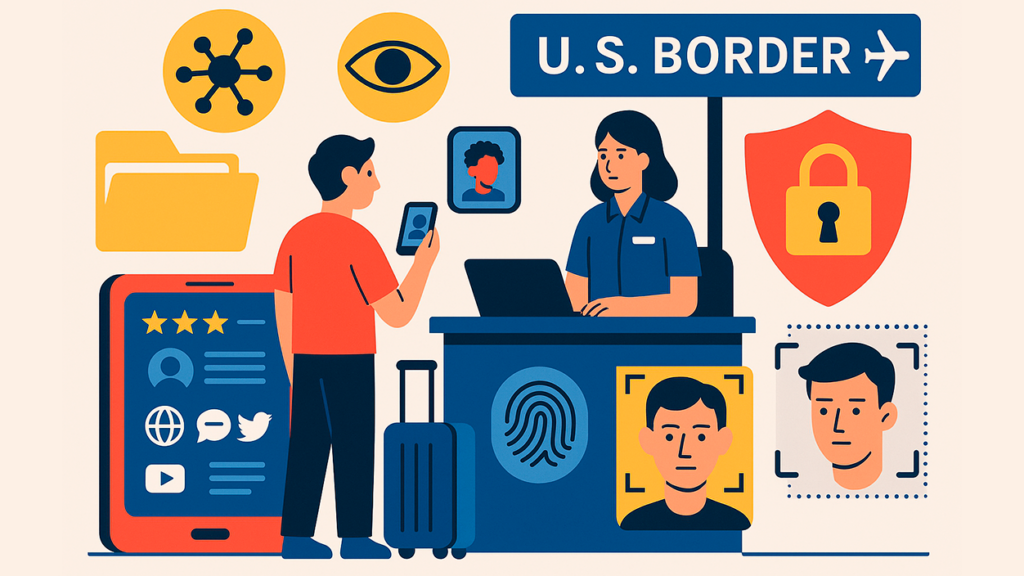
The United States is preparing for a profound change in the way tourists are controlled who arrive in the country, with a special focus on their digital activity. Immigration authorities have raised the issue. a battery of measures that would give border agents access to very detailed information about travelers, from their social media to their biometric data.
The epicenter of this proposal is the Visa Waiver Program and the ESTA systemused by millions of visitors from Europe, including Spain, and other allied countries. What until now was a A relatively simple procedure could become a much more intrusive and exhaustive process., with a direct impact on the planning of leisure, business and study trips.
Social media history as a mandatory requirement
Customs and Border Protection (CBP) and the Department of Homeland Security (DHS) suggest that Tourists must declare up to five years of social media history in order to enter the United States. This information would become a "mandatory data element" within the electronic form of the System for Travel Authorization, known as ESTA.
Until now, the form included a optional question about social mediaAccording to CBP, failing to answer the question did not have negative consequences. Under the new framework, this field would become a requirement for obtaining authorization, both for countries participating in the visa waiver program and, in some cases, for those requiring a traditional visa.
The measure would directly affect citizens of some 40-42 partner countriesThese include most European Union member states, including Spain, as well as Japan, South Korea, Australia, Israel, the United Kingdom, Ireland, New Zealand, France, and Qatar, among others. All of these countries can currently travel to the United States without a visa for up to 90 days using the ESTA, which costs around $40 and is usually valid for two years.
Under the new model, applicants would have to provide information about the accounts they have used on social media platforms during the last five years. The proposal does not specify which networks or what exact type of content. It would be examined, which leaves a wide margin of interpretation for the authorities when reviewing profiles, publications, and online relationships.
The Trump administration justifies this reinforcement by claiming national security and terrorism prevention needsIn official documents, CBP links the initiative to executive orders signed at the beginning of the president's second term, aimed at increasing scrutiny of foreign travelers before they board flights to the United States.
More personal information: phone numbers, emails and family
The increased monitoring is not limited to social media. The proposal includes incorporating additional information deemed relevant. "high value" for intelligence and filtering tasks of travelers. In practice, it's about expanding the documentary trail left by each tourist before setting foot on American soil.
Among the new fields proposed are the phone numbers used during the last five yearsboth personal and professional, and the email addresses used in the last ten yearsThis also applies to the workplace and private life. The stated objective is to more accurately reconstruct the applicant's communications and relationships.
Furthermore, an unprecedented level of detail regarding the traveler's family background would be required. The forms would include the names of parents, spouse, siblings and childrenalong with their dates and places of birth, place of residence, and contact information, such as addresses or telephone numbers. This approach broadens the scope of control beyond the tourist themselves and extends to their relatives.
Some versions of the proposal also mention the possible collection of IP addresses and other technical data associated with the traveler's online activityas well as metadata from photographs or other digital content. Although these points are not entirely clear, they suggest a verification model closer to intelligence analysis than to simple border control.
Qualitative leap in the collection of biometric data
Another major new feature of the plan is the strengthening of the biometric data capture before the tripTo date, fingerprinting or facial imaging has mainly been carried out upon arrival, at passport control points in airports and land borders.
Under the new scheme, this phase would partly shift to prior application: there is talk of requiring the traveler to send a selfie as part of the ESTA processso that the image can be cross-referenced with existing databases and facial recognition systems. Other possibilities mentioned include collecting iris scans or even DNA samples, which would be added to fingerprints and traditional photographic records.
Authorities maintain that advance biometric verification It would allow for the earlier detection of individuals considered at risk and prevent them from boarding flights to the United States. However, digital rights organizations and privacy experts warn that this is a A very significant expansion of physical and digital control over travelerswhich could be used for purposes other than border security.
In parallel, the implementation of a new mobile tool for foreigners is being studied. electronically register your departure from the United StatesThis type of system would strengthen the monitoring of stays and make it easier to detect those who exceed the maximum time allowed under the visa exemption program.
Forced digitization: the ESTA app as the only channel
CBP is also proposing a structural change in the way travel authorizations are processed. The plan involves Migrate the ESTA process to an official government mobile application, gradually eliminating the possibility of requesting the permit through the traditional website.
According to preliminary estimates, more than 14 million applicants per year would have to use the application If the reform comes into effect, centralizing all data—biographical, contact, family, social media, and biometric—into a single app would allow authorities to more easily integrate the information into their databases and analysis systems.
This shift towards the mobile channel raises practical questions, especially for travelers less accustomed to technologyolder people or those without easy access to compatible smartphones. Immigration lawyers and consumer groups fear this mandatory digitization could become an additional barrier for certain types of tourists, including some Europeans who travel regularly for family or work reasons.
From a data protection perspective, concentrating so much sensitive information in a single application also raises concerns Questions about cybersecurity, potential breaches, and the future use of those recordsThis is especially worrying in Europe, where the General Data Protection Regulation (GDPR) imposes very strict standards on institutions and companies that handle personal data.
Political context and the extension of digital scrutiny
The proposals fit into a broader immigration hardening strategy pursued by the Trump administrationwhich in recent years has introduced changes to almost all entry points into the country, both regular and irregular. The control of social media, in particular, has become one of the preferred tools of this approach.
Since 2019, all immigrant and non-immigrant visa applicants They are already required to declare their social media accounts. More recently, scrutiny has increased on foreign students and highly skilled workers with H-1B visas, requiring them to Keep your profiles public. to facilitate the review of opinions, contacts, and publications.
In instructions sent to embassies and consulates, the State Department has indicated that officials may investigate possible “hostile attitudes” toward American society or institutions as part of the application evaluation. It is even considered that the absence of a social media presence could be interpreted negatively in some cases, something that particularly worries young Europeans planning to study or work temporarily in the United States.
The recent security context has provided further support for these policies. Incidents such as the attack against members of the National Guard in WashingtonThe case, attributed to an Afghan citizen, has led to temporary suspensions of immigration procedures for certain countries and has reinforced the narrative that it is necessary to intensify pre-travel screening.
Concern for privacy and civil liberties
In contrast to the Government's position, digital rights organizations and immigration lawyers They warn of the implications of this model for freedom of expression and the privacy of travelers. One of the recurring criticisms is that these measures They have not proven to be particularly effective at detecting terroristswhile they do generate significant side effects.
Groups like the Electronic Frontier Foundation argue that the obligation to disclose social media history can lead to self-censorship among students, researchers, and touristswho might avoid commenting on sensitive political issues, criticisms of governments, or international conflicts for fear of being denied entry.
Sophia Cope, a lawyer from this organization, has emphasized that this type of policy “It undermines freedom of expression and invades the privacy of innocent travelers and those around them.”without providing clear guarantees that they will improve security. It is also noted that tracking online activity can indirectly affect American family members, friends, or colleagues, whose interactions are also exposed.
From Europe, where data protection is a key regulatory pillar, several experts see these measures as a clash of regulatory modelsWhile the European approach seeks to minimize data collection and limit its uses, the scheme proposed by the United States tends to accumulate and cross-reference information from multiple sources, which many legal experts find difficult to reconcile with the principles of the GDPR.
Another worrying aspect is the foreseeable increase in processing times Regarding ESTA authorizations, the larger the volume of data that needs to be analyzed, the more likely delays are, especially during peak tourist seasons. This uncertainty can complicate the organization of short trips, weekend getaways, or business trips at short notice.
Impact on international tourism and European travelers
The tightening of controls comes at a time when The United States is already noticing a decline in tourist appeal compared to other destinations. Recent data indicates double-digit declines in the number of international visitors during peak seasons, with estimated losses of billions of dollars in tourism spending.
Organizations such as the World Travel and Tourism Council have gone so far as to project that The United States may be the only major economy, among more than 180 analyzed, with a reduction in spending by international visitors. in the short term. Some specialized consulting firms point to expected declines of more than 8% in international arrivals and cuts of several percentage points in total spending, figures that translate into billions of dollars less for the industry.
This context is particularly striking given that the country is preparing to host events with huge tourist appeal, such as the 2026 World Cup - which it shares with Mexico and Canada - or the Los Angeles Olympic Games in 2028. Any additional obstacles to travel, such as more intrusive procedures or slower bureaucracy, could end up reducing the number of fans from Europe and other continents willing to travel.
From Europe, and particularly from Spain, where travel to the United States is common for leisure, study, or work, the evolution of these measures is being closely followed. Many Spanish citizens are covered by the visa waiver program and depend on ESTA for trips of up to 90 days. The possibility of having to hand over years of digital life, contacts, and public opinions is causing concern among those who value privacy as a basic element of their daily lives.
At the same time, a comparison with the reverse flow is inevitable. Whereas US citizens can visit Spain and other European countries without a visa And without a similar level of data requirements, many Europeans perceive a certain imbalance in the conditions of reciprocity. This debate has already crept into some political discussions within the EU regarding the future of mobility agreements with the United States.
In this scenario, Washington's proposal to expand data collection, require social media accounts to be declared, and strengthen biometric controls has become a point of friction between safety and ease of travelWhile US authorities argue that it is a necessary tool to protect the country, a growing segment of international public opinion—including many Spanish and European tourists—is beginning to question whether the cost in privacy and bureaucratic complexity outweighs the experience of visiting the destination.

I am a technology enthusiast who has turned his "geek" interests into a profession. I have spent more than 10 years of my life using cutting-edge technology and tinkering with all kinds of programs out of pure curiosity. Now I have specialized in computer technology and video games. This is because for more than 5 years I have been writing for various websites on technology and video games, creating articles that seek to give you the information you need in a language that is understandable to everyone.
If you have any questions, my knowledge ranges from everything related to the Windows operating system as well as Android for mobile phones. And my commitment is to you, I am always willing to spend a few minutes and help you resolve any questions you may have in this internet world.