- DGT 3.0 is an IoT platform from the DGT that connects vehicles, infrastructure and users to offer free, real-time information.
- The combination of anonymous data, 5G technology and devices such as the connected V16 beacon makes it possible to reduce accidents, traffic jams and emissions.
- The geolocated V16 beacon will be mandatory from 2026 and will automatically send the position of the broken-down vehicle to the DGT 3.0 cloud.
- Manufacturers, municipalities, fleets, insurers, and developers can integrate into the platform using REST and MQTT APIs with high security standards.

La DGT 3.0 has become one of the major technological initiatives of the Directorate General of Traffic to completely change the way we move around on Spanish roads. It's not just about putting sensors or devices in cars, but about building a connected ecosystem where vehicles, roads, emergency services, road workers, cyclists, and government agencies share information in real time.
In this context of connected cars, 5G and smart mobility, The DGT 3.0 platform aims to drastically reduce accidents, traffic jams and emissions While making daily life easier for drivers and other road users, let's take a closer look at exactly what it is, how it works, what technologies it uses, the role of the connected V16 beacon, and how it will change our roads in the coming years.
What is DGT 3.0 and why is it so important?
DGT 3.0 is a smart digital platform based on the Internet of Things (IoT) which the Directorate General of Traffic began developing in 2017. Its mission is to connect in real time all elements related to traffic and mobility: vehicles, signs, variable message panels, traffic lights, maintenance workers, bicycles, cranes, emergency services, city councils, transport fleets, insurers and many more actors.
Through this platform, The DGT (Spanish Directorate General of Traffic) can know at any given moment what is happening on Spanish streets and roads.This includes information such as where a car has broken down, what roadworks are underway, whether an emergency eCall has been activated, if there's a sudden storm, or if a sporting event is taking place that affects traffic. All this information, processed anonymously, is shared with other users to improve traffic safety and flow.
The project is part of the European vision for road safety, which aims to The goal is to achieve zero deaths and zero serious injuries by 2050. in traffic accidents. In Spain, DGT 3.0 is a key part of that strategy: by leveraging data from connected vehicles and infrastructure, it is hoped that up to 80% of accidents can be avoided, according to estimates from researchers such as José Francisco Monserrat, from the Polytechnic University of Valencia.
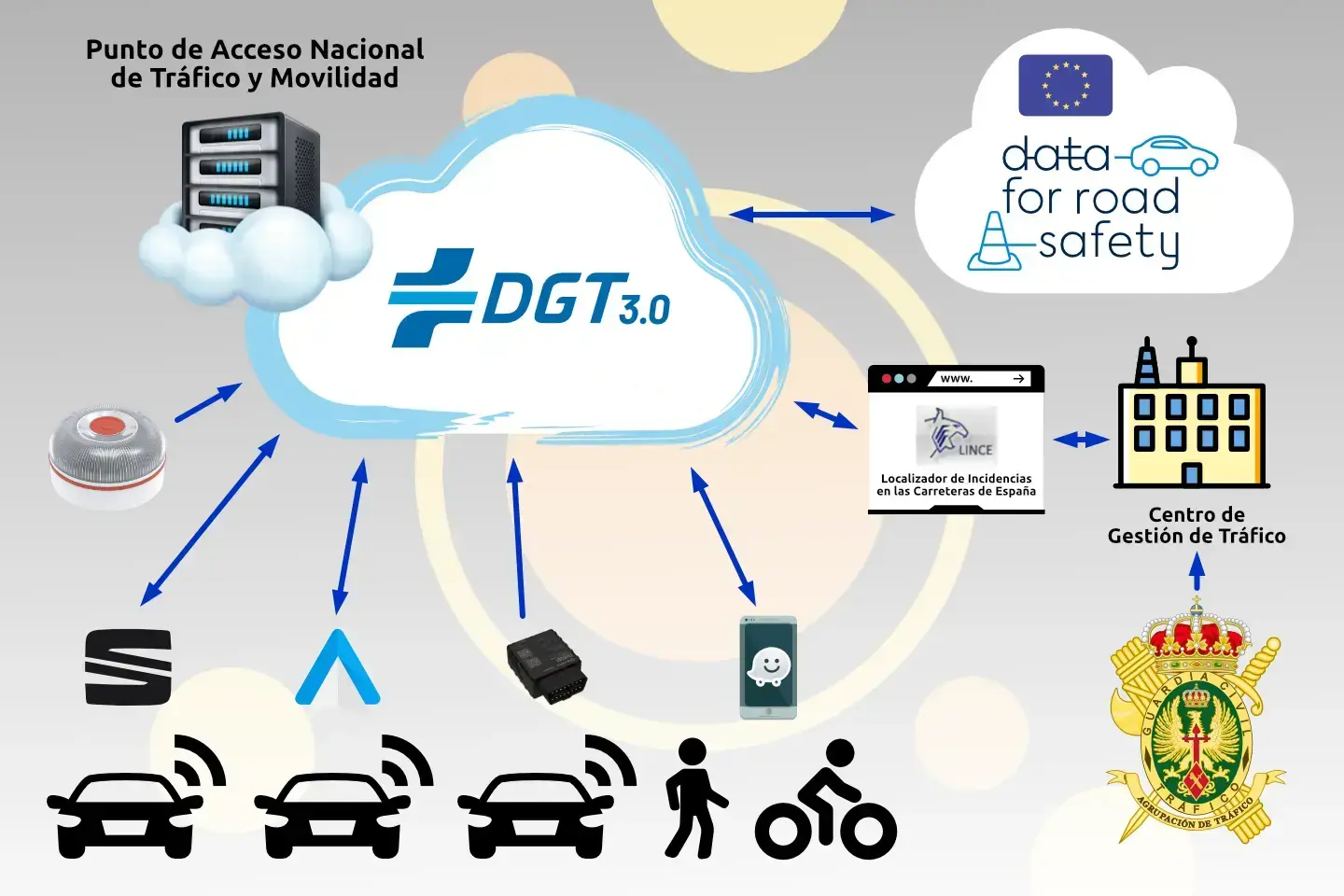
Main objectives and benefits of the DGT 3.0 platform
The core of the project can be summarized as follows: DGT 3.0 aims to offer unique, free and truthful information in real time especially regarding driving in Spain, both on urban and interurban roads. But behind that simple idea lie many specific objectives.
On the one hand, the DGT seeks that all road users are informed immediately about any relevant incident: a vehicle stopped on the shoulder, roadworks blocking lanes, an approaching ambulance, a stretch of road with heavy rain, or a Low Emission Zone (LEZ) restriction. The more reliable information the driver has, the better they can anticipate and the lower the risk.
On the other hand, the platform aims Optimize traffic management through aggregated data and predictive analyticsIf you know in real time how the entire (or a large part) of the vehicle fleet is moving, it is possible to detect emerging traffic jams, predict congestion, adjust variable speed limits, or decide which routes are more efficient for certain types of transport.
Among the direct benefits for drivers and other users are the following: early warnings about road safety and conditions: roadworks alerts, notification of a broken-down vehicle, traffic jam detection, information on adverse weather conditions or alerts of the presence of vulnerable users such as cyclists and pedestrians in risk areas.
The platform also allows to better manage environmental protocols and Low Emission ZonesDGT 3.0 can cross-reference environmental label data with information from Low Emission Zones (LEZs) and warn a driver in advance that their vehicle cannot access a certain zone, so they can find another route or alternative transport.
How DGT 3.0 works: data, anonymity and information flow
To fully understand the logic of the system, one must start from the premise that Modern vehicles already incorporate a multitude of sensorsSpeed, ABS or ESP activation, windshield wiper usage, fog lights, eCall, etc. With the right connectivity, all this data can become very valuable information for road safety when shared in an aggregated and anonymous way.
DGT 3.0 acts like a large cloud that receives data from connected vehicles, devices, and systemsFor example, if a car suddenly stops on the shoulder and the eCall emergency call is activated, the system knows there's a significant incident at that location. If many vehicles abruptly reduce their speed on a particular stretch of road, it can be deduced that there's a traffic jam or an obstacle.
This data is managed while guaranteeing privacy: The platform knows the vehicle's information and its position, but does not directly associate the data with a personal identity.Only in situations where a driver or vehicle is considered to pose a serious risk to road safety could the information be analyzed in more detail.
Once processed, The information is redistributed to different actors and channelsNavigation apps, car multimedia systems, fleet management platforms, city councils, insurance companies, and emergency services all use this information. This way, anyone about to drive through a dangerous area receives advance warnings, either on the car's dashboard, in a mobile app, or on the navigation system.
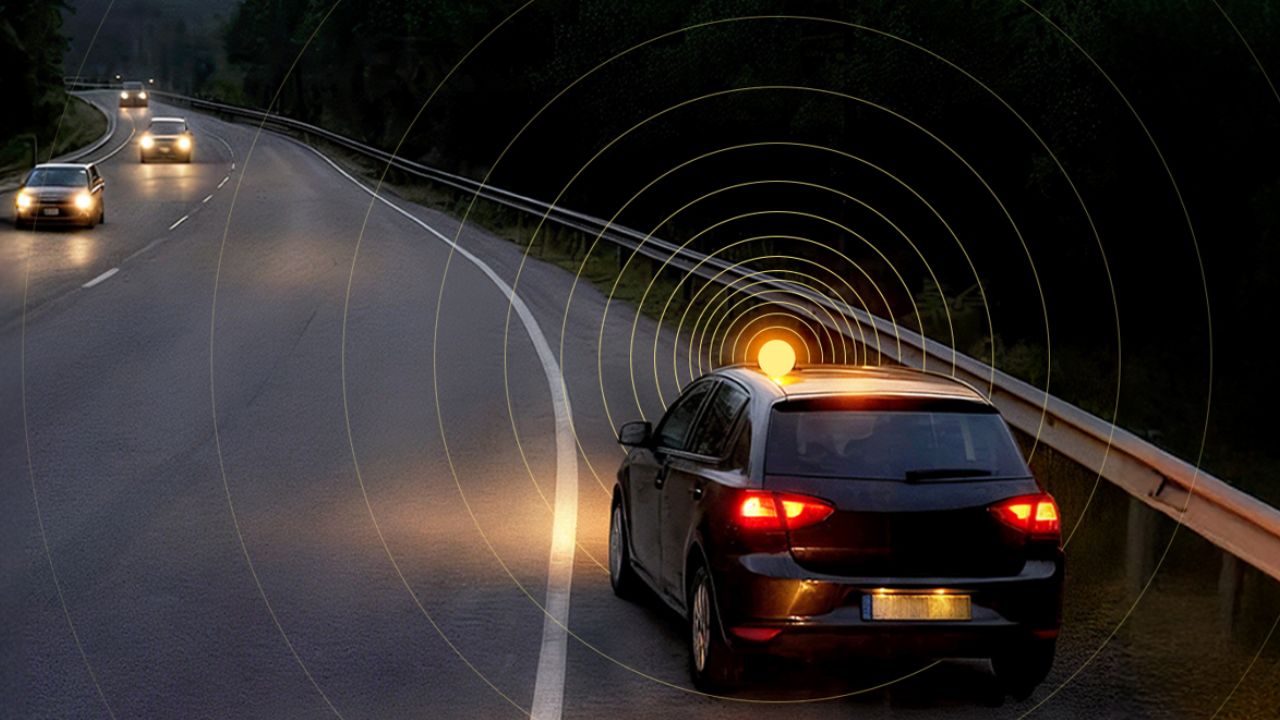
A very graphic example is that of the virtual hazard sign V-27If a connected car has to stop on the shoulder due to a breakdown, that information reaches the cloud and the other approaching vehicles can see a warning similar to a virtual emergency triangle on their instrument panel, minutes before physically encountering the obstacle.
What kind of information will DGT 3.0 offer to users?
One of the platform's great strengths is that It does not simply warn of accidents or breakdownsThe range of data that can be displayed is very broad and grows as more actors connected to the ecosystem are added.
Among the most relevant data that DGT 3.0 will handle are the real-time traffic situation (fluid, dense, retained), based on the average speed associated with a given GPS position, and the local weather conditions, deduced from parameters such as the use of windshield wipers or fog lights by numerous vehicles in the same area.
The platform will also allow to be aware of the existence of minor or serious accidents Thanks to the activation of safety systems such as ESP or ABS, or to automatic emergency calls via eCall, authorities and emergency services can react faster and more accurately.
In urban areas, drivers will be able to consult Information on traffic lights, loading and unloading zones and parking availability (available spaces, parking features, opening hours). This is especially useful for delivery fleets, public transport, or last-mile services.
Another key data set relates to special mobility and events: location of sporting events, large transports, routes for hazardous goods, roadside assistance cranes or points of interest such as level crossings and marked cycle paths. This allows users to decide whether to avoid these areas or take extra precautions.
Furthermore, thanks to the sensorization of the road and the connected devices, DGT 3.0 will offer information on roadworks and temporary diversionsaccurately locating where workers are operating, which lanes are occupied, and what maneuvers drivers must perform to safely pass through that section.
Actors who share and consume information in DGT 3.0
For the system to work, it is essential that Many types of organizations connect and collaborateThe platform is designed as an open, collaborative, and free environment where everyone can contribute and benefit from information.
Among the actors interested in share information These include manufacturers of signaling devices (such as beacons, panels or sensors), infrastructure managers, companies responsible for road maintenance, and developers or providers of safe mobility applications.
On the side of those who They consume the information According to DGT 3.0, the list includes vehicle manufacturers, navigation service providers, city councils, public transport management platforms, fleet companies with telematics systems, insurance companies, roadside assistance operators and mobility applications in general.
The interconnection between all of them makes it possible that the network feeds itself almost entirely with dataA connected vehicle generates information that a workshop, an insurance company, or a fleet manager can use to improve their services, while these same actors can upload data to the platform so that other road users can drive more safely.
The vehicle manufacturers themselves have indicated that Sharing user data anonymously can have real benefits for societyProvided there is a clear regulatory framework and privacy is respected. At the same time, brands like SEAT emphasize that the widespread implementation of this connectivity depends on economic, technological, and regulatory factors, and, of course, on end-user acceptance.
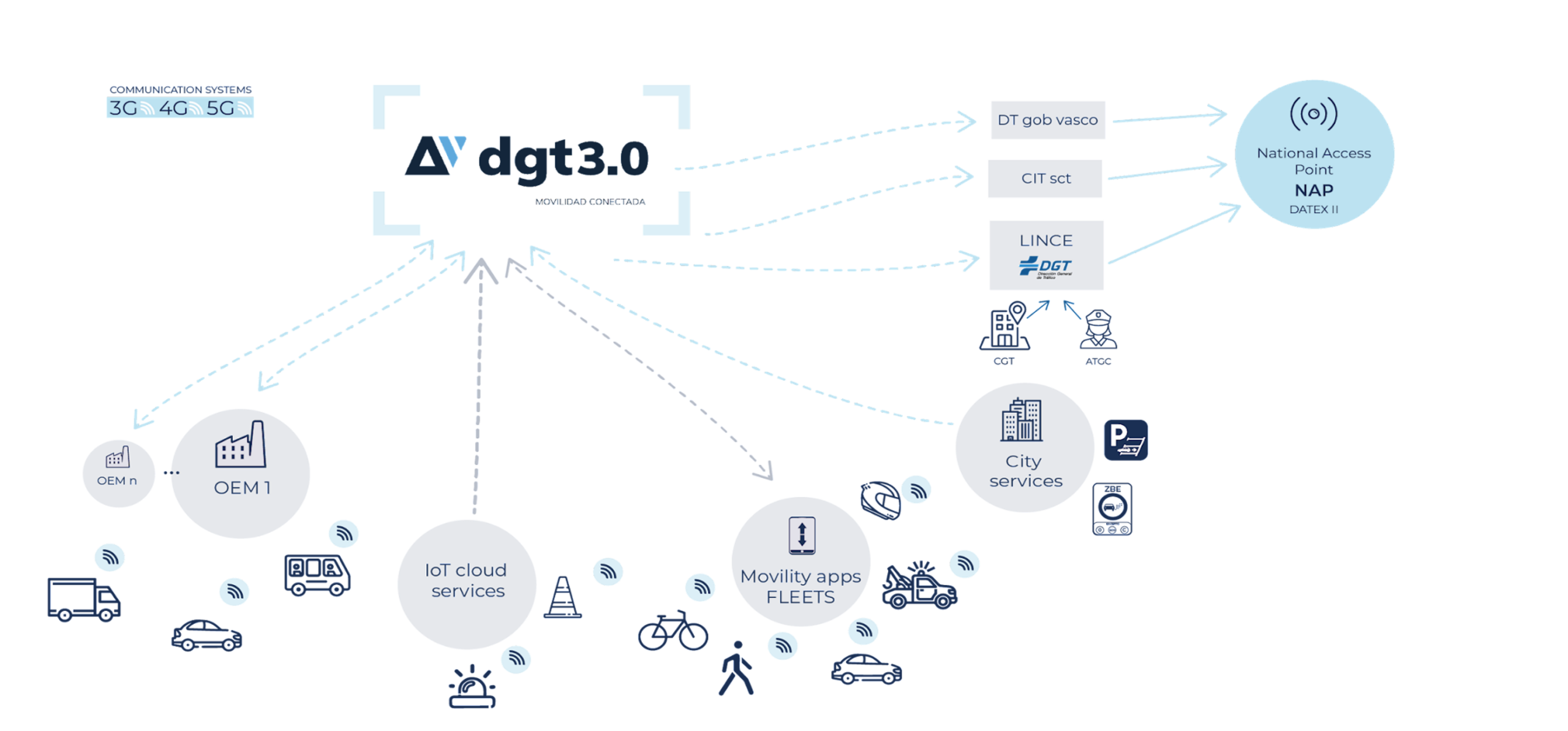
Technical infrastructure: public cloud, REST APIs and MQTT
From a technological point of view, DGT 3.0 has been developed as a IoT platform hosted in the public cloud with high scalability, availability, and securityThis allows the system to grow as more actors join, without the need to deploy a disproportionate physical infrastructure.
The platform communicates with the backends of each participating actorThis is where the server applications responsible for sharing or consuming information reside. These, in turn, connect with client applications that may be on beacons, mobile phones, vehicle telematics units, smart traffic lights, or other devices.
To make this integration possible, DGT 3.0 uses market standards such as REST APIs and MQTT queuesDepending on the use case, REST is ideal for traditional web services, while MQTT is well-suited for lightweight, low-latency communication between IoT devices. This allows each company or organization to use its preferred programming language and architecture, as long as it communicates with the platform using one of these standard languages.
Regarding safety, it is mandatory that each actor must have at least one public IP address included in the whitelist of DGT 3.0 and that has a client X.509 v3 digital certificate for authentication and authorization. This certificate is issued by an internal Certification Authority of the platform itself, which strengthens control over who accesses the system and how data is exchanged.
The DGT also makes available to interested parties specific technical documentation for each service, so that manufacturers, developers and infrastructure managers can integrate their systems without too much friction and with full compatibility.
The role of 5G and connected mobility
The arrival of 5G is the major accelerator of this model, since It offers greater speed, more capacity for connected devices, and minimal latency.While 4G takes around 50 milliseconds to send and receive information, 5G can reduce that time to as little as 1 millisecond, making it virtually instantaneous for most uses.
This reduction in latency is crucial for real-time road safety applicationsWarning drivers of a stopped car a few seconds in advance can mean the difference between braking in time and being rear-ended. With 5G networks deployed on roads and in cities, intelligent transportation systems can make decisions almost instantly.
Spain has made a firm commitment to this technology, announcing investments of more than one billion euros for its deployment and the creation of thousands of jobs to support the network across the country. The European Union, for its part, plans to invest around €3.500 billion in the development of 5G, with the goal of having major urban areas, roads, and railway lines covered by 2025.
The DGT insists that It will not be necessary to sensorize the entire road network to benefit from connected mobility. The key will be mobile phones and connected vehicles themselves, which will be able to operate on any road with 4G or 5G coverage, including conventional roads, considered the most dangerous.
Looking ahead to the next few years, it is estimated that Around 35% of the vehicle fleet will be connected in the near future, and that by 2030 virtually all cars less than five years old will communicate with the DGT 3.0 platform in one way or another.

Geolocated V16 beacon and its integration into DGT 3.0
The most familiar part to the average driver within this ecosystem is the V16 emergency beacon connectedThis device, which is intended to replace the traditional emergency triangles, will be mandatory in Spain from January 1, 2026.
Until the end of 2025, drivers can continue to use triangles or unconnected beaconsHowever, from 2026 onwards, any vehicle traveling on our roads must carry an approved V16 beacon with geolocation and connected to the DGT 3.0 platform. Those who do not have it will be subject to fines.
The main reason for this change is security: With the warning triangles, the driver is obliged to get out of the carWalking several meters along the road and placing the signs, often in conditions of poor visibility or heavy traffic, poses a real risk of being hit by a vehicle, especially on highways.
The V16 beacon, on the other hand, is placed from inside the vehicleSimply lean slightly out of the window and attach it to the roof using its magnetic base. It emits a flashing amber light visible from a long distance (over a kilometer) and in 360 degrees, so other road users immediately notice that a vehicle is stopped.
The real revolution comes with the Connectivity and geolocation integrated into the homologated V16When activated, the device sends the car's exact coordinates to the DGT 3.0 cloud within a few seconds, without requiring any further action from the driver. This allows traffic control centers and emergency services to immediately know the location of a stopped vehicle and better manage assistance.
Requirements and technical operation of the connected V16 beacon
For a V16 beacon to be valid for regulatory purposes, It must have official approval from the Ministry of the Interior and the DGT (Spanish Directorate General of Traffic).This approval is reflected in a code visible on the device itself or on its packaging, and can also be checked in a list that the DGT publishes periodically on its website.
On a technical level, the beacon must emit amber light visible in 360 degrees and be detectable from over a kilometer awayWith a compact, watertight design that is resistant to rain, wind, and extreme temperatures, the magnetic base is essential for ensuring quick and secure attachment to the car roof.
The beacon is also required to have autonomous operation through V16 beacon battery or batteries with a guaranteed minimum lifespan, which is usually around 18 months or more for higher-quality models. The goal is that, even if it spends a lot of time stored in the glove compartment, it will work perfectly the first time when needed.
Regarding connectivity, the beacon must be able to automatically send the GPS position to the DGT 3.0 platform through the mobile network, without depending on the user's phone. Some manufacturers include data service for many years at no extra charge, so the driver doesn't have to subscribe to separate paid plans.
To use it correctly, the basic recommendation is stop the vehicle in the safest place possibleTo activate the beacon from inside the vehicle, place it on the roof and visually verify that the flashing light is active. From there, the system will alert other drivers and report the incident to the DGT 3.0 (Spanish Directorate General of Traffic).
How to become part of DGT 3.0 and who can connect
Any actor wishing to integrate with the platform, whether to share or consume information, must Apply for registration through the official DGT website 3.0The process usually involves filling out a contact form and providing some technical and administrative documentation.
Once the data has been sent, the DGT itself Review and validate the information provided, and contacts the applicant to explain the next steps: delivery of certificates, connection tests, access to detailed technical documentation or definition of specific use cases.
The minimum requirements include, as mentioned before, have at least one public IP address for the backend which will be added to the platform's whitelist, along with a client X.509 v3 digital certificate to secure communications. This ensures that only authorized parties exchange data with DGT 3.0.
From that moment on, the actor's server applications (for example, a navigation provider or a fleet manager) will be able to connect using REST APIs or MQTT to send their own information or receive the information that DGT 3.0 makes available to the ecosystem. Each organization decides how to present this data to its end users, whether through mobile apps, vehicle-integrated systems, connected beacons, or other types of interfaces.
The underlying idea is that The driver doesn't have to fight with multiple isolated sources and platformsbut rather receives coherent, structured, and real-time information, regardless of the application or device used to access it.
Looking at the medium term, DGT 3.0 is shaping up to be the heart of connected mobility in SpainBy integrating data from millions of vehicles and devices into a single platform, it better coordinates emergencies, reduces accidents, and makes daily commutes smoother and cleaner.

Editor specialized in technology and internet issues with more than ten years of experience in different digital media. I have worked as an editor and content creator for e-commerce, communication, online marketing and advertising companies. I have also written on economics, finance and other sectors websites. My work is also my passion. Now, through my articles in Tecnobits, I try to explore all the news and new opportunities that the world of technology offers us every day to improve our lives.