- Dell and other major manufacturers anticipate price increases for PCs and laptops due to the rising cost of RAM.
- The cost of DRAM has skyrocketed by more than 170% due to the demand for artificial intelligence and the shortage of supply.
- Some Dell configurations charged up to $550 extra to upgrade from 16GB to 32GB of RAM.
- Alternative manufacturers like Framework are announcing more contained and transparent increases in their memory upgrades.
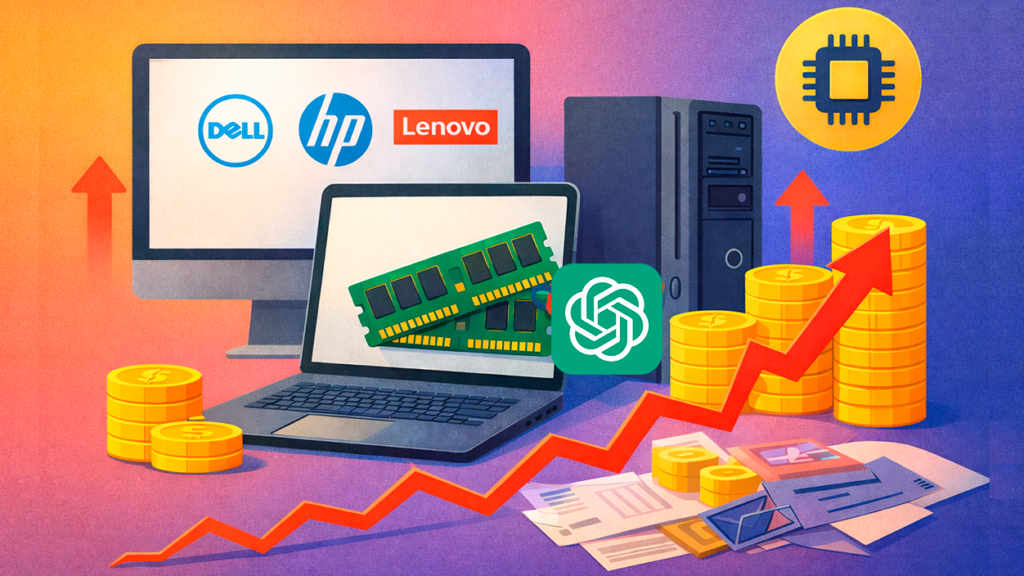
Users who were thinking of upgrading their laptop or desktop computer in the coming months are faced with a a discouraging outlookIn the sector, it is practically taken for granted. Price increase on Dell equipment and from other major manufacturers, motivated by a unprecedented increase in the cost of RAM and other internal components.
Major brands in the professional and consumer markets have begun to inform distributors and companies that the period of relative stability in hardware costs is over. Dell, HP and Lenovo They are among the manufacturers who have already warned that their catalogs will be adjusted upwards in the short termThis move will have an impact on both large corporate contracts in Europe and purchases by individuals.
The perfect storm: DRAM through the roof and AI pressure

The origin of this price shift lies in the memory market, where the chips DRAMs have risen by more than 170% in one yearThis surge is not due to a simple temporary setback, but to a combination of supply shortages and rampant demand from large technology companies that are setting up data centers and servers specifically for artificial intelligence.
Memory manufacturers have been redirecting some of their production toward higher-margin components for servers and AI accelerators, leaving less capacity available for modules intended for personal computers. This reduced availability This translates into higher costs for PC manufacturers., who are now forced to pass on part of that increase to their laptop and desktop ranges.
From the European user's perspective, this will be especially noticeable in configurations with more memory. Systems with 16 GB of RAM could remain the standard for a time, while The 32GB or 64GB versions will experience the biggest price increasesmaking both mid-to-high-end models and workstations more expensive.
Some industry analysts suggest that memory price volatility could continue for several years, with estimates placing it beyond 2028. In this context, various reports recommend do not delay planned hardware purchases too muchsince waiting could mean encountering significantly higher rates.
Dell under scrutiny: controversy over RAM upgrades
Amid this tense climate, Dell has become embroiled in a controversy over the price of some of its configurationsThis is especially true for laptops geared towards productivity and content creation. The discussion has spread rapidly through social media and specialized forums, where RAM upgrades have been pointed out as being unjustifiably expensive compared to the competition.
One of the cases that generated the most controversy was that of a Dell XPS model with Snapdragon X Plus processor and 16 GB of RAMIn a screenshot from their online store, when choosing the configuration with With 32 GB of RAM, the price difference was around $550., a figure well above what that memory upgrade usually costs, even in premium brands.
Comparisons soon followed. In the high-end laptop ecosystem, Apple charged around $400 Dell offered a similar RAM upgrade in some of its systems, illustrating just how noteworthy Dell's proposal was. This difference reinforced the perception that memory shortages were leading to very aggressive pricing strategies.
Shortly after, Dell's own website showed a very different additional cost. In the updated configuration of the same computer, the upgrade to 32 GB appeared with an increase of approximately $ 150This figure is much more in line with typical memory upgrades in the industry. This adjustment raised questions about whether the initial price was the result of a one-off error, a broader combination of hardware improvements, or a poorly executed business experiment.
The incident has left a residue of distrust among some of the more informed consumers, who are now scrutinizing expansion options and comparing them with alternatives from other manufacturers. Even so, the underlying context remains the same: RAM has become one of the most critical aspects in PC configurationboth in terms of availability and price.
Framework and other manufacturers are distancing themselves from Dell
The reaction hasn't been limited to end users. Smaller companies, like Framework, have taken advantage of the situation to to establish its own profile in contrast to Dell's pricing policy and the rest of the major brands. This company, focused on modular and repairable laptops, has been very critical of what it considers excessive price increases taking advantage of the market situation.
Framework has openly admitted that it will also be forced to raise the price of their laptops and RAM modules due to increased supplier costs. However, he assures that he will try to contain the increases as much as possible and avoid turning the current shortage into an excuse to inflate profit margins at the expense of the user.
The company has even gone so far as to publish a detailed list of the supplements it will apply to each memory configuration, something unusual among major manufacturers. Its catalog includes, for example, 8GB DDR5 5600 modules with a $40 surcharge16GB options with $80 increments and 32GB kits (2 x 16GB) with a $160 surcharge.
These figures, while still representing a noticeable increase, turn out much more moderate than the public cases attributed to Delland are better aligned with the actual increase in component costs. In this way, Framework seeks to differentiate itself with a transparent pricing policy and a clear message: to pass on only part of the problem to the end customer instead of the entire cost.
This contrast between the strategy of large, traditional manufacturers and that of smaller companies is fueling a broader debate about the extent to which Part of the industry is taking advantage of the situation to improve its margins under the umbrella of component shortages.
Impact on European companies, administrations and users
For the European market, and especially for countries like Spain where Dell has a strong presence in the professional sector, the price increase comes at a delicate time. Many companies and public administrations were immersed in computer fleet renewal processes after several years of teleworking, system updates and delayed replacement cycles.
The prospect of increases of up to 20% in certain product lines necessitates rethink budgets and purchasing schedulesSince these are large contracts, any price variation in configurations with more RAM or storage translates into thousands of additional euros, leading to prioritizing some acquisitions over others or opting for more modest specifications.
In the home user sector, the situation is perceived somewhat differently but equally significant. Many consumers, accustomed to seeing aggressive offers on laptops and desktops, are now finding that computers with 32 GB of RAM or more skyrockets in price, prompting them to consider whether they really need that much memory or if intermediate configurations are sufficient.
Hardware experts emphasize that, for general and office use, 16 GB is still enough In most cases, especially if the system is well optimized and paired with a fast SSD, the price increase will be significant. However, those working with video editing, 3D design, multiple virtual machines, or heavy local AI tools will still require larger amounts of memory, so the price hike will affect them considerably.
From a logistical standpoint, European distributors are also trying to anticipate future price increases. Some chains and specialist stores are reinforcing its stock of equipment and RAM modules before new price lists are implemented, although that strategy also entails risks if demand does not keep pace.
Is it better to buy a PC now or wait?

With the information available, many individuals and organizations are wondering whether it's better to buy now or wait for the market to stabilize. Forecasts indicate that the Memory price instability could last for several years This leads many analysts to recommend not delaying planned investments too much.
In the case of Dell computers and those from other major manufacturers, the most frequent recommendation is that, if you need a computer for work or study in the short term, It's not worth waiting for prices to drop.Because there are no guarantees that this will happen in the medium term. Conversely, if it's a purely optional purchase, it might make sense to consider options with less RAM as standard and leave the upgrade for later, when the user can install modules themselves if the system design allows it.
For those who depend on very specific, officially distributed configurations, the prudent course of action is carefully compare the different expansion options that manufacturers offer and study whether it is worth paying the extra they ask for for more memory, or if it is better to jump to a next higher range where that extra cost is proportionally lower.
The debate is also reaching the regulatory arena, with voices calling for greater transparency in pricing structures of PCs and laptops sold in Europe. Although no specific measures are currently in place, it is possible that, if discontent grows, initiatives may emerge to more closely monitor potential abuses in the context of component shortages.
The scenario that emerges is one of a computer market in which RAM becomes a critical factor both technically and economicallyDell is in the spotlight due to its significant presence in both the professional and consumer segments, but the problem is much broader and affects the entire industry. Anyone planning to upgrade their computer in Spain or the rest of Europe would be wise to research thoroughly, carefully review the configurations, and assess whether it's the right time to buy or adjust their expectations regarding performance and budget.

I am a technology enthusiast who has turned his "geek" interests into a profession. I have spent more than 10 years of my life using cutting-edge technology and tinkering with all kinds of programs out of pure curiosity. Now I have specialized in computer technology and video games. This is because for more than 5 years I have been writing for various websites on technology and video games, creating articles that seek to give you the information you need in a language that is understandable to everyone.
If you have any questions, my knowledge ranges from everything related to the Windows operating system as well as Android for mobile phones. And my commitment is to you, I am always willing to spend a few minutes and help you resolve any questions you may have in this internet world.