- Fundamental difference between the use of reactive chatbots and the implementation of autonomous agents capable of executing complete workflows.
- Orchestration strategies to divide complex processes into specialized sub-agents that reduce cognitive load and error.
- Human governance and oversight methodologies to ensure safety and quality in business process automation.
How can a lead agent delegate tasks to other agents? I'm sure it's happened to you: you start using artificial intelligence to write an email or summarize a text, and suddenly you realize that the potential is much greater. We're no longer in the era of simple chats that answer questions; now we're in the era of... AI agentsTools that not only talk, but also execute. The real magic happens when we stop interacting with AI as if it were an encyclopedia and start building workflows where it takes the reins and acts for us.
Moving from a consultation assistant to a true delegation system is what makes the difference between saving a few minutes a day or transform productivity of an entire business. It's not about giving it isolated commands, but about setting up a structure where AI knows which tools to use, who to contact, and how to deliver a final result without us having to constantly copy and paste data. Let's see how to put this into practice in the real world, from the simplest scenarios to the orchestration of complex digital teams.

Agents vs. Chatbots: The Leap to Execution
To understand how to delegate, you first need to be clear that an agent is not a souped-up chatbot. While a chatbot waits for you to tell it what to do each turn, an agent combines the capabilities of the language model with permissions and tools specific. This means it can autonomously read your inbox, write in a spreadsheet, or schedule an appointment in your calendar.
The key here is the flow. Instead of asking AI to draft an email, you set up a scenario where, when a lead enters through a form, the agent qualifies it, searches for customer information, and Prepare a custom draftIt's the difference between having an advisor who tells you how to do things and having a digital employee who does them from start to finish.
What tasks can you start delegating right now?
If you don't know where to start, the best thing to do is look for those tasks that are a real drag because they're repeated over and over again. Those recurring tasks These tasks may seem short and take no time, but by the end of the week they add up to hours of exhausting mental work. Some practical ideas include:
- Lead management: detect new contacts, filter them according to criteria and send the first contact message.
- Routine data analysis: Create weekly summaries of sales or incidents from raw files.
- Support and triage: Read support tickets, label them by urgency, and prioritize the work queue for the human team.
- Agenda organization: coordinate schedules among several people and send relevant reminders.
A very simple rule of thumb: if you could give an intern a three-line instruction and they could complete the task without asking any further questions, that task is... Perfect for an agent.

The architecture of delegation: Main agents and sub-agents
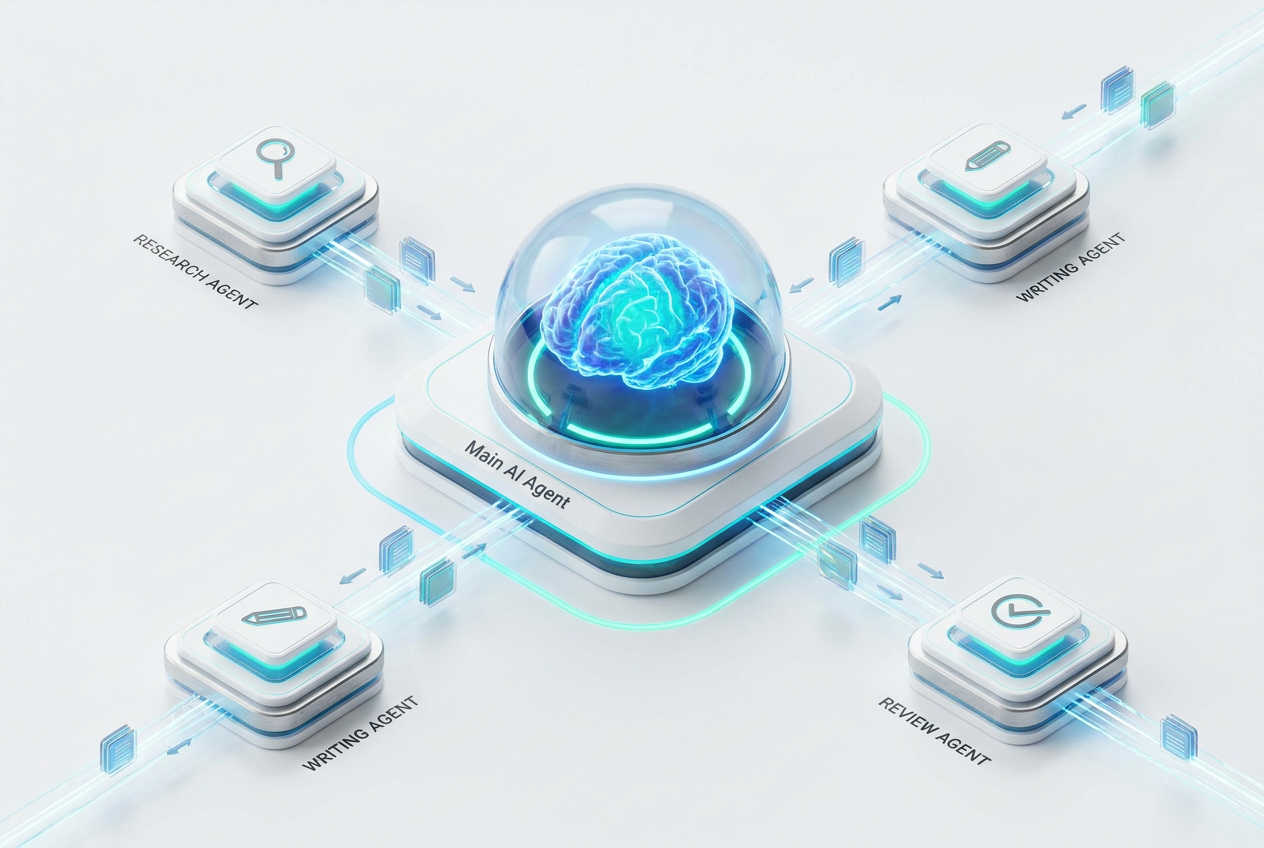
When the task becomes complex, a single agent can collapse. This happens when you ask it to do too many things at once: it starts mixing concepts or forgetting constraints. To solve this, the... orchestration of agents, which consists of creating a hierarchy where a main agent distributes the work among specialized sub-agents.
In this model, the lead agent acts as a Project Manager. He owns the end goal, knows the branding constraints and the delivery format, but doesn't do the dirty work. Instead, he activates auxiliary sub-agents who handle very specific work packages. For example, in the creation of a technical report, the principal could delegate the search for sources to a "research agent", the writing to a "writing agent", and the data verification to a "review agent".
Orchestration patterns for reliable flows
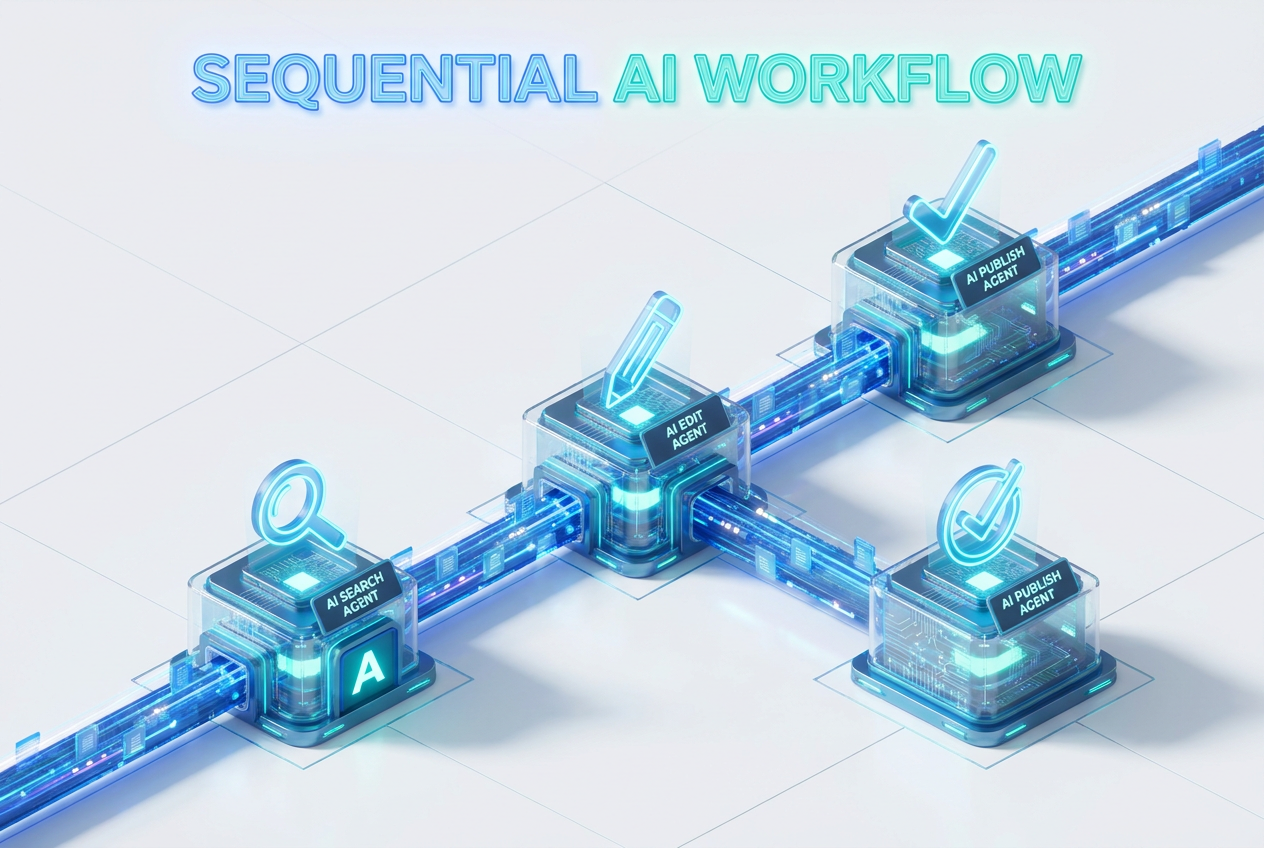
Not all AI teams are organized the same way. Depending on your goals, you can apply different communication patterns:
- Sequential chain: It is the simplest flow. Agent A finishes their part and passes it to Agent B, who in turn delivers it to Agent C. It is ideal for linear processes such as extracting data, cleaning it, and writing a summary.
- Parallel with aggregation: Several agents work simultaneously on different parts of the problem, and a final coordinator brings all the pieces together. This is very useful for analyzing an issue from multiple angles at the same time.
- Iterative or consensus-based: The agents consult with each other and correct each other until the result is optimal. This is the highest level of quality, as it includes a phase of critique and improvement constant.
To implement this without going crazy with the code, there are frameworks like LangChain, AutoGen or CrewAI, which already have predefined structures to manage these hierarchies and shared memories.

Governance and security: How to delegate without losing control
Delegating to AI can be a bit daunting, especially if the agents have access to the company's actual systems. The solution isn't to monitor every step (because then you wouldn't save any time), but to apply a model of restricted permissions or the principle of least privilege.
An investigative sub-agent may have permission to read internal documents, but should never have permission to email clients or make payments. By separating these functions, you create a security barrier. Furthermore, it's crucial to always maintain a human in the loopespecially at the beginning. Confidence is built by reviewing a sample of the results and adjusting the prompts until the system is predictable.
Practical implementation: From theory to automation
If you want to set up your first workflow today, you don't need to be a programming expert. No-code tools like Make o n8n They allow you to connect applications through scenarios. You can start by choosing a trigger (such as receiving an email), add an AI module to process the information, and define a final action (such as creating a task in Trello).
To scale to something more professional, you can use Python and OpenAI APIs by implementing a simple orchestratorThis process handles sending the prompt to the researcher, receiving the result, passing it to the writer, and finally asking the reviewer to validate whether the text meets the requirements. If the reviewer says no, the orchestrator can request a new version from the writer, creating a quality loop automatic.

Metrics to know if your delegation is working
To avoid this being an expensive experiment, we need to measure the results. Don't just focus on whether the text "is okay," but on real KPIs. cycle time (How long the task takes from entry to exit) is the key metric. It's also vital to monitor the rework rateThat is, how many times the main agent has to ask the sub-agent for corrections before the result is acceptable.
If you notice that orchestration consumes more resources or time than manual work, you probably have too many intermediate steps. The key is simplicity. Less is moreStart with two or three basic roles and add complexity only when the process is stable.
Implementing multi-agent systems allows companies to move from using AI as a toy to integrating it as a strategic asset. By dividing complex tasks into specialized roles coordinated by an orchestrator, the margin of error is drastically reduced, freeing up human talent to focus on strategy and decision-making, while digital teams handle the technical and repetitive execution.

Index
- 1 Agents vs. Chatbots: The Leap to Execution
- 2 What tasks can you start delegating right now?
- 3 The architecture of delegation: Main agents and sub-agents
- 4 Orchestration patterns for reliable flows
- 5 Governance and security: How to delegate without losing control
- 6 Practical implementation: From theory to automation
- 7 Metrics to know if your delegation is working
