- The extreme price increase of DDR5 has led to a surge in scams involving counterfeit, manipulated, or decorative modules.
- Cases have been detected of DDR2 and DDR4 disguised as DDR5, as well as kits that mix real RAM with memoryless bars.
- Manufacturers like Corsair are changing packaging and security seals to curb these frauds.
- Checking pins, labels, BIOS detection, and buying from authorized distributors is key to avoiding problems.

The price of DDR5 RAM has skyrocketed in a very short time, creating the perfect scenario for the emergence of scams, counterfeits and frauds involving RAM modules which are sold as if they were completely legitimate products. The frenzy of AI data centers, large language models, and the brutal demand for memory have strained supply so much that now a simple RAM upgrade can cost more than a powerful processor or even a high-end graphics card.
In this context, all sorts of tricks have begun to proliferate: from DDR5 kits that actually hide old DDR2 or DDR4 modules disguised under fake heatsinksThese range from "mixed" packages where only part of the RAM actually works, and the rest are decorative RGB bars that don't contribute a single megabyte. Added to this is the classic return fraud on marketplaces like Amazon, where some buyers switch the contents of the package, return it, and the next customer ends up receiving a "fake DDR5" module without even realizing it.
Why DDR5 is the new target of scams
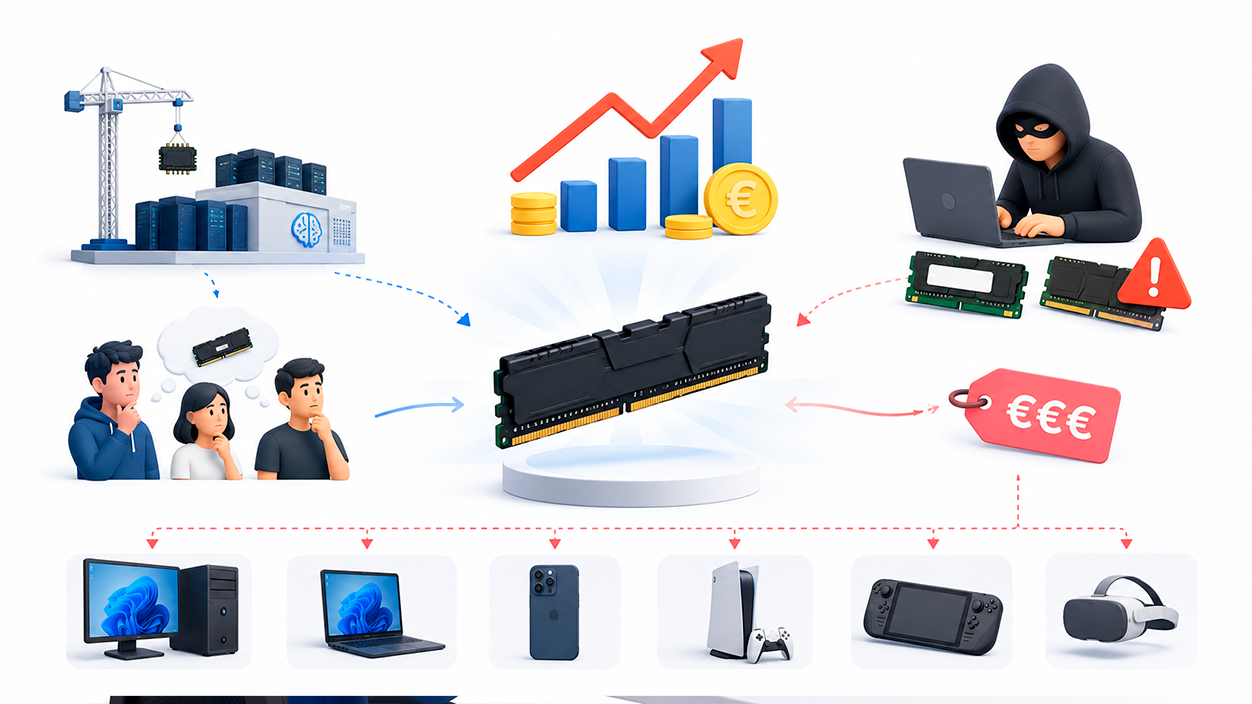
The trigger for all of this is the explosive combination of memory chip shortage and price increasesThe expansion of generative artificial intelligence has spurred the construction of data centers, which in turn consume enormous amounts of DRAM. This leaves "normal" consumers (gamers, content creators, professionals, etc.) competing for a resource that is currently quite limited.
High-capacity kits are already appearing with completely exorbitant prices, with increases reaching multiply by five the cost they had a few months agoWhere you used to be able to find 32GB of DDR5 RAM for just over €120, it's now not uncommon to see prices around €500 or considerably more depending on the speed and brand. For capacities of 64GB or higher, the cost skyrockets to well over €1.000.
This price jump has had a direct impact not only on desktop PCs, but also on other devices: mobile phones, consoles, powerful laptops, or future Steam Machines They are all affected because they all depend on memory. In fact, there have already been jokes that the escalating price of RAM is delaying highly anticipated announcements such as a hypothetical Half-Life 3 or the new generation of consoles, by drastically increasing the cost of their hardware configurations.
The more expensive a component is, the more profitable it is to try to scam people with counterfeit versions. Scammers know that many users are looking for fakes. "bargains" on DDR5 RAM And they take advantage of any attractive price to pass off manipulated, incomplete, or outright counterfeit products. We've seen it for years with graphics cards and processors, and now it's memory's turn.
Real-life cases of fake DDR5: from disguised DDR2 to disguised DDR4
One of the cases that has generated the most noise involved some memory kits XPG Caster DDR5 32 GB sold on Amazon SpainA buyer acquired four 2 x 16 GB 6.000 MT/s kits, seemingly new, sealed, and in their official blister packs. Three of them were genuine, but the fourth concealed a surprise worthy of a con artist's handbook.
The suspicious package was wrapped in plastic, unlike the other kits. At first glance, everything seemed normal: colors, logos, capacity specifications… However, upon closer inspection, the buyer noticed something odd about the “aluminum heatsink.” It was actually… a printed piece of paper stuck onto a very old RAM module, type DDR or DDR2The label with the specifications was also fake and poorly cut.
Turning the module over completely revealed the deception: the chips, the PCB, and the pin layout itself all corresponded to a completely outdated memory...unusable on a modern motherboard with DDR5. To top it all off, the scammers had added a small metal plate to the back of the blister pack to match the weight of the original kit with aluminum heatsinks, so that Amazon's automatic weight control wouldn't detect any difference.
Everything points to a classic return fraud: someone buys genuine DDR5 kits, keeps them for their own use, fills the packaging with modified old modules and a metal plate to compensate for the weight, returns the product as if nothing happened, and receives a full refund. The next buyer encounters a “New and sealed kit” that actually contains technological junkThe manufacturer ADATA, owner of the XPG brand, has acknowledged the incident and recommends buying exclusively from official distributors and partners, as well as reinforcing user training so they can better identify their products.
Another worrying example has been seen with Corsair Vengeance DDR5 modules. A Reddit user recounted how, after ordering 96 GB of DDR5 available at the official Corsair store on AmazonHe received a memory module that at first glance seemed immaculate: same heatsink, same stickers, same design. The problem was inside: hidden beneath the heatsink were DDR4 modules, with the notch positioned in the correct location for that generation.
The trap here is more sophisticated, because the module looks real from the outside. Only when you try to install the RAM in the motherboard do you discover that It doesn't fit in the DDR5 socketThis is because each generation of memory has the notch in a different location to prevent installation errors. If you don't look closely and aren't aware of this detail, you might think the problem lies with the motherboard or the module itself, without suspecting that an older generation has been installed.
This type of fraud has already been seen with processors: old chips are used, a perfectly imitated label with the new model is affixed, everything is repackaged, and it's returned as if it were an unopened product. The automated controls of some marketplaces, which don't open the boxes for detailed inspection, They fail to detect that the content is not originalWith DDR5 they are replicating exactly the same move.
How brands are responding: the case of Corsair and its new packaging
Memory manufacturers haven't been idle. Corsair, in particular, has seen an increase in incidents related to counterfeit, tampered, or swapped DDR5 kitsand has decided to change the way it packages its products to make it more difficult for scammers.
Until now, Corsair RAM (both DDR4 and DDR5) was sold in classic cardboard boxes with the model information and specifications printed on them. This type of box complies with regulations, but it has an obvious problem: It does not allow you to see the actual content without opening it.This makes it easy for someone to replace the original modules with different ones, or even with dead modules, and reseal them in a more or less convincing way.
To combat this, Corsair has started using packaging of clear plastic for your Vengeance DDR5 kitsThe aim is to allow a clear view of the contents without breaking the seal. This way, both store staff and customers can visually verify that the modules inside match the description on the box.
This new transparent blister pack also incorporates a specific security seal, designed to make it virtually impossible to access the modules without leaving signs of tampering. For kits still sold in cardboard boxes, the company has announced that will add new security labels to strengthen control. Implementing these changes will take time, so both versions will coexist in the market for a while.
From the user's point of view, something very simple but effective is recommended: record the package opening process on video As soon as you receive the RAM, especially if it was purchased online or through platforms with multiple sellers, this video serves as evidence if you later need to claim that the product was counterfeit, incomplete, or had been tampered with before reaching you.
Kits with decorative modules: DDR5 “half real, half prop”
The DDR5 memory crisis has not only led to blatant scams, but also to highly questionable commercial solutions from a technical standpoint. One striking example is that of V-Color and its “1+1 Value Pack” kits, which combine in the same package a functional RAM module and another that is pure prop, a decorative bar without DRAM chips.
These "filler" modules look exactly like genuine DDR5 sticks: same casing, same form factor, RGB lighting included if the model supports it. However, they are empty inside when it comes to memory. They are simply a shell designed for occupy the second slot and give the impression that the team is using a dual kit, when in reality there is only one module that provides capacity and bandwidth.
The first kits have been seen in 16GB and 24GB configurations at DDR5-6400 speeds, where the entire declared capacity corresponds to the single functional module. The dummy module is only used to fill the motherboard slot. V-Color itself has proposed developing 2+2 kits (two real modules and two decorative ones) designed for motherboards with four slots, intended for those who want to have all slots visually occupied But they don't want to or can't pay what it costs to fill the motherboard with genuine RAM.
The controversy lies in the fact that, although these packages are sold through official channels and the labeling is supposed to make it clear that One of the modules does not contain DRAMIt's very easy for many users to assume both kits are functional if they don't read the fine print. And if these kits end up on the secondhand market, the risk of confusion or deception is even greater.
When the system operates with only one real module, the platform enters mode single-channelThis significantly reduces the effective memory bandwidth. In games and many professional workloads, this loss translates into noticeable performance drops. V-Color has tried to sell this concept as a "psychological" option: the system "looks complete," and the user feels they have a visually balanced system, even though they are sacrificing performance.
AMD, the 3D V-Cache and the impact of using dummy or filler modules
Kits with decorative modules have a clear technical consequence: the system then works with a single active memory channel instead of taking advantage of the bandwidth of a true dual-GPU kit. This, for most processors, is a pretty bad idea, especially in tasks where RAM is a major bottleneck.
In AMD Ryzen processors with 3D V-Cache (like the Ryzen 9000X3D series)The large integrated L3 cache acts as a buffer against bandwidth reduction. In other words, the impact of single-channel operation is noticeable, but less so than on a chip without this technology, because many reads are handled directly from the cache instead of constantly accessing main memory.
This has led some to see Ryzen users with 3D V-Cache as the “natural” target for these 1+1 kits: they can afford to sacrifice some performance in exchange for potential savings on RAM or maintaining a full motherboard aesthetic. Even so, the performance penalty It doesn't disappear, not by a long shot.On Ryzen processors without V-Cache, the performance drop can be large enough to make these kits a less defensible option.
For those managing infrastructure, workstations, or development teams, operating with limited RAM or single-channel configurations due to fake, decorative or poorly documented modules This means longer compilation times, slower machine learning model training, and generally lower productivity. In professional environments, this can be very costly.
The moral of the story is clear: in a tight market, any “creative solution” that promises miraculous savings or seemingly complete kits at suspiciously low prices may well be a scam. strong performance commitment or outright deceptionIt's best to read the fine print and double-check what you're buying.
How to detect fake, decorative or manipulated DDR5
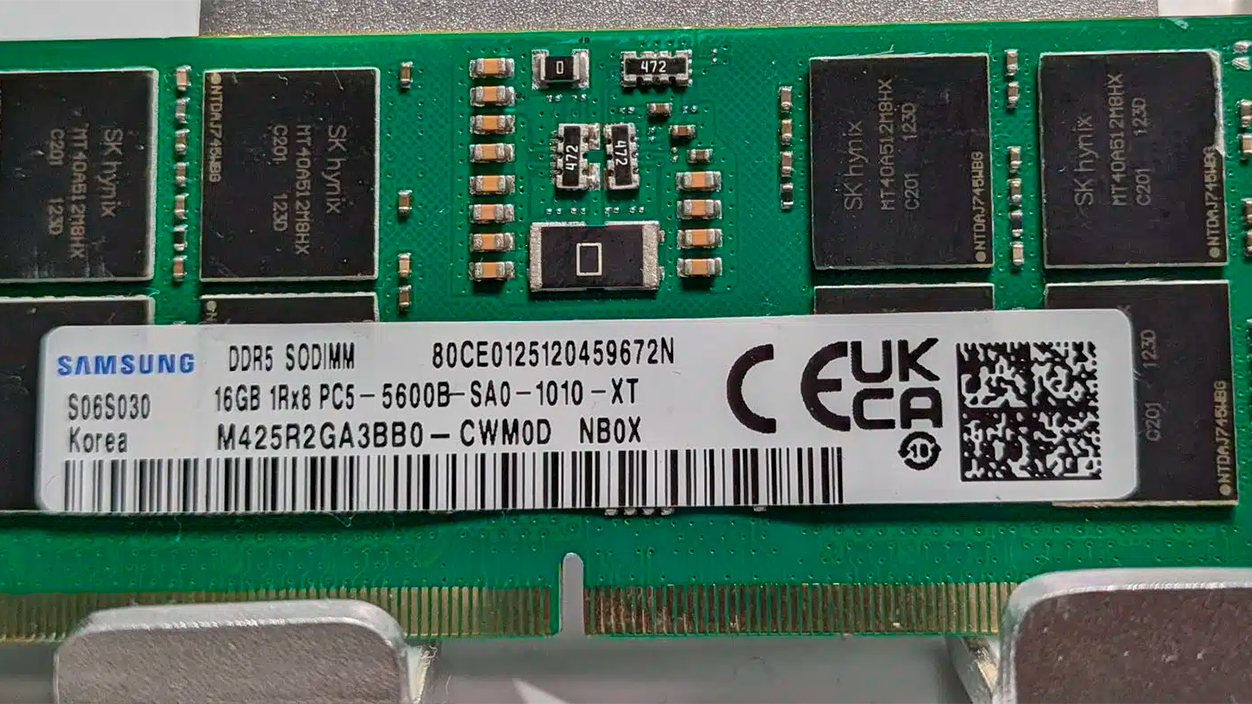
The best defense against fake DDR5 scams is knowing what to look for. While some scams can be quite elaborate, most leave clear clues if you take a careful, unhurried look at the product before installing it and perform some basic system checks.
A first key point is the pin layout and notch positionEach generation of RAM (DDR, DDR2, DDR3, DDR4, DDR5) has the notch cut in a different position on the connection edge. If a module supposedly designed for DDR5 doesn't fit into a DDR5 slot, or if you see that the slot lines up with a DDR4 slot, then you're dealing with a module that isn't what it claims to be.
It's also worth taking a closer look at the stickers and labelsBlurry, misaligned prints, strange fonts, or sloppy cutouts are red flags. The same goes for "heat sinks," which are actually sheets of paper or plastic glued onto old modules, as in the case of the modified XPG Caster: if you see poorly cut edges or low-quality materials, be suspicious.
In the case of decorative or filler modules, the The labeling on the box should make it clear that do not contain DRAM. Look for terms like “non-DRAM”, “decorative”, or “filler”. If none of those appear and one of the modules is still not recognized by the BIOS or operating system, it may be a purely aesthetic bar.
After installation, it's essential to check everything in software to make sure it's working correctly. Tools like CPU-Z, HWiNFO, or the BIOS/UEFI interface itself will show you. how much memory does the system detect and on how many channels is it workingIf you have installed two modules and only one appears, or if the board indicates single-channel mode when you should be in dual-channel, something is wrong.
Finally, it's advisable to apply a couple of good practices when buying: opt for authorized distributors and reputable sellersBe wary of deals that seem too good to be true on third-party platforms, and as mentioned before, record the unboxing to have clear proof in case of a claim. Marketplaces like Amazon usually respond well to these situations, but the more evidence you provide, the better.
This whole surge in fake DDR5 scams is simply a reflection of the critical moment the memory market is experiencing: wild price increases, skyrocketing demand driven by AI, and kits that mix... real modules with decorative bars And return fraud is affecting even well-established stores. In such a landscape, being meticulous when buying hardware, documenting what you receive, and knowing the basic warning signs has become almost mandatory for anyone wanting to upgrade their PC without running into unpleasant surprises.

Index
- 1 Why DDR5 is the new target of scams
- 2 Real-life cases of fake DDR5: from disguised DDR2 to disguised DDR4
- 3 How brands are responding: the case of Corsair and its new packaging
- 4 Kits with decorative modules: DDR5 “half real, half prop”
- 5 AMD, the 3D V-Cache and the impact of using dummy or filler modules
- 6 How to detect fake, decorative or manipulated DDR5
